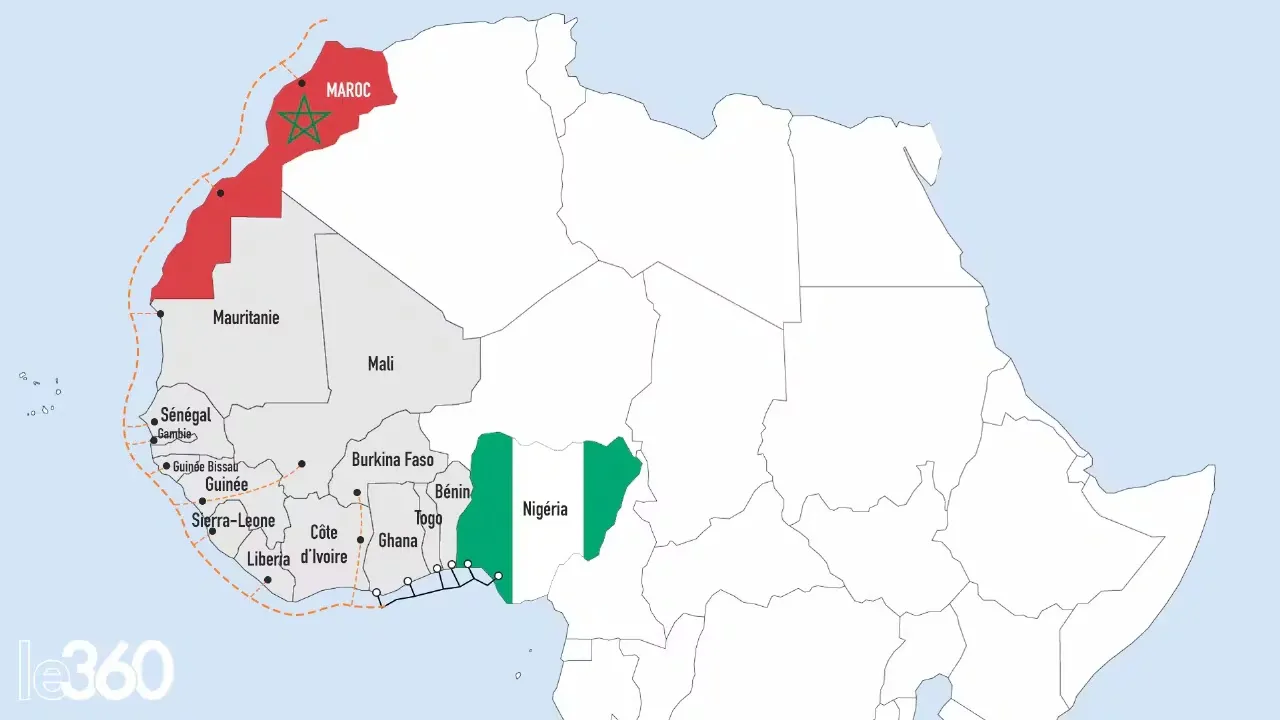
The Nigeria-Morocco gas pipeline has entered a pivotal stage in its development. Following political backing from West African nations, Morocco is now addressing the crucial barrier to the project's realization: the financing required, estimated at $26 billion. This ambitious infrastructure initiative aims to create a gas corridor linking Nigeria to Morocco, with the prospect of connecting to the European market in the future.
According to reports by Bloomberg, Morocco is seeking assistance from the United States Export-Import Bank and the World Bank to facilitate the realization of this significant gas pipeline. While discussions remain preliminary, their initiation marks a substantial shift in the project's scope and ambition. The U.S. Export-Import Bank has confirmed that initial talks have commenced; however, the World Bank has refrained from commenting on the ongoing efforts. At this stage, no financial commitments have been secured, but Morocco is actively working to ensure the pipeline gains visibility among major international financiers.
During a recent interview with Bloomberg in Washington, Morocco's ambassador to the United States, Youssef Amrani, described the pipeline as "one of the most ambitious infrastructure projects currently under development in Africa." The political support, garnered on July 19 from leaders of the Economic Community of West African States (ECOWAS), represents a significant advancement for the initiative, providing a more robust regional foundation. Nevertheless, this agreement does not resolve the funding challenges that remain.
Establishing such a vast infrastructure requires more than just diplomatic agreements. The involved nations must come to terms on various aspects, including the pipeline's route, transportation tariffs, facility security, operational regulations, and the allocation of responsibilities. Any delays or national disagreements could significantly impact the entire timeline of the project.
Bloomberg indicates that construction is expected to commence in 2028, with the first gas volumes projected to flow by 2031, contingent upon securing funding. The transition from political discussions to operational execution will depend heavily on Morocco and Nigeria's ability to present a compelling financial framework to potential lenders. Support from the World Bank or the U.S. Exim Bank could streamline this process by providing not only financial resources but also guarantees that would attract additional banks and investors. In return, this support would necessitate clear visibility on costs, future revenues, and the commitments made by the various states involved.
Notably, Morocco is positioned to become a significant beneficiary of the pipeline, with an expected capacity to transport 30 billion cubic meters of gas annually, as stated by the National Office of Hydrocarbons and Mines, which is collaborating with the Nigerian National Petroleum Company on this project. Half of the gas volumes are intended for Morocco, while the remainder could potentially be routed to Europe. Thus, Morocco is not merely a transit country; it stands to gain substantially from the infrastructure, with 15 billion cubic meters earmarked for its domestic market, bolstering its role as a crucial energy link between West African producers and Europe.
This allocation of gas volumes serves as a financial incentive for lenders, who will need assurance on buyers, pricing, and contract durations. Financing a $26 billion project necessitates long-term purchase agreements and predictable revenues to cover construction and operational costs. Consequently, Morocco must demonstrate that the volumes allocated for its market have a genuine demand. The same requirement applies to the European segment, where immediate energy diversification needs must align with a gradual reduction in fossil fuel consumption policies.
The international context has given renewed momentum to the project, as Youssef Amrani noted that disruptions in energy flows due to the Iranian conflict have highlighted the necessity of a gas pipeline transporting African gas to Europe. Bloomberg also reports a sustained increase in gas prices in the European market, amidst concerns regarding stock levels before winter. Current tensions remind European countries of their vulnerability to supply disruptions and the urgent need to diversify their import routes.
Morocco aims to leverage this situation to promote the Africa-Atlantic gas pipeline as a new avenue for energy security. Connected to the Maghreb-Europe pipeline, this project could provide African producers access to the European market while also supplying the countries along its route. However, the current surge in prices alone will not justify an investment expected to operate for decades. Financiers must consider long-term demand, especially as Europe seeks to decrease its reliance on gas.
Anne-Sophie Corbeau, a research associate at Columbia University's Center on Global Energy Policy, raises concerns about the necessity of extending the pipeline to Europe. The risk lies in a potential mismatch between the project’s commissioning schedule and the future trajectory of European consumption. Moreover, the pipeline's length and the number of countries involved pose significant challenges. Corbeau suggests that this multitude of stakeholders could complicate the project's execution. While ECOWAS's support mitigates the risk of immediate political blockages, it does not guarantee uninterrupted operations. Producer countries, transit states, and consumer markets must uphold their commitments over an extended period, despite differing economic and energy priorities.
Additionally, competition among major African projects could further complicate capital mobilization efforts. Bloomberg notes that the Nigeria-Morocco pipeline is progressing alongside the Trans-Saharan project backed by Algeria and significant gas developments in Mozambique. Financiers will need to navigate multiple costly projects vying for international funding. However, the initiative led by Algeria faces severe security constraints in the Sahel and particularly in southern Algeria, which serves as a base for terrorist movements.
The Africa-Atlantic gas pipeline now has a defined route, regional support, and identified gas resources. What it still lacks is the decisive element: financial commitments commensurate with its cost.
As reported by fr.le360.ma.