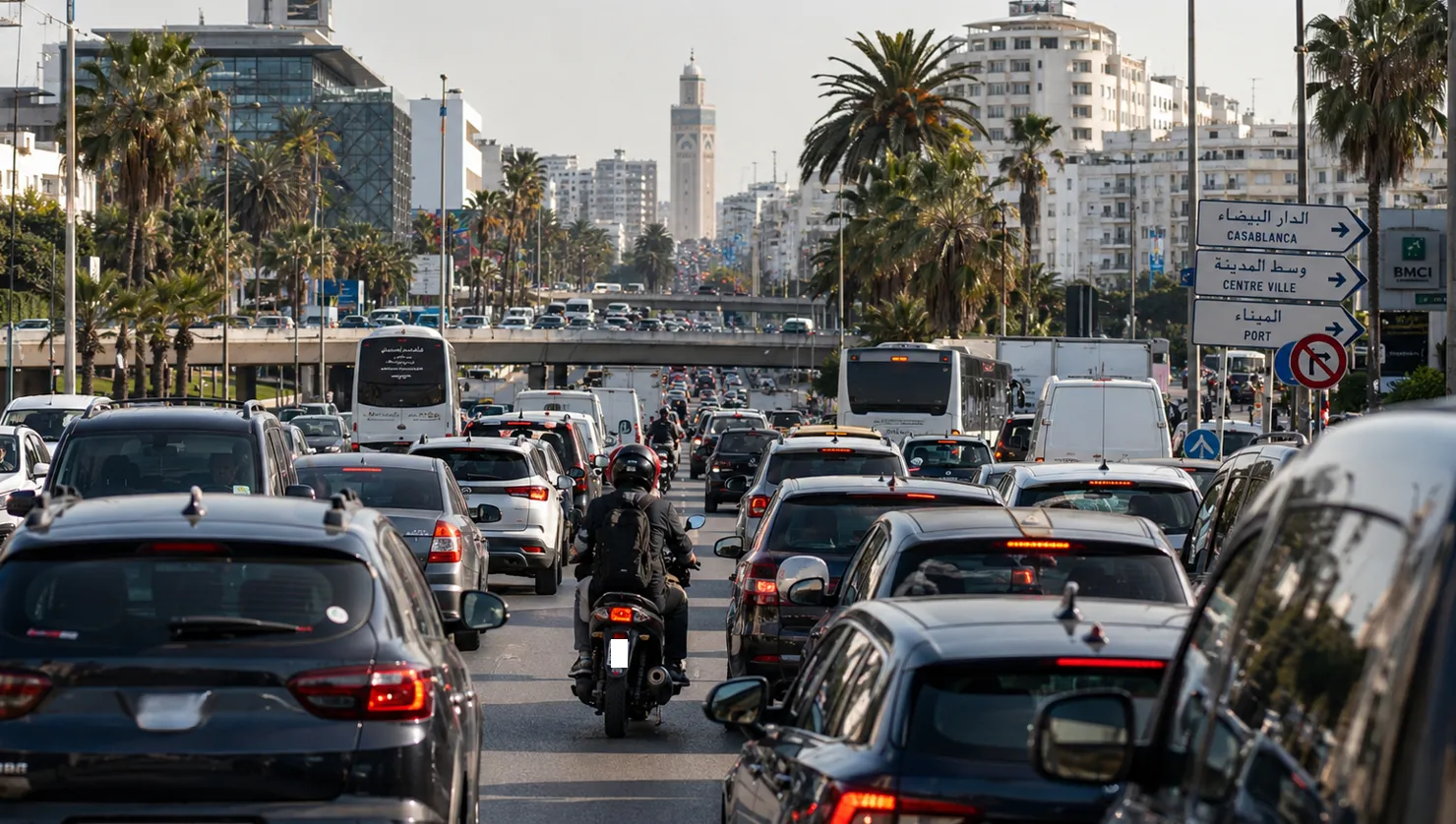
The Unifying Challenge of Traffic in Morocco
In Morocco, few topics bring people together quite like road traffic. While the rising cost of living sparks debates and football ignites passions, the traffic jams have a way of uniting everyone in agreement. Both Casablanca and Rabat have transformed the act of driving into a mental discipline, rather than a mere means of getting from point A to point B. The modern driver no longer simply navigates the roads; instead, they find themselves meditating, sighing, and tuning into the radio or a podcast as they traverse distances that are hardly a few kilometers long. Traffic has evolved from a frustration into an immersive experience, encapsulating the essence of urban life.
Casablanca: The Capital of Emergency Braking
In the bustling city of Casablanca, traffic appears to follow its own set of unspoken rules. Despite the presence of roads, interchanges, smart traffic lights, and navigation apps, every morning sees a mass exodus of vehicles heading towards the same point of saturation. The daily miracle lies in the city’s ability to accommodate a number of vehicles that far exceeds its capacity, all while maintaining an illusion of functionality, albeit generously interpreted. A journey of twenty kilometers can feel like a rite of passage; as one departs for the office, they arrive slightly aged, philosophically altered, and already fatigued before the workday has even begun.
In this grand theatre of Moroccan roads, there are unique accessories that define the driving culture: the decorative turn signal, an assertive horn engaged in public discourse, and a level of creativity behind the wheel that could merit recognition as intangible cultural heritage. The Moroccan Highway Code is an intriguing document, commonly known yet varying in its application, which often veers into the realm of artistic interpretation. Indicators are treated as rare commodities, preserved for future generations, while the horn serves multiple purposes — from alerting to danger to expressing impatience or existential participation in the collective conversation. Some drivers even sound the horn a mere third of a second after the traffic light turns green, showcasing reflexes that would impress even Formula 1 racers.
Moreover, one cannot discuss Moroccan traffic without acknowledging the motorcyclists, who navigate through obstacles with a skill that borders on the extraordinary. Where a car driver sees a blockage, they perceive three potential pathways, skillfully weaving in and out with a mastery of space and time that could warrant academic study. Rather than circumventing traffic jams, Moroccan motorcyclists simply forge ahead through them.
Rabat, once condescendingly gazing at Casablanca, has also begun to experience the joys of metropolitan traffic. Each morning, flows of vehicles from neighboring towns converge towards the capital, resulting in a shared national solidarity as thousands of citizens find themselves immobilized, their eyes fixed on the dashboard clock. Even the grandest avenues have devolved into open-air parking lots. Amidst the mechanical farce, the reality remains stark.
Behind the humor of this situation lies a serious concern: thousands of workers spend countless hours stuck in traffic daily. Fuel is wasted, stress accumulates, and fatigue becomes an unavoidable aspect of the commute. For many, the car has morphed into a secondary office or even a second home; there is ample time to reflect on personal lives, reassess priorities, and regret the decision to venture out in the first place.
Despite these slow-moving traffic jams, they signify a nation in transition. Cities are expanding, suburbs are densifying, and exchanges are intensifying. The challenge remains to transform this energy into actual mobility — a feat that would represent a small revolution. Until then, tomorrow morning, thousands of Moroccans will once again take their places in this mechanical saga, confronting the same slowdowns, the familiar honks, and the recurring promises of fluidity, all while experiencing that peculiar sensation of having lived an entire day before even starting their work.
As reported by libe.ma.