Transforming Deserts into Clean Energy Labs
While deserts are often perceived as unproductive regions around the globe, Morocco has boldly decided to take a different path by transforming the Sahara Desert into one of the world's largest clean energy laboratories. The Noor Ouarzazate solar complex, situated approximately 200 kilometers from Marrakech, is now recognized as one of the largest solar facilities globally. However, despite the grandeur of this ambitious project, the reality unveils a more complex scenario where innovation coexists with significant structural challenges.
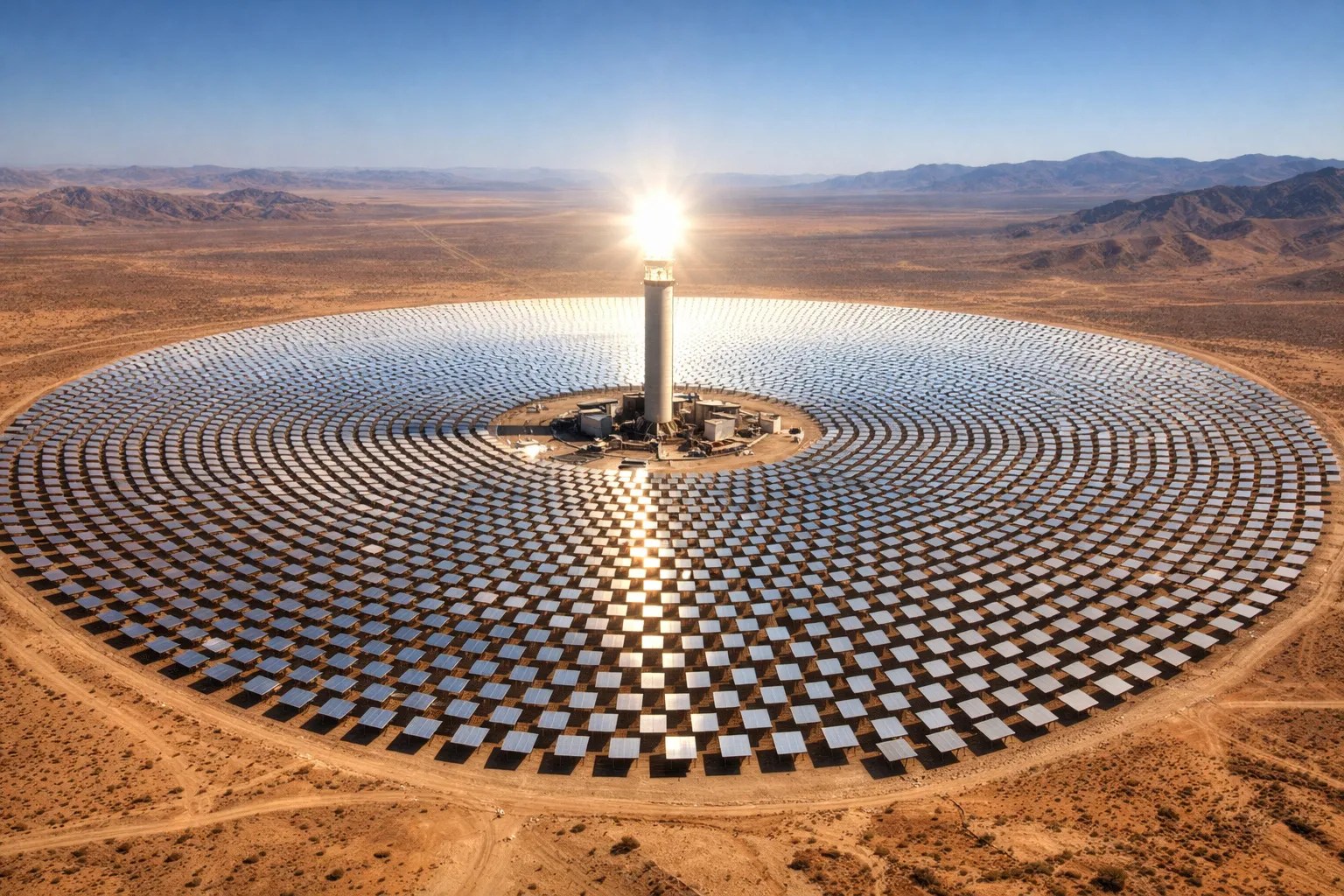
The complex, constructed on a plateau surrounded by the Atlas Mountains, spans around 500 hectares (approximately 1,200 acres) and has the capacity to supply energy to over one million homes. Unlike traditional solar plants, Noor employs concentrated solar power technology, utilizing nearly two million giant mirrors that direct sunlight towards a receiver atop a 247-meter tall tower. This ingenious system generates heat that reaches an impressive 600°C, melting special salts used to store thermal energy, allowing electricity generation even after sunset—a remarkable advancement compared to conventional systems.
Challenges and Structural Issues
Despite these groundbreaking innovations, the direct impact on local communities remains limited. In Ouarzazate, many residents still rely on butane gas rather than solar energy, and electricity costs soar, with Moroccan families averaging around $110 per month against an average income of approximately $550. This financial burden is particularly significant in a hot country where summer temperatures can exceed 40°C. The situation is exacerbated by Morocco's heavy dependence on fossil fuels, with about 48% of greenhouse gas emissions from energy generation stemming from coal, oil, and gas. Furthermore, the country imports approximately 90% of its fossil fuel needs, making its energy system vulnerable to fluctuations in the international market.
Infrastructure remains another critical hurdle. Although Morocco has the potential to generate up to 46% of its electricity from renewable sources, practical implementation is much lower due to the electric grid's inability to fully integrate energy produced by projects like Noor. Consequently, even with high production levels, a portion of clean energy fails to reach daily consumption. Experts emphasize that Morocco must invest not only in generation but also in infrastructure to ensure the advancement of renewable energies.
Nevertheless, Morocco continues to pursue ambitious plans, aiming to generate a significant portion of its energy from renewable sources and committing to completely phase out coal by 2040. The Noor complex is merely one component of a broader strategy that includes around two dozen solar, wind, and hydroelectric megaprojects, with many more underway. However, the model is not without criticism. Researchers and organizations have raised concerns that megaprojects like Noor may not be the most efficient solution for all contexts, suggesting that decentralized solutions, such as rooftop solar panels, could yield quicker and more accessible results.
In this light, the Noor complex represents more than just a power plant; it has evolved into a global experiment. It demonstrates the feasibility of generating clean energy on a large scale even in extreme regions while revealing that the energy transition entails challenges that go beyond merely constructing large projects. Therefore, Morocco's case illustrates that the future of energy depends not only on technology but also on infrastructure, planning, and social inclusion.
As reported by es.clickpetroleoegas.com.br.