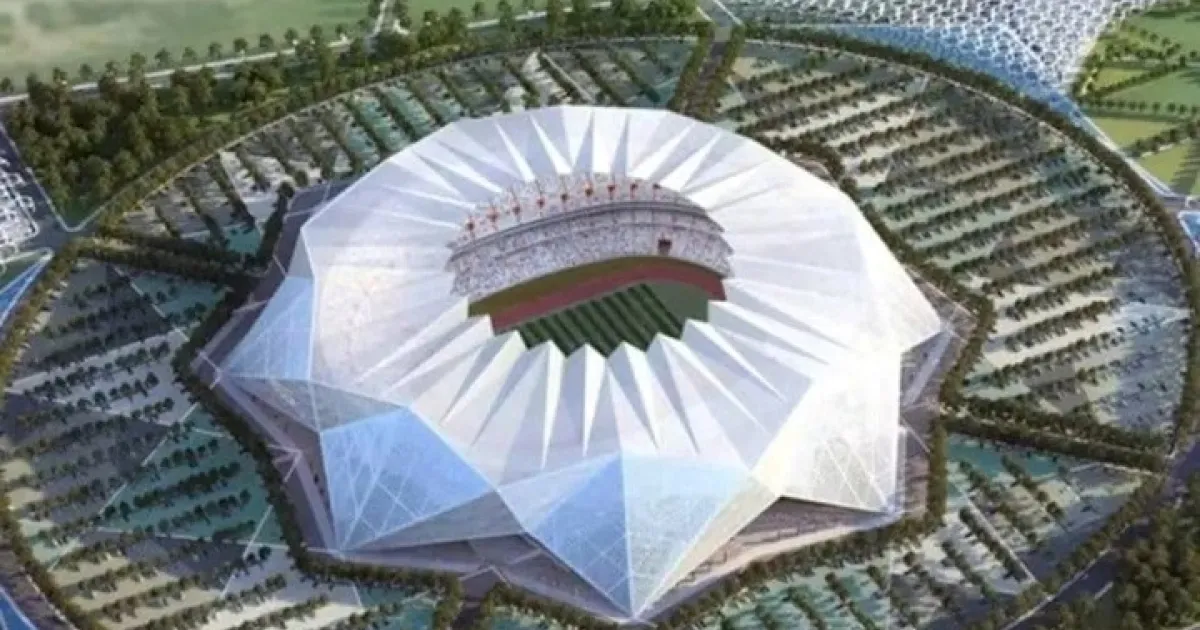
In a significant stride toward hosting the 2030 FIFA World Cup, Morocco is making rapid progress on the Grand Stadium Hassan II, projected to be the largest stadium in the world with a seating capacity of 115,000. This monumental infrastructure is being constructed just outside Casablanca, competing with the renowned Santiago Bernabéu Stadium in Spain to host the prestigious final of the tournament.
The World Cup will be jointly held in Morocco, Spain, and Portugal, and the ambitious vision for the Grand Stadium reflects Morocco's commitment to making a mark on the global sporting stage. Currently, approximately 30% of the construction is completed, with over 40,000 seats installed, as confirmed by project officials during a recent press tour. They aim to have the stadium operational by December 2027, demonstrating an impressive pace of work that has seen significant advancements in just ten months.
Yassir Soussi, the Deputy Director of the National Agency for Public Equipment (ANEP), which oversees public infrastructure and sports facilities in Morocco, highlighted the extraordinary challenge of completing the stadium within a tight timeframe. To meet these ambitious deadlines, workers are engaged in continuous shifts, operating day and night in three eight-hour teams. Soussi described the ongoing construction as a magical endeavor that poses complex architectural and technical challenges, particularly the installation of a tent-like roof structure spanning 20 hectares.
With around 5,000 workers currently on-site, this number is expected to double as the project progresses, underscoring the scale and urgency of the undertaking. The chief architect of the Grand Stadium, Tarik Oualalou, shared that the design draws inspiration from the 'moussem,' a traditional Moroccan festival that emphasizes cultural, social, and economic gatherings, symbolizing the hospitality of Morocco. This thematic influence is reflected in the stadium's design, incorporating the tent motif as a universal architectural element that aims to resonate with every visitor.
Oualalou further emphasized that the stadium will feature cutting-edge technology, boasting around 9,000 VIP and VVIP seats, making it the largest of its kind globally. Additionally, the stadium will have a superior ring with LED lighting that surpasses other similar facilities, enhancing its appeal and functionality.
Financially, the project is underpinned by a budget of €1 billion, with an expected completion date that allows for adequate testing before the World Cup. Soussi explained that having the stadium ready by 2027, rather than 2029 or 2030, ensures optimal conditions for the tournament.
Complementing this grand project, a train station is planned to connect the stadium with the metropolitan area, as part of a broader infrastructure initiative linked to the World Cup. This includes road and rail projects, as well as urban facilities across the various candidate cities, including Rabat, Marrakech, Tangier, and Agadir.
As reported by lapatria.com.