In a significant shift within the African industrial landscape, Morocco has ascended to the top of the African Development Bank's (AfDB) Africa Industrialisation Index for 2025, effectively displacing South Africa after a remarkable 15-year reign as the continent's preeminent industrial economy. This pivotal report was unveiled during the AfDB's Annual Meetings held in Brazzaville, highlighting Morocco's strategic industrial policies, diversification of exports, and robust growth in manufacturing across critical sectors such as automotive, aerospace, and infrastructure.
The top ten countries in the index also include Egypt, Tunisia, Mauritius, Algeria, Eswatini, Senegal, Namibia, and Côte d'Ivoire, illustrating a diverse range of industrial capabilities across the continent. The index evaluated the industrial development of 54 African nations from 2010 to 2024, revealing that 41 countries have successfully enhanced their industrialisation scores, contributing to an overall improvement of 6% in Africa's industrial performance. Notably, North and Southern Africa continue to dominate both manufacturing output and export sophistication, whereas intra-African trade remains a substantial challenge, constituting only 14.4% of total trade.
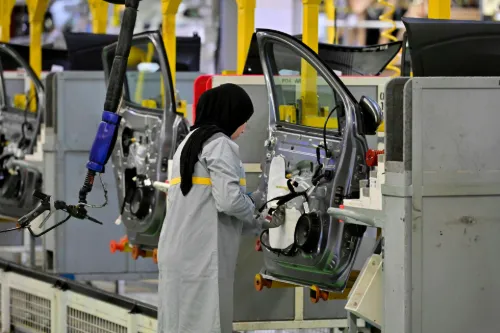
Morocco's impressive rise is the culmination of two decades of dedicated policy implementation. The automotive sector has emerged as Morocco's largest export industry, with an impressive production of 493,004 passenger cars in 2025, significantly outpacing South Africa's output of 329,600 units. Additionally, automotive exports to the European Union reached a staggering €15.1 billion in 2023. The aerospace sector, which includes over 150 companies such as Boeing, Airbus, Safran, and Thales, has also seen remarkable growth, generating $2.87 billion in exports in 2024, a dramatic increase from $839 million just ten years prior. Furthermore, strategic infrastructure investments, including the Tanger Med port, the Al Boraq high-speed rail line, and the Nador West Med complex, have solidified Morocco's status as a pivotal manufacturing and logistics hub connecting Europe, Africa, and the Middle East.
Conversely, South Africa's decline can be attributed to the failure of two key state monopolies. Chronic outages from the power utility Eskom have compelled manufacturers to resort to costly self-generation, while the breakdown of Transnet's rail network has forced freight traffic onto roads, resulting in significant port congestion in Durban and Cape Town. Over the past decade, South Africa's GDP growth has stagnated at below 1% annually on average, with gross fixed-capital formation contracting in three of the four quarters of 2024. President Cyril Ramaphosa has indicated that the nation requires R1.6 trillion ($99 billion) in public infrastructure investment, alongside R3.2 trillion from the private sector, to achieve its infrastructure objectives by 2030.
The AfDB asserts that Africa's industrial future hinges on reliable energy, enhanced infrastructure, technical skills development, appropriate financing, and deeper regional integration under the African Continental Free Trade Area (AfCFTA). As Harouna Kaboré, a contributor to the report, pointed out, "The continent's real deficit is no longer an absence of industrial strategies; what is still lacking is rigour in implementation."
The reversal in rankings between Morocco and South Africa illustrates a narrative of one country's ascendancy juxtaposed against another's institutional failures. Morocco's industrial strategy, anchored in royal commitment since the early 2000s, has maintained an exceptional level of consistency compared to the more volatile political landscape of South Africa, which has been subject to electoral cycles. This stability has fostered a manufacturing base that has evolved dramatically over two decades, with automotive production skyrocketing from almost nothing to nearly one million units annually, the aerospace sector transforming into a $2.87 billion export industry, and phosphate-derived chemicals becoming vital to global fertiliser markets. In contrast, South Africa's industrial competitiveness has been undermined by significant debt from Eskom, exceeding 400 billion rand, which has restricted necessary infrastructure spending, while the deterioration of Transnet has imposed additional logistical burdens on manufacturers throughout the country.
The AfDB's report highlights a systemic issue: intra-African trade currently stands at a mere 14.4% of total trade. This statistic underscores that, despite Morocco's successes and South Africa's challenges, African manufacturers predominantly export to Europe and Asia, focusing on commodities rather than finished goods, and often operate in supply chains that exclude neighboring countries. The AfCFTA, now in the implementation phase, aims to address these challenges, but its effectiveness will rely on the same energy, logistics, and institutional capacities that the index identifies as core deficits in Africa's industrial landscape.
As reported by dabafinance.com.