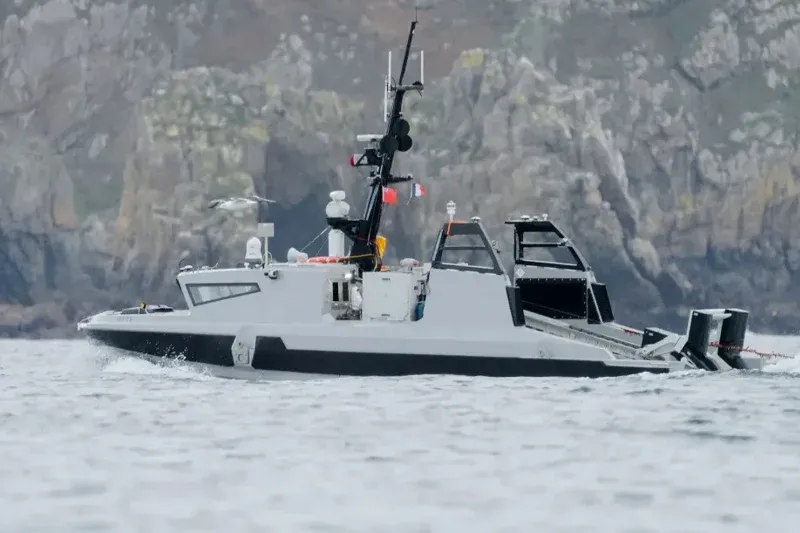
Morocco Expands Its Naval Capabilities with Advanced Unmanned Vessels
The Moroccan government has taken a significant step to bolster its maritime defense capabilities by acquiring advanced unmanned vessels specifically designed for anti-submarine and mine warfare. This development comes after the Dutch government, through its Ministries of Foreign Affairs and Foreign Trade and Development Cooperation, officially notified the Dutch Parliament of its approval to export military equipment to Morocco. This includes two unmanned surface vessels, a Mission Control Station, and various spare parts, with the total deal valued at approximately €13 million.
According to a document reviewed by Hespress from the official Dutch Parliament website, the end-user of this military equipment is the Royal Moroccan Navy, reinforcing its operational capabilities in maritime defense. The document, signed by Dutch Foreign Affairs Minister Wopke Hoekstra and Foreign Trade Minister Liesje Schreinemacher, emphasizes Morocco's strategic partnership with the Netherlands, particularly given its geographical position on the southern border of the European Union. The Dutch government views a stable and reliable Morocco as vital to regional security.
Further details in the official correspondence outline that the export request was assessed in accordance with the EU's Common Position on arms exports, leading to the issuance of a license based on multiple arguments. Notably, this equipment will not be used for migration control efforts, although Morocco plays a crucial role in managing irregular migration routes between West Africa and the Canary Islands.
The document also mentions that Morocco exercises effective authority over Western Sahara, including through the presence of Moroccan armed forces and naval activities in the region's territorial waters. However, it clarifies that these military assets are not intended for aggressive actions or to bolster territorial claims through force, especially given the ongoing low-level confrontations with the Polisario Front, primarily of a land-based nature.
Designed for specific defensive maritime tasks, the unmanned vessels will enhance the Moroccan Navy's operational capabilities. Their potential armament is limited to defensive measures to protect the platforms and conduct anti-submarine and mine warfare operations. The document reiterates that while these vessels are tailored for specific missions, any alternative use would require significant modifications.
In conclusion, with a stable security environment and limited military confrontations, the likelihood of these military assets being deployed in the ongoing Western Sahara dispute remains low. The Dutch defense industry, known for its advanced technology in unmanned vessel development, is poised to support Morocco with state-of-the-art platforms capable of underwater surveillance and other maritime operations.
As reported by hespress.com.