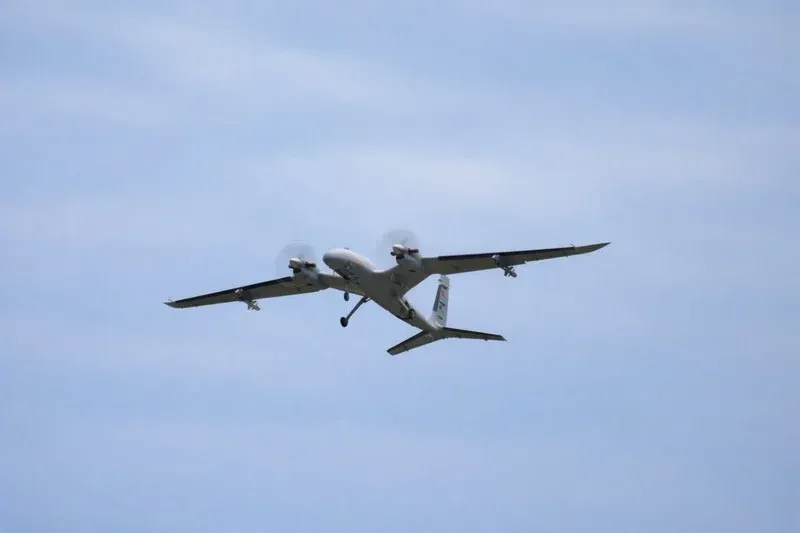
Introduction of Turkish Akinci Drones into Moroccan Military
A recent report from the military affairs platform 'Defensa' has unveiled the integration of Turkish-made 'Akinci' drones, produced by Baykar, into the Moroccan armed forces. Satellite images captured over the sixth airbase in Ben Guerir confirm the operational deployment of these advanced unmanned aerial vehicles (UAVs), which began service alongside the existing 'Bayraktar TB2' drones. The report highlights that Morocco possesses the necessary infrastructure, including integrated ground equipment, to ensure high operational readiness for these systems, marking a significant advancement in the military collaboration between Rabat and Ankara.
This acquisition aligns with Morocco's broader strategy to strengthen its military arsenal and modernize its defense capabilities. The report indicates that the development of Morocco's military drone capabilities has followed a well-structured timeline, with the first deliveries of 'Bayraktar TB2' drones commencing in September 2021, when the initial system became operational at the Ben Guerir base. Currently, Morocco has a substantial fleet of 'Bayraktar TB2' drones, having initially ordered 13 units in April 2021, which eventually grew to over 20 units, all scheduled for delivery by 2024.
Strategic Implications of Akinci Drone Integration
'Defensa' notes that the Akinci drone's capability to target aerial threats marks a significant enhancement in Morocco's UAV fleet. This allows the nation to extend its drone operations beyond ground target engagement to include active air defense and countermeasures against hostile UAV threats. This development signifies a qualitative shift in modern engagement rules. Plans for future upgrades include equipping the Akinci drone with the 'Murad 100-A' Active Electronically Scanned Array (AESA) radar developed by Turkish company Aselsan, enabling precision strikes against aerial, ground, and maritime targets. The operational impact of this radar will be amplified when combined with short-range air-to-air missiles like the 'Bozdoğan' and the long-range 'Gökdoğan', enhancing the drone's combat effectiveness.
Moreover, the document suggests the potential integration of Turkish electro-optical systems, such as the 'Aselsan FLIR-500', capable of detecting and designating targets from distances exceeding 80 kilometers. The Akinci drone boasts impressive combat characteristics, including a continuous flight capability of 24 hours at altitudes above 12 kilometers, placing it outside the operational range of most short-range air defense systems. With an attack payload capacity of 1.5 tons, the drone may include future armaments such as cruise missiles with ranges of up to 250 kilometers.
Additionally, the defense relations between Morocco and Turkey extend beyond the importation of high-tech systems; they encompass the establishment of a joint defense industrial platform in the Ben Slimane region in collaboration with Baykar. This initiative aims to reduce reliance on imports and bolster national defense production capabilities. The integration of the Akinci system reflects a multifaceted strategic dimension, enhancing Morocco's ability to monitor its southern borders while serving as a deterrent against potential military maneuvers amid regional tensions with Algeria and the Polisario Front.
In conclusion, the incorporation of Akinci drones into the Royal Moroccan Armed Forces represents a pivotal advancement in national defense modernization efforts, with expectations for further integration of advanced systems like the 'Bayraktar Kızılelma', a stealthy combat drone. The current trajectory—marked by the acquisition of cutting-edge systems and localization of military industries—demonstrates Morocco's commitment to establishing a robust deterrent capability in an evolving regional and international landscape.
As reported by hespress.com.