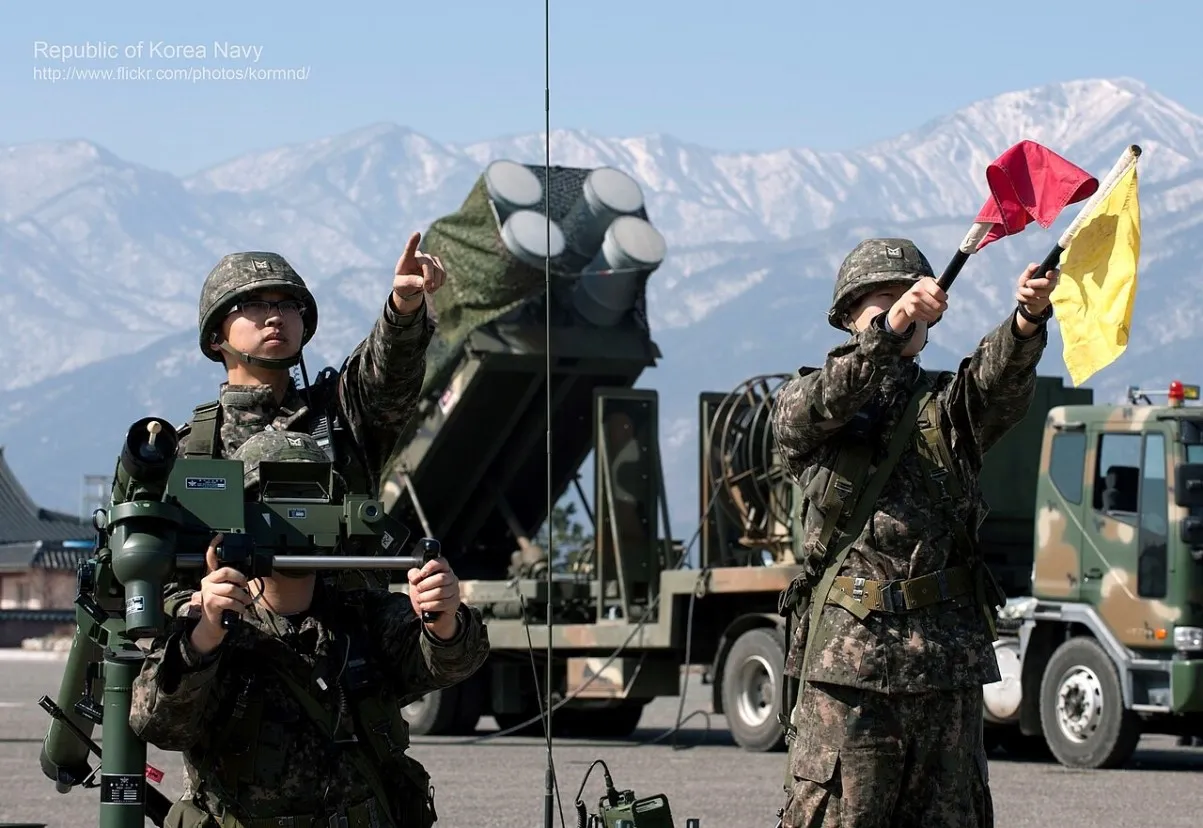
Morocco has emerged as one of the latest operators of the short-range air defense system KP-SAM, commonly known as "Chiron." A report from the Republic of Korea submitted to the United Nations Conventional Arms Register indicates that Rabat has received a shipment consisting of 101 Chiron missiles along with 50 launchers from the KP-SAM system. This marks the first official confirmation of the receipt of this South Korean system by the Moroccan Armed Forces, a significant step in the ongoing modernization of Morocco's low-altitude air defense network.
The Chiron system was developed between 1995 and 2004 by the Defense Acquisition Program Administration of South Korea and the company LIG Nex1, entering service with the South Korean military in 2005. This missile boasts an effective range of 7 kilometers and an interception ceiling of 4 kilometers, achieving a maximum speed of Mach 2.5. Weighing 15 kilograms without the launcher, the projectile employs a dual-band seeker that operates within the infrared and ultraviolet spectrums, enabling it to distinguish between actual targets and thermal decoys.
Equipped with a 2.5-kilogram warhead containing 720 tungsten balls, the Chiron is designed to engage fixed-wing aircraft, helicopters, drones, and cruise missiles. Despite its external resemblance to the French Mistral system, the missile is entirely a product of local development, demonstrating a 90 percent success rate during testing. However, reports from 2021 highlighted a failure rate of 24 percent in some South Korean inventories, attributed to aging and poor storage conditions.
Morocco's acquisition of the Chiron systems is not an isolated move but part of a broader strategy to strengthen its air defense capabilities. On April 15 of last year, the United States State Department approved the sale of FIM-92K Stinger Block I anti-aircraft missiles to Morocco, estimated at a cost of $825 million. This agreement includes up to 600 Stinger missiles, in addition to associated equipment, training, and logistical support. This trend illustrates Rabat's focus on building multi-source defense layers to address tactical gaps at lower levels.
Previously, the Moroccan military relied on a combination of portable air defense systems (MANPADS) and short-range missiles, including Russian-made Igla and Strela-2 systems, until introducing the French Mistral 3 in recent years. The Mistral 3 represents a qualitative leap in Rabat's arsenal due to its use of infrared imaging technology (IIR) instead of traditional infrared (IR) seeking.
The integration of the Korean Chiron systems, alongside the U.S. Stinger agreement and the presence of the French Mistral, creates a tactical combination that provides Moroccan forces with extensive operational flexibility. The primary objective of this diversification appears to be enhancing immunity against low-altitude aerial threats, such as kamikaze drones, cruise missiles, and tactical drones, which have become prominent challenges in contemporary conflicts.
As reported by defensa.com.