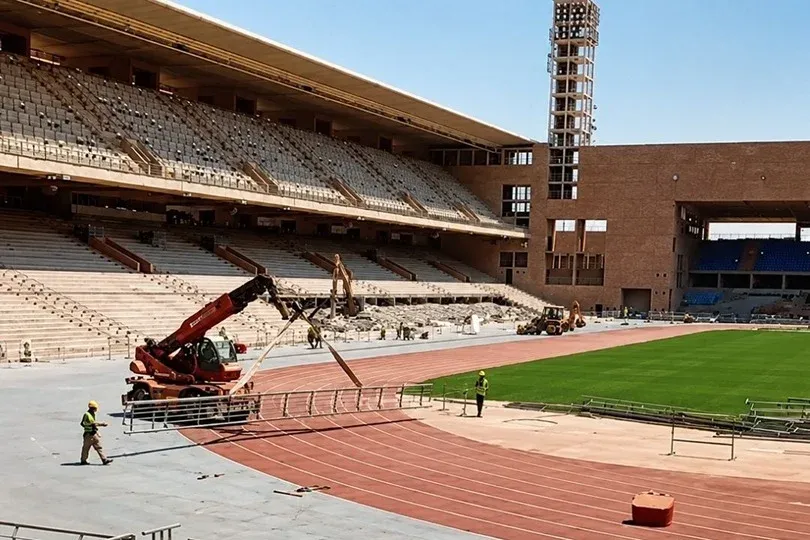
Revamping Marrakech Stadium: A Step Towards International Standards
The Marrakech Stadium is undergoing a significant transformation aimed at modernizing its facilities to meet international standards. The National Agency for Public Equipment (ANEP) has issued an international call for tenders for the construction work on the stadium's roof and facade, with a projected budget of 767.2 million dirhams. This initiative is part of Morocco's extensive national program to enhance sports infrastructure in preparation for major international competitions, including the highly anticipated 2030 World Cup.
This modernization project transcends mere renovation; it reflects the Moroccan authorities' commitment to equipping the nation with state-of-the-art facilities that adhere to global standards. The revamped installations are expected to meet the stringent requirements of international competitions regarding security, accessibility, comfort, and operational efficiency. The new roofing will significantly enhance the spectator experience, while the updated facade will provide a renewed architectural identity to the stadium.
Multi-functional Infrastructure for Economic Growth
The modernization of the Marrakech Stadium also aligns with the evolving role of sports facilities. Contemporary stadiums are now envisioned as multifunctional infrastructures that serve beyond the realm of sports. They are designed to integrate seamlessly into their urban environments, stimulate year-round economic activity, and host a variety of cultural and economic events.
The choice of Marrakech for this ambitious project is strategic, given its status as a popular tourist destination capable of attracting an international audience. By enhancing the stadium's capacity, the city aims to solidify its position as a prime sports destination, complementing its existing tourist appeal. The authorities are banking on the economic benefits associated with hosting large-scale events, which are anticipated to generate positive repercussions for the tourism, transportation, services, and commerce sectors. Consequently, sports infrastructures are seen as vital drivers of territorial development, with the potential to elevate the profiles of cities and enhance Morocco's international standing.
The ongoing renovations in Marrakech are part of a broader strategy to upgrade several sports venues across the country. The overarching goal is to create a network of stadiums that meet the expectations of international governing bodies and can accommodate high-profile competitions. This initiative goes hand in hand with investments in access routes, urban development, transport networks, and public services, ensuring that the facilities meet international hosting standards.
Morocco is also intent on ensuring that these infrastructures leave a lasting legacy. Authorities envision these venues continuing to generate value beyond major competitions by hosting various sporting, cultural, and economic events while supporting local activities. With an investment of 767.2 million dirhams, the transformation of the Marrakech Stadium exemplifies a vision that extends beyond football, aiming to strengthen Morocco's international position and leverage sports as a catalyst for economic and territorial development. The challenge now lies in establishing a sustainable operating model capable of maintaining, animating, and ensuring the profitability of these infrastructures in the long term.
As reported by fr.hespress.com.