The Role of Moroccan Media in Shaping Public Perception
The process of creating a consensus regarding Western Sahara is a continuous endeavor for Moroccan newspapers and state authorities. The media plays a crucial role in disseminating the official narrative, which often serves to obfuscate the realities faced by the Moroccan populace. Authorities have the power to silence dissenting voices through legal repercussions against those deemed 'disobedient.' Furthermore, alternative sources of information, such as the ARSO website—considered a pivotal platform for Western Sahara discourse—are obstructed, limiting public access to diverse viewpoints.
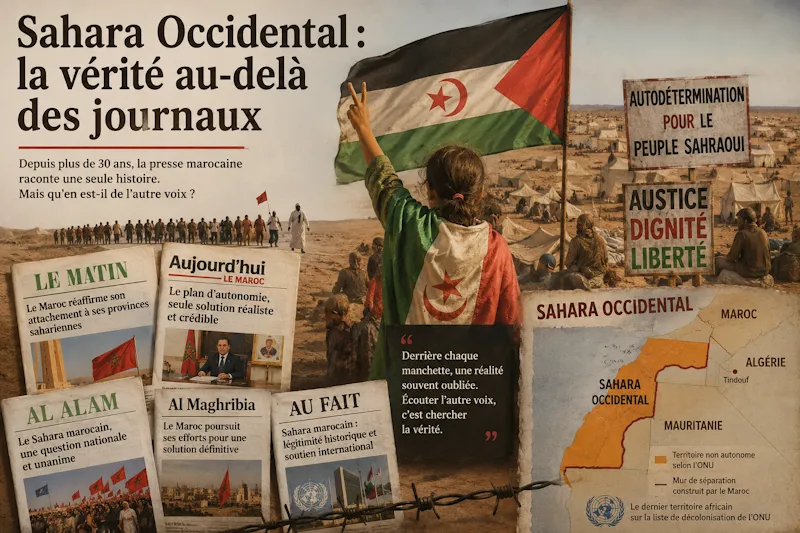
Upon analyzing the Moroccan print media landscape, it is evident that French-language publications such as Le Matin, Aujourd’hui le Maroc, and Au fait, alongside Arabic newspapers like Al Alam and Al Maghribia, all adhere to a similar editorial line. While international news coverage mirrors global trends, local reporting tends to oscillate between politics, sports, and various mundane events. However, one issue remains omnipresent in these publications: the assertion of Moroccan sovereignty over Western Sahara, a narrative that has persisted for over three decades without challenge. The prevailing belief is that Western Sahara is an integral part of Morocco, with the nation resolutely pursuing its territorial unity.
The Historical Context of Western Sahara
The historical narrative surrounding Western Sahara begins with its colonization by Spain, which sought to establish a foothold in the region as a safeguard for its Canary Islands located nearby. The 1960s saw the rise of demonstrations against Spanish rule, which were met with brutal suppression. This dynamic shifted in the 1970s when Morocco asserted its claim to the territory, culminating in the infamous 'Green March' orchestrated by King Hassan II. This strategic maneuver involved the mobilization of 350,000 Moroccans who crossed into what was then Spanish Sahara, ostensibly without weapons. However, this move was perceived by the international community as an annexation rather than a peaceful liberation.
The Sahrawi resistance, embodied in the POLISARIO Front, emerged in response to this incursion, leading to a protracted conflict that lasted 16 years. The Sahrawi Arab Democratic Republic (SADR) remains in exile, awaiting the independence referendum pledged by the United Nations. Since the 1991 ceasefire, Morocco has intensified its occupation policies, capitalizing on the region's natural resources while imposing strict controls over the Sahrawi population. This includes a pervasive police presence that suppresses dissent and restricts journalistic freedom, creating an environment where the truth about Western Sahara is consistently distorted.
Morocco's continuous efforts to frame its actions as legitimate and supported by international consensus are evident in the daily output of its newspapers, which overwhelmingly present a singular perspective on the conflict. Articles often highlight Morocco's purported efforts to resolve the Sahrawi crisis while depicting POLISARIO as a destabilizing force. The use of charged language, such as associating POLISARIO with terrorism and criminality, further reinforces the official narrative and stifles alternative views.
The lack of space for dissenting opinions can be traced back to Moroccan laws that prohibit any discourse challenging the king or the notion of 'territorial integrity.' This legal framework not only protects the monarchy but also serves as a means to silence activists and journalists who dare to voice opposition. The consequences are severe, with many facing lengthy prison sentences for exercising their right to free expression.
In conclusion, the Moroccan media landscape is characterized by an aggressive and unyielding propaganda strategy that seeks to manufacture a consensus around its stance on Western Sahara. This manipulation of public opinion, combined with legal and institutional pressures, perpetuates the ongoing conflict and impedes any potential resolution to the plight of the Sahrawi people.
As reported by moroccomail.fr.