Exploring Marrakech: The Heart of Morocco's Rich History
Nestled at the foothills of the majestic Atlas Mountains, where the azure sky meets the earthy hues of the land, Marrakech stands as one of the most significant cities in Islamic history, serving as the capital of empires that shaped the destinies of Morocco and Andalusia. Marrakech is not merely a fleeting city in the passage of time; it is a poetic tapestry of clay woven by the Amazigh people, witnessing the birth of the Almoravid dynasty and embracing the aspirations of the Almohads, thus remaining a symbol of sovereignty and dignity throughout the ages.
The origins of Marrakech date back to the latter half of the 5th century AH, specifically between the years 452 AH / 1058 AD. The Almoravid leader, Abu Bakr ibn Umar, followed by the historical figure Yusuf ibn Tashfin, chose this strategic location to establish a fortified base aimed at unifying the desert tribes, serving as the launchpad for their empire that stretched from the depths of the Sahara to the heart of Andalusia.
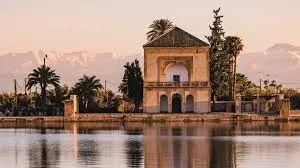
The name Marrakech is believed to derive from Amazigh words meaning 'Land of God' or 'Hurry,' becoming a capital and a name intertwined with Morocco for centuries. Its history and civilization are marked by the reddish hue of its walls, earning it the epithet 'The Red City,' a title that clings to it like a shadow. Over the centuries, various states and civilizations left an indelible mark on the city; during the Almohad period, it experienced remarkable architectural prosperity, exemplified by the construction of the Koutoubia Mosque and the establishment of an ingenious irrigation system that continues to nourish its lush gardens, such as the Menara and Agdal gardens.
Marrakech: A Cultural Crossroads
Despite the capital shifting to other cities in later periods, Marrakech retained its spiritual, economic, and political significance, serving as a cultural melting pot and a bridge linking the desert to the coast. Its famous square, Jemaa el-Fnaa, vibrant markets, and ancient streets, recognized as a UNESCO World Heritage site, continue to narrate tales of glory, the spiritual essence of the 'Seven Men,' and the artistry of Islamic and Andalusian architecture. In this exploration, we turn the pages of history to delve deep into Marrakech, uncovering the secrets of its inception while drawing inspiration from a civilization that resisted the ravages of time, remaining a living emblem of enchantment and authenticity.
The most commonly accepted theory among historians and researchers posits that the name Marrakech is derived from the Amazigh phrases 'Amor N'Akush,' literally meaning 'Land of God,' or 'Amor Wakush.' Some believe the original name is a distortion of this phrase, representing the sanctity of the location and the beauty of its nature. Historical accounts often lean towards the myth that it means 'Hurry.' Some sources suggest that the site where the city was built once served as a refuge for bandits, and passersby would warn each other in the local Amazigh dialect, saying 'Amrakch,' meaning 'Hurry' to avoid danger. Over time, this warning evolved into the name associated with the area.
Marrakech is situated in southern Morocco, at the base of the Atlas Mountains, approximately thirty kilometers from their peaks, standing 450 meters above sea level. It is 327 kilometers from the capital, Rabat, surrounded by notable mountains like the Atlas and Toubkal, with rivers such as the Tensift flowing through it. The city boasts a semi-arid climate, with mild, wet winters and hot, dry summers, and includes numerous natural reserves. Covering an area of about 230 square kilometers, it ranks as the fourth largest city in Morocco, following Rabat, Fes, and Casablanca. Known as 'The Red City,' Marrakech is enveloped by a red clay wall, offering expansive spaces that harmoniously blend warmth and shade.
The city was founded by the Almoravid leader Abu Bakr ibn Umar al-Lamti, and developed further by his cousin Yusuf ibn Tashfin, eventually becoming the capital of the Almoravid Empire. The name 'Morocco' in several foreign languages, including Spanish, is derived from this city’s name. During the Almohad period, the Almohads took control of Marrakech, making it the capital of their caliphate, which marked the golden age for the city, highlighted by the construction of the renowned Koutoubia Mosque, the city walls, and the Kasbah. During the Marinid and Saadian eras from the 13th to 16th centuries, the capital shifted to Fes under the Marinids, but Marrakech regained its status as a flourishing capital during the Saadian rule, evident in the Saadian Tombs and the Badi Palace. Marrakech remained an important political and military center under the Alaouite dynasty and entered a French protectorate in 1912, continuing to evolve until Morocco's independence in 1956.
Marrakech cradles a rich Islamic heritage that spans centuries, with successive ruling dynasties—the Almoravids, Almohads, and Saadians—all contributing to its stature as a center of knowledge and a hub for the arts and architecture. Notable Islamic landmarks that narrate the history of this ancient city include:
- Koutoubia Mosque and Its Tower: The Koutoubia Mosque is the largest mosque in Marrakech and a reference point in Islamic architecture, constructed during the reign of the Almohad caliph 'Yaqub al-Mansur.' Its minaret, characterized by its unique Andalusian style, rises approximately 77 meters and has inspired the construction of many similar structures, such as 'Giralda' in Seville.
- Ben Youssef Madrasa: The Ben Youssef Madrasa is an architectural gem dating back to the Marinid period, renovated during the Saadian era. It served as a major institution for teaching sciences and jurisprudence, adorned with intricate decorations, including carved wood, decorative plaster, and Moroccan mosaic (zellij). The madrasa reflects the beauty of classical Islamic architecture and the geometric mathematics utilized in its construction.
- Jemaa el-Fnaa Square: Jemaa el-Fnaa Square is more than just an ordinary square; it is the pulsating heart of the city and a gathering place for people. Historically associated with the social and religious functions of the mosque it was named after, it is classified as a UNESCO Intangible Cultural Heritage. The square retains its traditional Islamic character, where folk tales are recounted and traditional arts are displayed.
- Bahia Palace: The Bahia Palace epitomizes the art of Moroccan Islamic architecture and decoration from the 19th century. Its design showcases craftsmanship in space utilization, featuring riads (inner courtyards) and lush gardens that embody the concept of 'oases' in Islamic art, where flowing water meets greenery in a stunning geometric harmony.
- Saadian Tombs: Marrakech is home to the historic Saadian Tombs, dating back to the 16th century. These tombs are distinguished by their decorated domes and imported marble columns, representing a remarkable Islamic architectural masterpiece that highlights the significance of funerary architecture in various Islamic eras.
- City Walls and Gates: The ancient city is surrounded by historical walls built during the Almoravid period, punctuated by grand gates reflecting Islamic military architecture. Among them, Bab Doukkala and Bab Agnaou stand out as artistic masterpieces in their own right, showcasing exquisite arches and decorations.
The Islamic monuments in Marrakech serve as an open record of the illustrious history of Islamic arts, and wandering through the ancient alleys of Marrakech, contemplating the details of its palaces and mosques, clearly reveals how civilizations intermingled and generations inherited arts and techniques, making this city a timeless architectural masterpiece embraced by the Atlas Mountains.
Among the most prominent scholars of Marrakech are Abu al-Fadl Iyad ibn Musa (476-544 AH / 1083-1149 AD), known as Al-Qadi Iyad, one of the greatest scholars of the Maliki school and their historians, author of 'Al-Shifa' concerning the rights of the Prophet, and Abu Abbas al-Sabti (524-601 AH / 1129-1205 AD), one of the most famous Sufis of Morocco, known for his doctrine of generosity and giving. Additionally, Abu al-Qasim al-Suhaili (508-581 AH) was a major figure in interpretation, language, and grammar, author of 'Al-Rawd al-Anf,' and Ibn al-Banna al-Marrakshi, Abu Abbas Ahmad ibn Muhammad (654-721 AH / 1256-1321 AD), a prominent mathematician and astronomer with significant contributions to arithmetic and algebra. Moreover, Abu Musa al-Jazuli, 'Isa ibn Abdul Aziz (540-607 AH / 1145-1210 AD), was a well-known grammarian and linguist who settled in Marrakech, and Abu Bakr ibn al-Arabi (468-543 AH / 1076-1148 AD), a Maliki jurist, hadith scholar, and judge, studied and taught in Marrakech. Lastly, Abbas ibn Ibrahim al-Marrakshi al-Samlali (1959 AD) was a historian, judge, and esteemed scholar, known for his encyclopedic work on notable figures in Marrakech and Aghmat.
As reported by gate.ahram.org.eg.