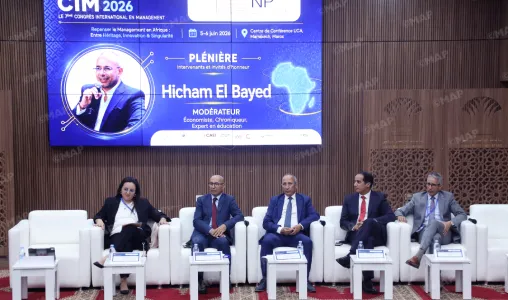
The city of Marrakech hosted the commencement of the seventh international conference on management on Friday, June 5, marking a significant opportunity for an academic and professional dialogue on enhancing management models that are rooted in the unique characteristics of the African continent and responsive to the ongoing economic and social transformations.
This scholarly event, organized by the New Management Practices Laboratory at the Faculty of Legal, Economic, and Social Sciences in Marrakech, carried the theme "Rethinking Management in Africa: Between Heritage, Innovation, and Specificity." It brought together researchers, university professors, doctoral students, experts, institutional officials, and business leaders from Morocco and various African nations.
In his opening speech, Belayed Boukadir, President of Cadi Ayyad University, underscored the importance of the conference's theme, highlighting the opportunities it presents for reflecting on inherited management practices within African societies and exploring new horizons based on innovation, experience exchange, and leveraging local knowledge.
Boukadir elaborated that the conference shines a light on issues surrounding the management and governance of enterprises and public institutions, asserting that the participation of researchers, experts, and managers from diverse countries enriches the discussion and fosters the generation of new perspectives capable of addressing the challenges facing the continent.
Fried Chouki, the head of the organizing committee, emphasized that this scientific gathering is part of an ongoing series of discussions led by the conference partners' network, aiming to enhance the presence of African issues in management science research.
Chouki noted that the choice of this year's theme reflects the growing need to develop management approaches that consider the cultural, historical, social, and economic dimensions specific to African communities. He stressed that many globally circulated models are based on Western experiences, while the continent boasts organizational and administrative practices that have proven effective over time and merit further study and appreciation.
The conference program includes a roundtable discussion on the future of management in Africa, alongside specialized scientific sessions that will cover topics such as artificial intelligence, innovation, entrepreneurship, public governance, human resource management, sustainable development, digital transformation, and economic integration across the continent, as well as the challenges related to the governance of both public and private institutions.
As reported by nichanealane.ma.