
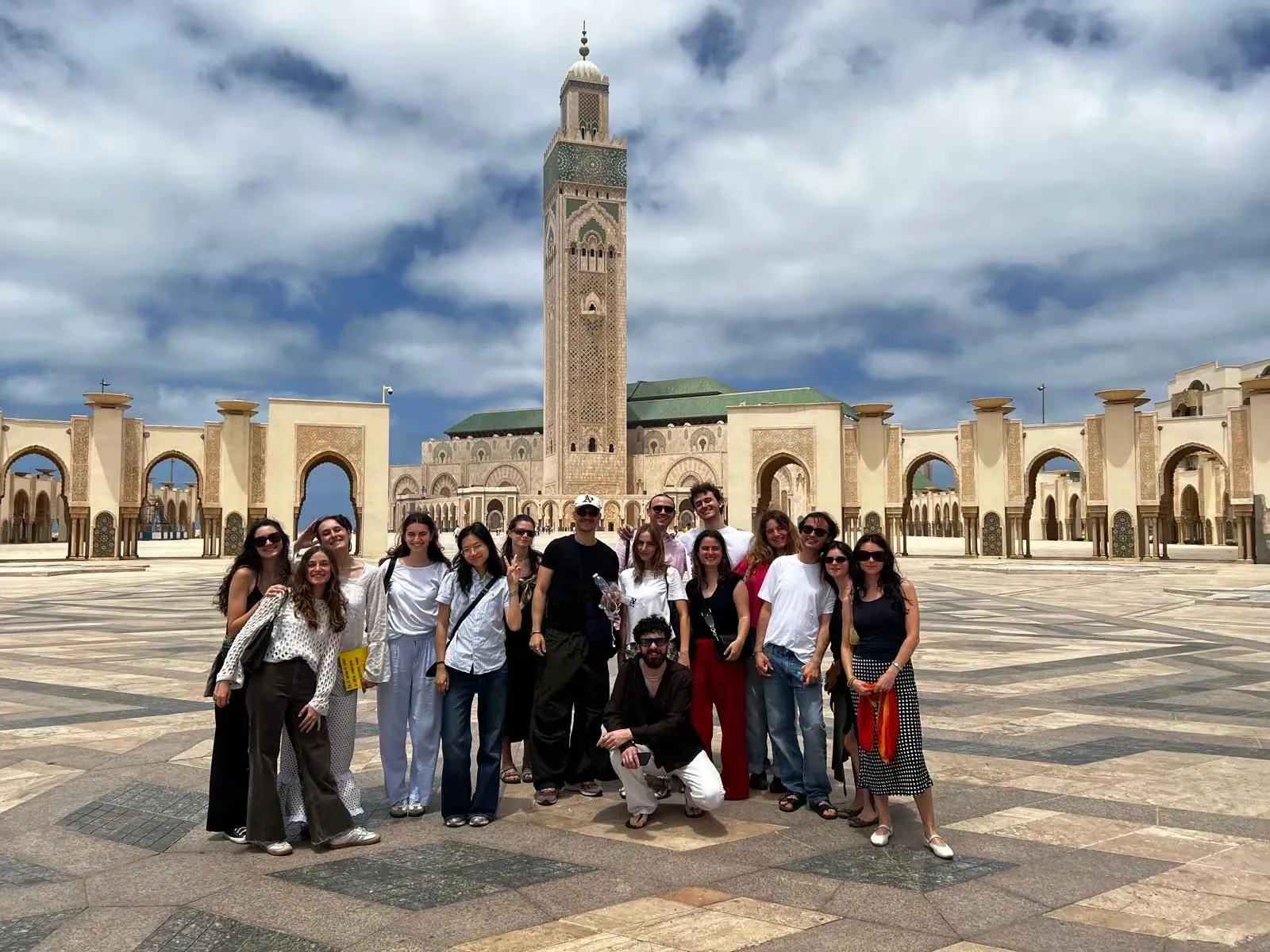
In early June, a cohort of approximately sixty students from the University of Paris 1 Panthéon-Sorbonne embarked on a unique journey to Morocco that transcended traditional tourism and academic exploration. Florent Pratlong, a senior lecturer and director of the Master’s program in Innovation Management at the Sorbonne Business School, describes this initiative as a _learning expedition_. Unlike conventional academic trips, this experience allowed students to immerse themselves fully in the local culture and business environment, taking on active roles rather than passively observing their surroundings.
This immersive approach is part of a pedagogical framework that has been evolving within the Master’s program for several years. The goal is not merely to expose students to different organizations or regions but to engage them in a process of exploration. Students themselves identified contacts, organized meetings, and prepared questions, fostering experiential learning that enhances their autonomy and ability to comprehend an ecosystem holistically. Florent Pratlong often quotes a Chinese proverb to illustrate this philosophy: "If you give a fish to a man, he will eat for a day; teach him to fish, and he will eat for a lifetime."
The decision to focus on Morocco came naturally. While students had the option to choose between Greece and Morocco, Pratlong confidently opted for the latter, citing the abundance of innovative activities occurring in the country. He noted, "Today, in terms of innovation—whether in entrepreneurship, sustainable development, or within the creative and luxury industries—Morocco is a highly active nation," as he explained to Le360.
This Moroccan experience is not unprecedented within the Sorbonne’s department, as several colleagues have previously conducted study trips to Morocco in recent years. However, for the Master’s program in Innovation Management, it marked a significant first. Some students, like Tristan Brion, who is pursuing a Master’s specializing in Technology and Sustainable Development, expressed their excitement long before the trip. Having visited Morocco about a decade ago as a tourist, a conversation with a former internship director who established himself in Morocco sparked his curiosity about the country. He recalled, "He spoke about his experiences and impressions, and I already knew before departing that Morocco was an economically developing country with numerous opportunities."
The choice of Morocco by the Sorbonne affirmed Brion's intuition. The students were divided into four thematic groups focusing on entrepreneurship and technology, sustainable development, arts and creative industries, and fashion and luxury industries, facilitating numerous interactions related to their respective fields. They engaged with the ENR Cluster, a key player in the energy transition that unites over 300 companies and startups around renewable energy innovation, and Masen, the public agency behind Morocco's significant solar and wind projects. The students observed the methodical approach to energy transition, noting that 46% of installed electrical capacity already comes from renewable sources, with a goal of reaching 52% by 2030. Brion was particularly impressed by Masen's consideration of the local impact on surrounding villages, emphasizing the importance of infrastructure development alongside energy projects.
Through their discussions, students discovered a common theme across various sectors: an intention to leverage innovation as a driver for both economic and social transformation. The entrepreneurial ecosystem in Morocco is equally noteworthy. The Technopark of Casablanca, the country's first incubator established in 2001, has supported 3,000 startups with a remarkable 96% success rate, impressing students with its atmosphere and results. They noted a palpable "desire to undertake" within the park. The Startup Station, founded in 2017 and extending to Dakar, demonstrated the Moroccan ambition that reaches beyond national borders, having supported over 2,000 startups and initiated open innovation programs with major international groups.
CDG Invest, the investment arm of the Caisse de Dépôt et de Gestion, further enriched their understanding by explaining the financing mechanisms that sustain this entrepreneurial ecosystem while aspiring to cultivate a new generation of Moroccan industrial "gazelles." Brion remarked, "Entrepreneurship is driven by investment funds, but also by the overall dynamics of the government. We can see that this is a country of opportunities right now."
The banking sector also provided a real-world lesson in transformation during a visit to Saham Bank. For the Innovation Master’s students, this encounter highlighted the managerial, technological, and social challenges inherent in significant banking transformations. Amaury Vittmer, vice president of Sorbonne Entrepreneur and co-founder of Lola, a Health Tech startup utilizing artificial intelligence for Alzheimer’s patients, confirmed that this journey revealed the quality and depth of entrepreneurial support in Morocco. He found the emerging ecosystem of support absolutely remarkable, emphasizing a culture of collaboration and networking that was evident from the first interactions.
Vittmer views the France-Morocco cooperation as more than a diplomatic issue; it is an operational reality. He stated, "Morocco brings agility, natural access to African markets, and a capacity for experimentation. France contributes structure, institutional networks, and expertise. This trip was pivotal for Lola. We established initial contacts with Moroccan companies and support programs and are considering deepening these exchanges, particularly with research actors and health institutions."
In the realms of luxury and creation, the discoveries were equally striking. The AKSAL Group, a leader in premium retail in Africa, along with its Morocco Mall, illustrated the ability of a Moroccan player to operate on a continental scale while developing its unique concepts. Students met with fashion and jewelry houses reinterpreting traditional Moroccan craftsmanship within a contemporary aesthetic, showcasing everything from Fez brocade to zellige patterns transformed into exceptional creations. During their visit to the CGEM, the Federation of Cultural and Creative Industries, students learned about a rapidly structuring sector that already represents 2.7% of the national GDP and aims to double its economic weight by 2030. They were also welcomed by the RSE Commission and the CGEM’s labeled companies club, which provided insight into the growing importance of corporate social responsibility in the transformation of Moroccan businesses.
In Marrakech, the exploration of Morocco's creativity continued at the Comptoir des Mines Gallery, founded by Hicham Daoudi, as well as at the Majorelle Garden and the Yves Saint Laurent Museum. In Casablanca, the Villa des Arts illustrated how heritage, contemporary creation, and transmission can mutually enrich one another. After delving into major energy projects, financing mechanisms for innovation, incubators, creative industries, and businesses committed to transforming the kingdom, students uncovered what may be one of the keys to this dynamic: significant investment in education, research, and entrepreneurship.
The visit to the Mohammed VI Polytechnic University campus in Ben Guerir likely left the most lasting impression. Founded by the OCP Group, UM6P has quickly established itself as one of Africa's most ambitious research and innovation hubs. Its 1337 Coding School, 3D prototyping center, and Startgate incubator—the largest university-based startup incubator and accelerator in Africa—demonstrated an institution designed as a true launchpad. For many students, this visit represented a genuine shift in perspective, as they did not expect to discover such an expansive campus conceived as a complete ecosystem where education, research, innovation, and entrepreneurship operate in an integrated manner.
Stella Zanon, founder of the podcast Born To Create and student in IMTE, articulated a newfound conviction, stating, "In Morocco, I feel like there are more choices: we are _born by necessity and made by ambition_. There is an innate creativity, a strong cultural resourcefulness, but today it is structured by technological rigor. The Moroccan entrepreneur does not create just for business; he creates to solve a concrete societal problem."
What she observed at UM6P and Technopark can be summarized in one phrase: "tech with a soul." Back in Paris, she has already initiated steps to record podcast episodes featuring Moroccan entrepreneurs to share this vibrant energy with an international audience.
Numerous discussions focused on potential cooperation between higher education institutions, particularly in the fields of innovation, entrepreneurship, technology, and sustainable development. These perspectives could pave the way for new opportunities for mobility, joint projects, or scientific collaborations between the two countries. Reciprocity is already in play at other levels. While students explored Casablanca, Rabat, Marrakech, and Ben Guerir, Moroccan entrepreneur Moncef Belkhayat delivered a lecture at Sorbonne titled _Entreprendre au Maroc dans un monde instable_, organized by the Sorbonne-Maroc association.
Florent Pratlong noted, "Some students who previously overlooked Morocco may now consider it professionally. Where a Moroccan opportunity might not have attracted them before, they will now view it differently." Tristan Brion echoed this sentiment, stating, "I spoke with several students, and the idea is lingering in our minds. Why not, after the master's, pursue an opportunity in Morocco? The market is genuinely interesting, whether as an employee or as an entrepreneur. There are still many things to develop and adapt to the local culture."
Pratlong summarized the students' initial perceptions, saying, "I think they envisioned going to Morocco with the clichéd images of Pierre Loti: spices, colors, and cuisine. They were unprepared to see Morocco as it is today. But a trajectory is shaped by the past. We only become who we are today because of the path that led us here." Beyond the official program, Morocco revealed itself in other equally captivating dimensions. Pratlong concluded, "There is also a whole philosophy, a soul that permeates Morocco. They encountered both the spirit of Morocco and its modernity." This discovery could have a lasting impact on some students' professional choices and further strengthen academic, scientific, and entrepreneurial ties between the Sorbonne and a nation that is asserting itself as one of the most dynamic hubs in Africa today.
As reported by fr.le360.ma.


