GNV’s Strategic Expansion in Morocco
GNV, a subsidiary of the MSC Group, has reaffirmed its strategic commitment to Morocco by deploying its two latest and technologically advanced vessels, the GNV Aurora and GNV Virgo, for the Moroccan market. Both ships are powered by liquefied natural gas (LNG) and are designed to facilitate the use of transitional fuels such as bio-LNG and synthetic LNG. This decision, along with the recent naming ceremony of the GNV Aurora in Tangier, highlights the importance of Mediterranean connections in the company’s developmental strategy and underscores the growing role of the North African market within the GNV network.
Over nearly two decades of operation in Morocco, GNV has transported approximately six million passengers, establishing a stable and continuous connection with the country and the Moroccan communities residing in Europe. In 2025, the company transported more than 465,000 passengers on its Morocco routes, reaffirming the nation’s strategic significance within the GNV network. The GNV Aurora and GNV Virgo will commence operations on June 1 and July 1, respectively, on routes connecting the ports of Tanger Med, Barcelona, and Genoa. Barcelona will serve as a transit hub for the entire connection network between Morocco, Spain, and Italy, while Genoa will act as the primary bunkering port for the LNG supply of the two ships, with refueling occurring approximately every four to five days.
Enhancing Connectivity and Sustainability
With this fleet deployment, GNV is preparing for the busy summer season of 2026, supporting passenger flows during Operation Marhaba, which annually sees over three million Moroccan citizens residing in Europe traveling between their homes and their homeland from June to mid-September. Concurrently, the company is strengthening its role in promoting trade between Italy and Morocco via the Tanger Med port, a key logistics hub in North Africa and a strategic gateway to the African continent. This infrastructure is becoming increasingly significant for businesses and supply chains on both sides of the Mediterranean.
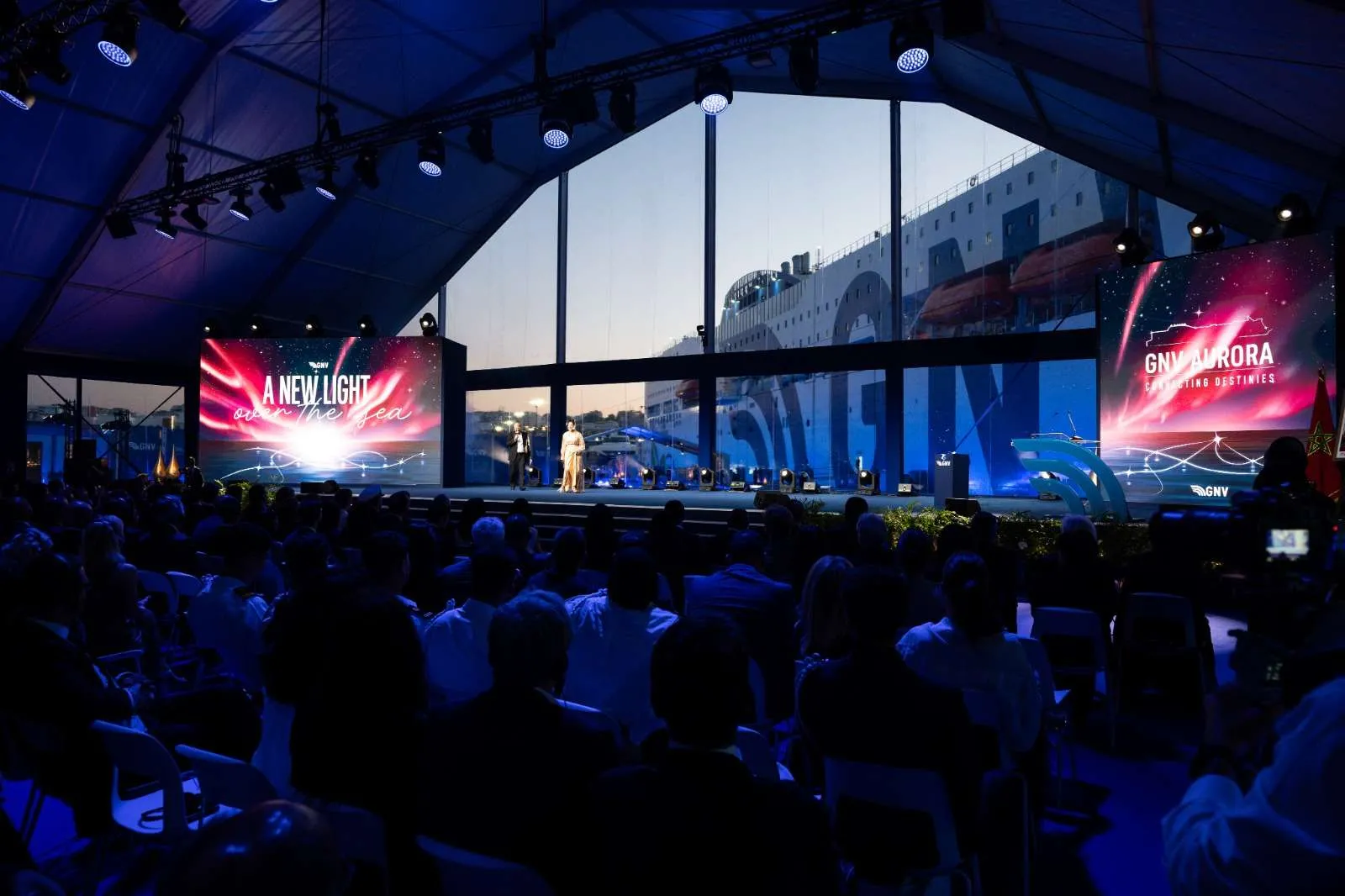
Looking ahead to 2030, Morocco will co-host the FIFA World Cup alongside Spain and Portugal, an event expected to further boost tourist flows and demand for mobility between Europe and North Africa. The naming ceremony for the GNV Aurora took place on June 1, 2026, at the port of Tanger Ville. This vessel is the second LNG-powered unit in the fleet and part of a fleet renewal plan worth €1.3 billion, which includes the delivery of four additional newbuilds starting in 2027, spaced six months apart. The event was attended by over 500 guests, including GNV CEO Matteo Catani, Pierfrancesco Vago, Executive Chairman of MSC Group’s cruise division and GNV, and Moroccan government officials such as Abdessamad Kayouh, Minister of Transport and Logistics, and Fatim-Zahra Ammor, Minister of Tourism and Handicrafts.
On the eve of the 80th anniversary of the Italian Republic, the commissioning of the GNV Aurora vividly illustrates the close ties between Italy and Morocco. By connecting Genoa and Tangier—two cities historically linked to the sea—this new ship aims to further strengthen connections between people, families, and trade relations across the Mediterranean.
“Our long-term presence in Morocco has grown steadily over many years, based on close cooperation and mutual trust. The naming of the GNV Aurora in Tangier marks another tangible step in our enduring partnership with the Kingdom of Morocco. Due to its strategic location between the Atlantic and the Mediterranean, the country is vital for the strength of the Mediterranean network. We intend to actively support the Kingdom’s strategic vision for maritime connectivity, trade, and tourism development,” stated Pierfrancesco Vago.
Matteo Catani, CEO of GNV, emphasized, “The GNV Aurora exemplifies the direction we are taking for the future of our company: combining investments in technology, safety, ecological sustainability, operational efficiency, and high-quality travel experiences. The LNG power allows for a significant reduction in emissions compared to earlier generations of ships. Systems like Cold Ironing further help reduce environmental impact in ports, relieving local communities. Technological innovation and sustainability go hand in hand, enabling us to enhance comfort, reliability, and service continuity. We are building a fleet that accompanies and accelerates the energy transition, in line with the strictest international safety and sustainability standards and maritime decarbonization goals. Morocco is playing an increasingly central role in our development strategies in the Mediterranean,” he added.
“Our presence in the Kingdom is also reflected in concrete numbers: around 250 Moroccan nationals—both onboard and on land—contribute daily to strengthen the connections between Europe and North Africa, firmly establishing GNV in the region. Morocco is undergoing a phase of profound infrastructural transformation and development, and GNV sees itself as a long-term and reliable partner on this journey. We are witnessing a steadily growing interest from European tourists in Morocco: nearly 500,000 passengers choose our ships to reach or discover the country for the first time each year,” Catani concluded.
As reported by touristiklounge.de.