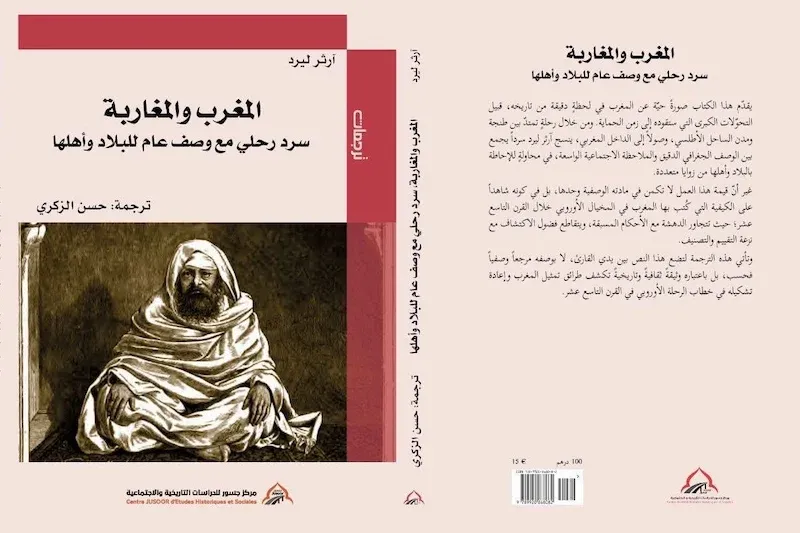
The book titled "Morocco and the Moroccans: A Journey Narrative with a General Description of the Country and Its People" has been translated into Arabic by the translator Hassan Zakri. This significant work, originally authored by Arthur Laird and published by the Bridges Center for Historical and Social Studies, is considered a crucial geographical and social document that brings to light the observations of one of the foremost foreign travelers who visited Morocco.
According to translator Zakri, this book enriches the Moroccan literary treasury and the libraries of Arabic readers, providing an essential insight into the historical and social fabric of Morocco. The scientific value of this publication is further enhanced by a comprehensive introduction written by renowned historian and researcher Richard F. Buron, who contextualizes the original manuscript within its intellectual and historical framework, offering an in-depth analysis that the work rightly deserves.
This new translation by Hassan Zakri opens a unique window into the Morocco of past centuries, meticulously tracing pathways with a keen eye that captures even the most intricate details of its civilizational and architectural aspects. The journey commences from the northern gateway of Morocco, the city of Tangier, and takes readers through coastal towns and inland cities, revealing a route infused with life and historical transformations.
The narrative emphasizes that this journey is not merely a record of geographical coordinates; rather, it is a profound exploration of the structure of Moroccan society and the expressions of its daily life and architecture through its historical ports and cities. The book begins with an engaging narrative about Tangier, highlighting its geostrategic significance as a bridge between two continents, before presenting a "Tour Outside Tangier" that reflects the geography of the surrounding area and tribes.
From there, the traveler ventures to Casablanca, portraying the city as an emerging trade port in early historical periods, encapsulating the early signs of the economic and social transformations that Moroccan coasts would later experience. As indicated in the introductory paper, the traveler follows the coastal line leading to "Mazagan," now known as El Jadida, showing a keen interest in its unique Portuguese fortifications. The narrative then shifts to "Mogador" or Essaouira, which receives special attention through two chapters, including a section titled "Excursions from Mogador," describing the cultural coexistence and the diplomatic and commercial flourishing that characterized this Atlantic city in Morocco's modern history.
This book also documents the author's journey to Marrakech, marking a transition into the interior and a distinct geographical adventure where landscapes change and ethnographic observations vary. It showcases the descriptive skill in detailing Marrakech's markets, mosques, and the customs of its residents, as well as the relationship of the old city with its surrounding foothills and the Atlas tribes. Following Marrakech, the narrative proceeds to Safi, describing the ancient trade routes and caravans that connected the Marrakech metropolis with the historic port of Safi, which served as a vital artery for western Morocco on the Atlantic coast.
What sets this publication from the Bridges Center apart is the meticulous balance between the original travel narrative and the investigative and scholarly footnotes that place terms and geographical names in their correct intellectual context. Consequently, it serves as an essential and enjoyable addition not only for specialists in social history and historical geography of Morocco but also for general readers eager to discover the nuances of daily life and the human paths that have shaped Moroccan identity throughout the ages.
As reported by hespress.com.