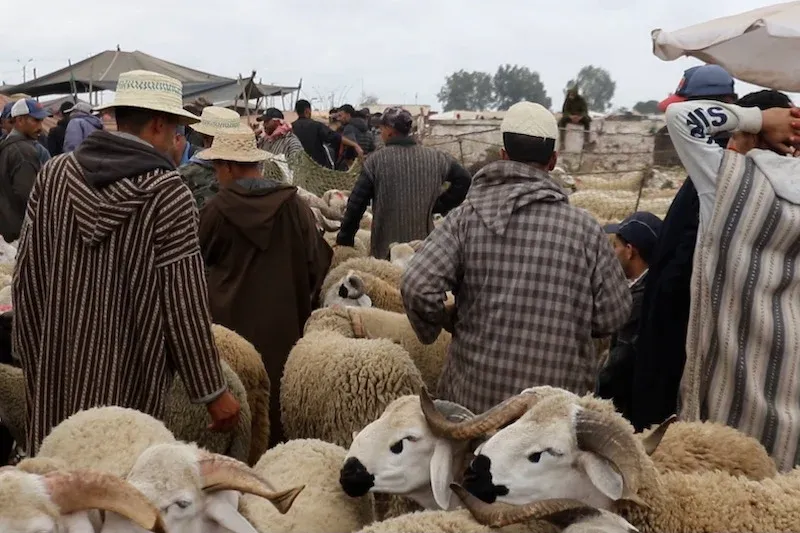
As the joyful occasion of Eid al-Adha approaches, a wave of confusion and distress has swept across sheep markets in Morocco, where the sudden disappearance of livestock has left many families scrambling to secure their animals for the holiday. Just hours before the festivities, reports from various parts of the country reveal that thousands of residents are facing an unprecedented shortage of sheep, leading to chaotic scenes in markets.
Since Monday night, social media platforms have been inundated with videos depicting eerily empty livestock sections, congested market entrances, and frantic buyers chasing after trucks transporting the few remaining sheep. In numerous clips, individuals can be seen surrounding vehicles before they come to a complete stop, desperately trying to grab an animal before supplies dwindle entirely.
This sudden scarcity has ignited a wave of anger among the public, especially after officials consistently reassured citizens that there would be ample livestock available for the Eid celebrations this year. Authorities had initially claimed that millions of sheep and goats were prepared for the holiday, asserting that supply would surpass national demand.
However, reports from major urban centers indicate that by Tuesday afternoon, medium and low-priced sheep had become exceedingly hard to come by. Vendors had to close their stalls early after quickly selling out, while other markets remained jam-packed late into the night as buyers continued their quest for suitable sheep. Footage shared online from various regions illustrated vast empty spaces where animals had been displayed just days prior, while other recordings captured the mounting tensions as crowds gathered around newly arrived livestock trucks, eager to purchase sheep before they were offloaded.
The situation has amplified public scrutiny regarding the soaring prices of Eid livestock this year. Many Moroccans argue that the crisis extends beyond mere supply and demand, pointing fingers at influential meat and livestock traders who they believe are manipulating distribution to artificially inflate prices during the crucial days leading up to Eid. The controversy intensified as government officials stood by their claims of sufficient livestock availability, despite the evident shortages observed on the ground.
Critics have raised legitimate concerns, questioning how millions of sheep could be accessible while numerous families struggled to find affordable options mere hours before the celebration. Adding to the unrest, videos surfaced showing local authorities and market officials entering livestock markets to monitor pricing and investigate suspected market speculators. Online reactions were swift, with many users expressing that these interventions came too late to make a meaningful difference.
Some residents accused traders of deliberately delaying distribution to incite panic buying, while others attributed the crisis to years of ineffective support programs and expensive import policies that failed to alleviate prices for average families. As the night wore on, business in several livestock markets persisted, with buyers moving from one location to another in hopes of finding a sheep before Eid morning.
The emotional and financial pressure on families is palpable as Eid al-Adha approaches. This holiday stands as one of the most significant religious celebrations of the year, and the anxiety of potentially entering the festivities without a sheep has led many to describe the current situation as “unprecedented.”
As reported by en.hespress.com.