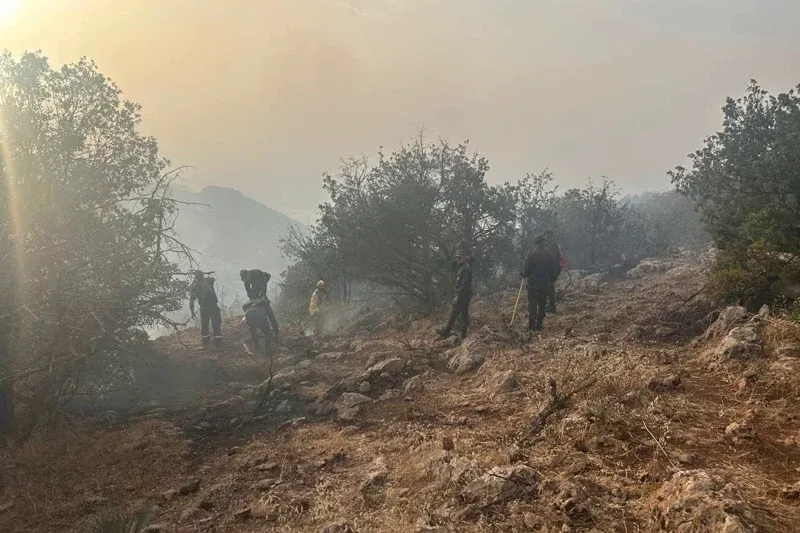
The local authorities in Taroudant have announced that they have gained complete control over the "Onaine Fire" as of early Monday morning. Initial findings regarding the cause of the fire have also been revealed.
Ismail Ben Omar, the regional director of the National Agency for Water and Forests in Taroudant, stated that the situation was fully under control as of this morning, with only a few scattered hotspots remaining. Ben Omar explained that firefighting teams continue their efforts to extinguish these remaining spots, which have persisted since this morning.
He noted that if the weather conditions remain stable and no strong winds occur, complete extinguishing efforts are expected to conclude by Monday evening. In this context, he reported that the affected area has reached 45 hectares.
Regarding the fire's cause, the aforementioned official indicated that investigations conducted by the royal gendarmerie have not yet yielded definitive conclusions concerning the primary reason behind the outbreak. Based on preliminary data, he suggested the possibility of an electrical short circuit in one of the medium-voltage lines, especially given the existence of images and testimonies from individuals who observed the fire starting near a power pole, although other potential causes cannot be ruled out.
Ben Omar concluded by emphasizing the level of control achieved, confirming that the fire has been completely contained, and work is ongoing to extinguish it definitively.
Previously, the National Agency for Water and Forests disclosed that from the beginning of this year until July 20, a total of 310 forest fires have been recorded nationwide, affecting an area estimated at 1,850 hectares. The agency detailed that the burned area includes 832 hectares of tree formations and approximately 1,018 hectares of secondary species and grass formations.
Despite an approximate 32% increase in the number of fires, rising from an average of 233 fires to 310, the area burned has decreased by about 30%, down from an average of 2,660 hectares to just 1,850 hectares. This reflects the effectiveness of the intervention system, according to the same source.
The agency attributed the increase in the number of fires to two main factors: the dense growth of grass cover due to the exceptional rainfall Morocco experienced last winter and the heat waves that swept the country at the end of May and the beginning of July, which accelerated the drying of this vegetation, increasing its flammability.
Furthermore, the pronounced decrease in the areas affected by fire underscores the effectiveness of the preventive and intervention system implemented by various entities, including the Ministry of Interior, the National Agency for Water and Forests, the General Directorate of Civil Protection, the Royal Armed Forces, the Royal Gendarmerie, the Royal Air Force, the auxiliary forces, and local authorities.
The National Agency for Water and Forests emphasized that the speed of detection, reporting, and coordinated field intervention has enabled the containment of the vast majority of fires in their initial stages before they expanded. This explains the increase in the number of fires alongside a clear reduction in the burned areas.
In terms of the regional distribution of fires, the data revealed that the Souss-Massa region topped the list with a total affected area of 600 hectares, followed by the Beni Mellal-Khenifra region with 410 hectares, while the Marrakech-Safi region ranked third with approximately 205 hectares affected by the flames.
As reported by hespress.com.