The Odyssey: A Groundbreaking Film Experience
Christopher Nolan's upcoming cinematic masterpiece, 'The Odyssey,' reimagines the timeless epic of Homer's narrative through an action-packed lens, utilizing cutting-edge IMAX® technology. Scheduled for a global release on July 17, 2026, this film marks the first time the legendary tale has been brought to IMAX® screens, promising to be an unforgettable visual journey. The film captures the essence of the original story while employing real-world locations to enhance its authenticity.
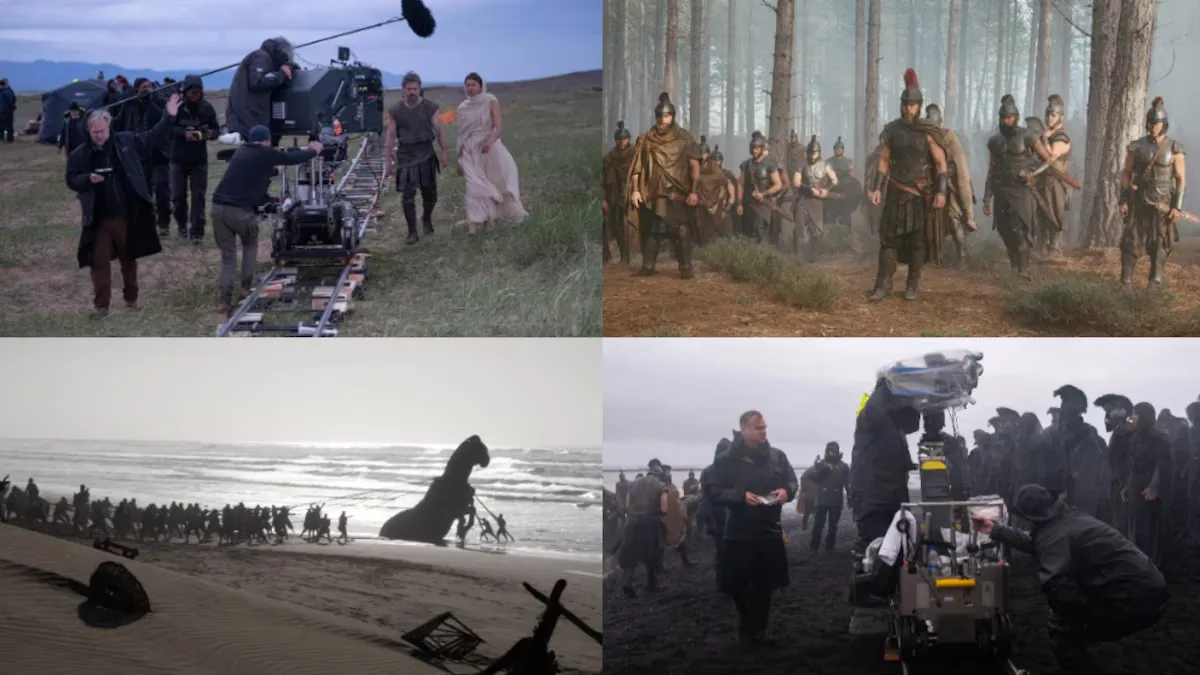
In one vivid scene from the film, actor Matt Damon strides along a winding path carved into the hillside of a Sicilian island, adorned in the tunic of Odysseus, with dust clinging to his sandals. Behind him, a procession of cast and crew walks under the sun, with no cameras or production tents in sight, only a distant castle and the anticipation of the next shot. This encapsulates Nolan's unique approach: creating a sense of reality in fiction, where every drop of sweat feels palpable.
Filming Across Diverse Landscapes
'The Odyssey' was, in many ways, an odyssey of its own, spanning 91 days of filming across six countries from February 25 to August 5, 2025. The production team ventured from the rugged landscapes of Greece's Peloponnese to the volcanic shores of Iceland, all in a bid to capture the grandeur and intensity of Odysseus's journey without relying on digital effects. Nolan articulated this philosophy to Empire, stating, "Filming in the physical world transforms the narrative. The environment presents limits that shape the story." The crew often eschewed studio comforts, opting instead for the authentic experiences that real locations provided.
The only exception to this was a sequence filmed at the water tank of Falls Lake at Universal Studios, where Damon and the cast navigated the waters aboard the Draken Harald Hårfagre, a Viking ship constructed using traditional techniques. The choice of a Nordic vessel, rather than a Greek one, sparked debates among experts, but Nolan prioritized genuine experiences over strict adherence to historical accuracy. This decision has led to some controversies, yet it has not affected the film's anticipated box office success, which is expected to rival that of previous blockbusters like Nolan's own 'Oppenheimer.'
The ancient walled city of Troy, the backdrop for the poem’s opening and Odysseus's initial trials, was not filmed in Greece or Turkey but in southern Morocco. Locations such as Marrakech, Tahanaoute, El Haouz, Essaouira, and Ouarzazate were transformed into the cinematic Troy, with the UNESCO-listed Ksar of Aït Benhaddou providing a stunning visual foundation. The region's red walls and dusty alleyways imparted a raw and primal atmosphere to the battle scenes, immersing the cast in extreme desert temperatures and authentic materials, devoid of any CGI.
Returning home is central to Odysseus's quest, and Greece serves as the emotional core of the film. The production team settled in the Peloponnese, where the jagged coastline and ancient ruins evoked a sense of nostalgia and longing. Key filming locations included Voidokilia Beach, Almyrolaka Beach, Methoni Castle, Acrocorinth, and Nestor's Cave, the latter being a legendary site where Nestor and Neleus tended their flocks. This cave became the setting for Odysseus's encounter with the Cyclops Polyphemus, a moment rich with tension that benefited from the cave's natural acoustics.
The immersive experience extended to the actors as well. Tom Holland, who plays Telemachus, recounted to GQ the sensation of walking for half an hour along a beach, surrounded by extras dressed as Greek soldiers, with no visible crew. “It felt more like a historical recreation than a film shoot,” he remarked, noting how this environment allowed him to embody his character almost instinctively.
The filming journey continued to Sicily, a land steeped in volcanic history and myth. The smaller islands of Sicily were chosen to evoke a sense of isolation and peril, with locations like Lipari, Vulcano, Basiluzzo, and Favignana serving as the backdrop for shipwrecks, feasts, and ambushes. In Favignana, the Castle of Santa Caterina was selected to represent the palace of Ithaca. The demanding logistics required the crew to hike a steep incline for 45 minutes to reach some locations, with heavy equipment transported by helicopter while the actors, including Damon, Pattinson, and Hathaway, made the ascent on foot, fully costumed.
In the original poem, Odysseus descends into the underworld in Book XI, a sequence that Nolan visually translated to the ethereal landscapes of Iceland. Filming locations included Hjörleifshöfði mountain, the Snæfellsnes Peninsula, the Markarfljót River, and Landeyjahöfn harbor. Iceland's unique geography created an atmosphere of otherworldliness that reinforced the narrative's themes of separation and journey. Matt Damon, as Odysseus, ventured into caves and walked on volcanic sand, enveloped in a silence that required no special effects.
The film's final filming location was the Moray Firth coast in northern Scotland, where the team tackled complex maritime scenes, utilizing the vast expanse of the 800-kilometer sea arm and the harsh weather conditions. The Findlater Castle and Culbin Forest served as dramatic backdrops for ambushes and landings. Local journalists even spotted a life-sized Viking ship docked in Inverness, the very same vessel used in the water tanks in the United States.
For Nolan, each location represented a test of endurance. He deliberately avoided comfort, aiming for the cast—Damon, Holland, Hathaway, Zendaya, Pattinson—to experience the journey viscerally. “Every location was the toughest I’ve ever filmed at,” Damon admitted. More than a simulation, the shoot became a genuine odyssey, with grueling marches, inhospitable landscapes, and extreme temperatures blurring the line between the actors' discomfort and that of their characters. The production team faced new geographies, languages, and logistical challenges at every turn, resulting not just in a visual spectacle, but in a shared experience that resurrects Homer's epic through physical effort and Nolan's radical commitment to authenticity. From the mud-brick Troy in Morocco to the Ithaca of Favignana, the underworld in Iceland, and the seas of Scotland, this film represents a cinematic journey that pushes the boundaries of storytelling and immerses its audience in the hero’s timeless quest.
As reported by infobae.com.