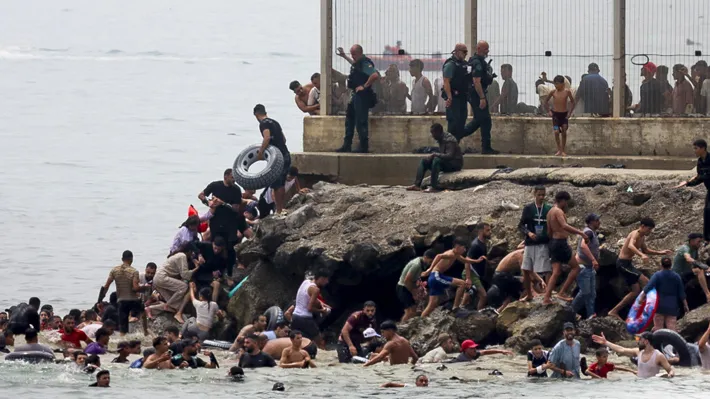
The Spanish enclave of Ceuta, located in North Africa, is experiencing a significant migrant crisis as hundreds of individuals attempted to enter the territory from Morocco over the past few days. This surge in migration has prompted local authorities to declare a national emergency and call for military deployment to bolster security along the border. Reports indicate that thousands of Moroccan youths converged at the border between Castillejos and Ceuta in what appeared to be a coordinated effort. Many arrived on foot, by motorcycle, and in cars, all with the intent of crossing the border fence. One participant was heard shouting, "We are heading to the fence, not by sea."
Among the crowds were entire families, including women and children. Despite the Moroccan police establishing security barriers at various access points, numerous groups managed to navigate through the hills surrounding the border and reach the fence. Hundreds successfully entered Ceuta after jumping over protective barriers in areas lacking police presence, while others crossed through a hole dug under the fence or swam along the coast to bypass the border line. Moroccan agents attempted to manage the flow and apprehended several migrants, including two individuals from Sub-Saharan Africa.
The reasons behind this sudden influx are not entirely understood. However, Spanish newspaper El País suggested that a recent ruling by the Supreme Court might be influencing the increase in attempted crossings. The ruling, issued in early July, prohibits the so-called “hot returns” of migrants who swim into Ceuta or Melilla, limiting this procedure to those who cross physical barriers like fences. In this context, the Spanish Ministry of the Interior argues that human trafficking networks have exploited this decision to encourage new crossings.
This massive influx coincides with the celebration of the 27th anniversary of King Mohamed VI's enthronement, who hosted an official reception in M'diq, located about 20 kilometers from Castillejos. Moroccan authorities interviewed by EFE claimed they were unaware of the reasons behind the massive gathering of people at the border. Local authorities in Ceuta estimated that between 1,500 and 2,000 migrants entered irregularly during the day, leading the local government to warn that reception centers are completely overwhelmed, with hundreds of individuals sleeping on the streets.
Juan Jesús Vivas, the president of the regional government of Ceuta, has urged the Spanish Executive to declare a national emergency for security reasons, increase police presence, and deploy the military to ensure "the inviolability of the border and public safety." The scenes captured throughout the day evoke memories of the 2021 migration crisis when more than 8,000 people surged into Ceuta within just two days.
In response to the escalating crisis, the governments of Spain and Morocco have agreed to enhance their coordination and review mechanisms to expedite the return of all individuals who have entered the Spanish enclave irregularly. Interior Minister Fernando Grande-Marlaska, who has maintained constant contact with his Moroccan counterpart, Abdelouafi Laftit, is set to travel to Ceuta to oversee the situation. Furthermore, officials in Madrid expressed gratitude to Morocco for operations that, according to the government, have prevented thousands of attempted irregular entries in recent days.
As reported by emol.com.