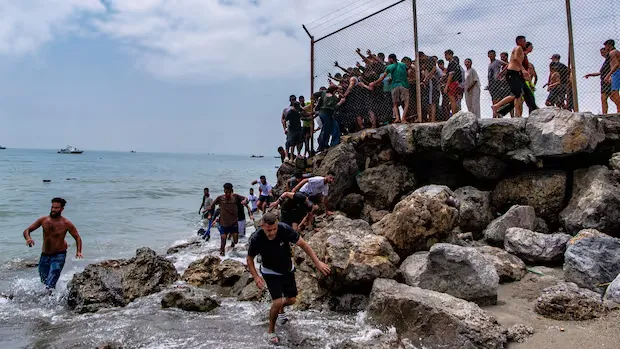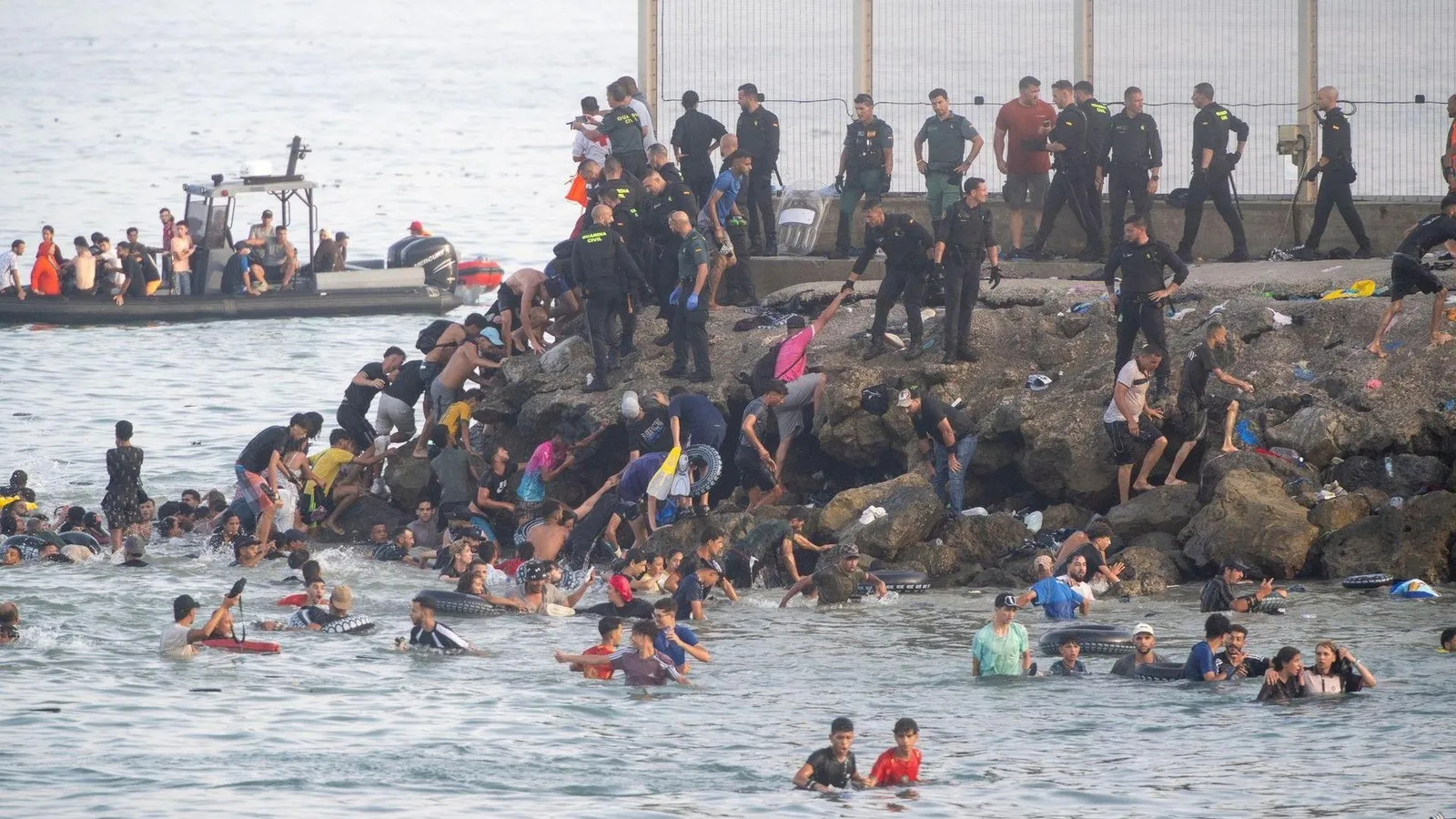
As hundreds of young men reach the shores of El Tarajal, they repeatedly cry out, "No Morocco! Please, no Morocco!" These individuals have battled the treacherous waves from the Moroccan coast to the Spanish enclave of Ceuta, fearing immediate deportation upon arrival. The beach, littered with discarded life rings, diving fins, and wetsuits, tells a story of desperation and hope, as more and more individuals emerge from the sea, some collapsing from exhaustion, while others kneel and kiss the ground in gratitude for their safety.
Many of the new arrivals quickly pull out their mobile phones from waterproof pouches to inform their families back home that they have survived the harrowing journey across the water. Conversations with these migrants reveal a common narrative—overwhelming unemployment, lack of prospects, and a pervasive sense of hopelessness regarding their futures in Morocco. Even those with higher education degrees struggle to find stable employment, and the increasingly repressive political climate drives many young Moroccans to view Europe as their only viable escape. Interestingly, few cite asylum reasons such as political persecution or state violence due to religious or sexual identities.
Escalating Migration Crisis in Ceuta
The situation escalated further as Spain deployed military forces to assist border police in Ceuta, surrounded by Moroccan territory. Both Madrid and Rabat have stated that migrants who entered Ceuta irregularly will be swiftly returned to Morocco. Officially, Spain claims to have capacity for only a few hundred asylum seekers in Ceuta. Prime Minister Pedro Sánchez condemned the influx as an "attack" on Spanish territory. While the exact number of migrants who successfully crossed the border remains unclear, unofficial estimates suggest that tens of thousands may have done so, with reports indicating that up to 60,000 people could have arrived in a single week. EU agencies estimated approximately 50,000 individuals had made the perilous journey from Morocco to Ceuta.
Tragically, at least 57 migrants have lost their lives in this desperate bid for a better life, most of whom drowned attempting to swim to the Spanish enclave. Reports are emerging of individuals returning to Morocco due to a lack of drinking water and shelter, with as many as 150 people reportedly turning back every minute. By the evening, authorities indicated that approximately 48,300 had already left Ceuta heading back to Morocco.
The situation in Ceuta is dire, with overcrowded reception facilities and many individuals wandering the streets in search of food, water, or a shaded place to rest. Shops and restaurants have closed for safety reasons, leading to isolated incidents of violence, including reports of looting and hostility from local residents towards the incoming migrants.
Political Implications and Future Developments
In light of the mounting pressure, Prime Minister Sánchez traveled to Ceuta to assess the situation firsthand, aiming to prevent a repeat of the 2021 crisis when around 10,000 people crossed into the enclave within just 36 hours, straining relations between Spain and Morocco. The fortified borders of Ceuta and Melilla are among the most secure in the European Union, yet migrants continue to face expulsion by both Spanish and Moroccan border authorities, with refugee advocates decrying these actions as "deportations" devoid of proper asylum procedures.
Recent developments suggest a significant political backdrop to the current migration crisis. Following a diplomatic thaw with Algeria, where Sánchez sought to strengthen ties, the Spanish government is also planning to grant citizenship to many Sahrawis born in the disputed territories formerly known as Spanish Sahara. This move could provoke further tensions with Morocco, which may feel pressured by these shifts in Spain's foreign policy.
As the crisis unfolds, questions arise about the motivations behind this sudden surge in migration. Analysts suggest that Morocco may have intentionally relaxed its border controls, drawing parallels to previous instances where Morocco has leveraged migration as a pressure tactic against Spain and Europe. The recent Supreme Court ruling in Spain that mandates individual assessments of migrants' asylum claims could also play a role, as this information rapidly circulates through North African social media, potentially influencing more individuals to embark on the perilous journey to Europe.
As reported by abendblatt.de.