Reflecting on the Impact of the Marrakech Declaration
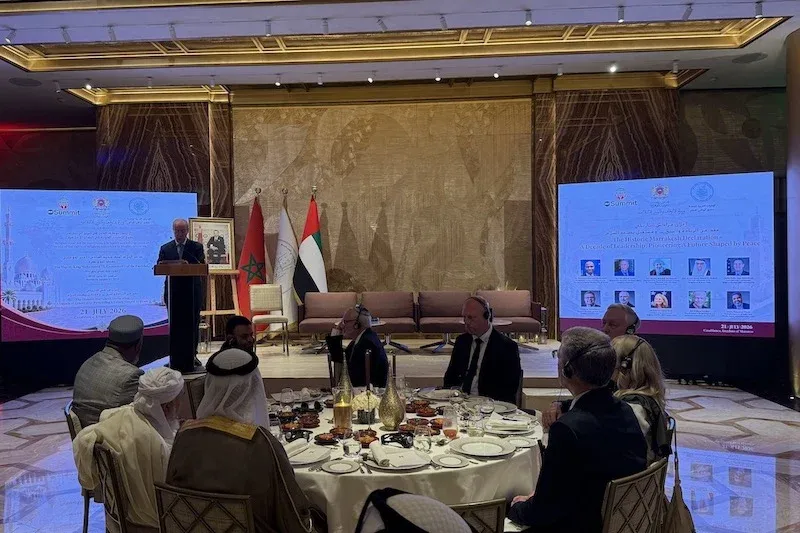
On Tuesday night, the vibrant city of Casablanca hosted a significant intellectual and religious gathering aimed at revisiting the core tenets of the "Marrakech Declaration," ten years after its launch in 2016 in Morocco. This initiative, organized by the Abu Dhabi Forum for Peace in collaboration with the Ministry of Endowments and Islamic Affairs, attracted a diverse array of religious, intellectual, academic, and diplomatic figures from within Morocco and beyond. Participants reflected on the international influence the declaration has had in promoting religious freedom, protecting minorities, and fostering values of coexistence, while also envisioning new pathways to continue spreading a culture of peace and dialogue among followers of various religions and cultures.
In his opening remarks, Ahmed Toufiq, the Minister of Endowments and Islamic Affairs, emphasized that Islam has long established clear principles that embrace pluralism and scholarly interpretation, underscoring the importance of engaging with people of the Book in a respectful manner. He stressed that Islam is a religion that rejects hatred and advocates for the principle of "no compulsion in religion," values that he argues were foundational in the formative period of the Islamic nation and have since become integral to its civilizational framework.
The Essence of Religious Freedom and Cultural Exchange
Toufiq elaborated on a previous royal message directed at participants in this initiative, indicating that mere adherence to religious rules is insufficient to achieve shared living unless it is coupled with a refined civil behavior that translates these principles into daily practices. He highlighted the world's pressing need for religious values, which possess virtues and ethics that souls adhere to in front of their Creator. He noted that the conclusion of the royal message offers an optimistic perspective rooted in goodwill and hope, based on the premise that peace is at the heart of religious messages and that communication grounded in love and mutual respect remains the most effective means to enhance human stability. He also asserted that defending religious freedom should not mask political ambitions or opportunistic calculations, emphasizing that this freedom should not serve as a pretext to infringe upon the public order of states but, in essence, creates fertile ground for cultural exchange.
Sheikh Abdullah bin Bayyah, President of the Abu Dhabi Forum for Peace, reminisced about the context in which the "Marrakech Declaration" was born in 2016, noting that it has been ten years since scholars, intellectuals, and religious leaders from around the world convened during a delicate international period marked by rising tensions and conflicts related to identity and religion. He explained that the conference, held under the patronage of King Mohammed VI and with the support of the United Arab Emirates, drew inspiration from the historical "Charter of Medina" as a model for organizing relationships among community components based on citizenship and coexistence.
Bin Bayyah affirmed that the "Marrakech Declaration" has evolved over the years into a prominent reference in international discussions regarding religious freedom and the protection of cultural and religious diversity. It has received widespread acclaim from universities and research institutions globally and has spurred multiple initiatives aimed at correcting misconceptions and opening broader avenues for cooperation among followers of different faiths. He acknowledged that the results achieved were a product of continuous support and care, which enabled this initiative to transform from a mere intellectual document into a global project for dialogue and human understanding.
Saeed Ahmed Al-Dhaheri, UAE Ambassador to Morocco, remarked that the "Marrakech Declaration" has become a global beacon for tolerance, coexistence, and human brotherhood. He highlighted that Moroccan-UAE relations transcend traditional partnerships and are built on a shared vision that recognizes the importance of intellectual security and the role of culture and religion in fortifying minds and communities. Al-Dhaheri further emphasized that the two countries continue to work towards establishing a sound religious discourse and promoting a culture of moderation and balance, asserting that freedom of belief is not merely an intellectual luxury or a temporary slogan but a fundamental human value that contributes to building stable and balanced societies.
Al-Dhaheri praised the efforts accompanying the launch of the "Marrakech Declaration," considering it a successful model for enhancing common humanity and solidifying values of mutual respect among various religious and cultural components. Mohamed Senoussi, a member of the Board of Trustees of the Abu Dhabi Forum for Peace, pointed out that the world was eager for a document rooted in religious principles that would enhance religious freedoms, thus making it natural to hold this meeting in Marrakech, given Morocco's wealth of scholars well-versed in religious matters and freedoms. He noted that Morocco has a successful experience in coexistence and religious minorities, stating that it was only fitting for the Islamic world to look to Morocco for issuing the Marrakech Declaration, which is derived from the Charter of Medina issued by the Prophet Muhammad (peace be upon him).
The U.S. Commissioner for Religious Freedom stated that the declaration was well-received globally for several reasons, primarily due to its foundation in the Charter of Medina, which is universally recognized in the Islamic world, the royal patronage of King Mohammed VI, and the leadership of Sheikh Abdullah bin Bayyah. He added that today, on this anniversary, representatives of all religions and U.S. government officials, as well as ambassadors of religious freedom in the American administration, are present. Members of the Abu Dhabi Forum for Peace's Board of Trustees further noted that the declaration has become a document relied upon to enhance religious freedoms worldwide, and the name "Marrakech" has gained international recognition, although the journey to implement the declaration's principles continues.
Participants at this gathering believe that, a decade after its issuance, the "Marrakech Declaration" is no longer merely a reference document tied to a specific time period but has transformed into a dynamic civilizational project aimed at establishing peace, coexistence, and recognition of differences as the foundations for building a more secure and open future.
As reported by hespress.com.