UNAM and Mohamed V University Joint Symposium on Seismic Alert Systems
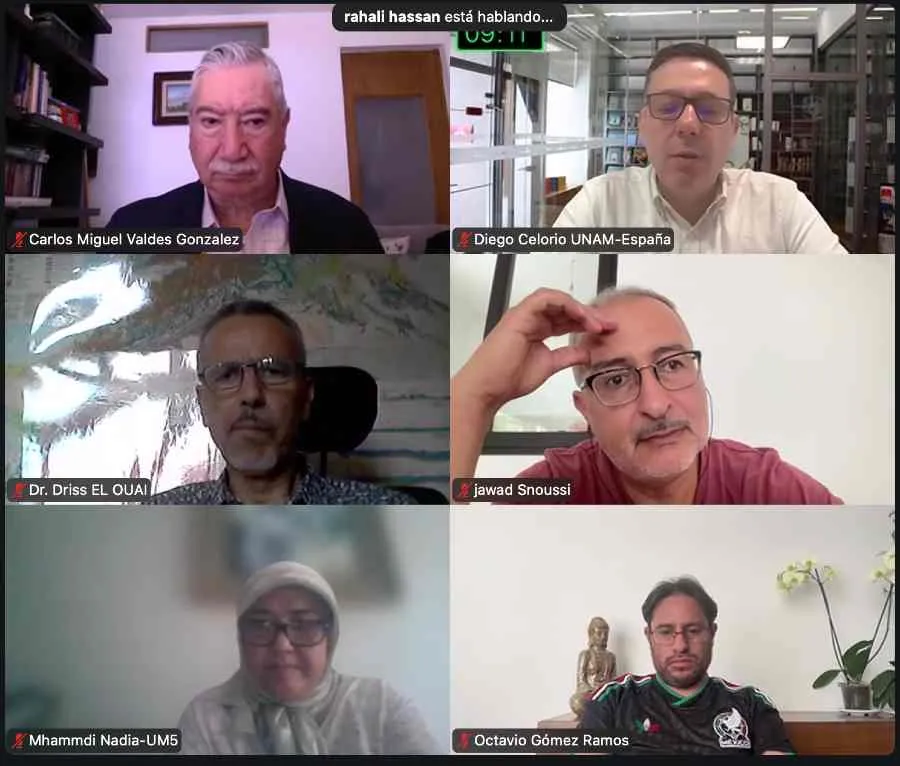
Researchers from the National Autonomous University of Mexico (UNAM) and Mohamed V University (UM5) in Rabat, Morocco recently convened for the inaugural symposium titled "Seismic Alert Systems and Geophysical Methods," which took place virtually on June 12. This significant academic event was inaugurated by José Luis Macías, the director of the Geophysics Institute at UNAM, and Nadia Mhammdi, head of the Geophysics department at UM5, along with Ciro Murayama, director of UNAM Spain. The symposium featured four distinct panels, each consisting of presentations from academics representing both institutions, followed by a brief discussion period for questions and feedback.
During the first panel, Carlos Valdés from UNAM presented on the sophisticated monitoring system established in the Pacific region of Mexico and its corresponding seismic alert system for Mexico City, developed over recent decades. In parallel, Lahcen El Moudnib discussed the contributions of UM5's Scientific Institute in detecting, monitoring, and mitigating risks associated with earthquakes in Morocco.
The second panel featured Octavio Gómez from the National Oceanographic Service of UNAM, who elaborated on numerical modeling of tsunamis in Ajacutla as part of a trinational project involving Mexico, El Salvador, and Japan, aimed at disaster reduction related to earthquakes and tsunamis. Concurrently, Driss El Ouai presented his research on refraction methods to identify seismic zones, drawing from his experience at the Bni Hadifa station located in the central Rif mountain range of northern Morocco.
In the third panel, René Chávez Segura from the Department of Geomagnetism and Geophysical Exploration shared his team's findings regarding subsurface characteristics in Mexico City, utilizing electrodes to identify challenges for urban engineering development. Additionally, Dr. Abderahime Nouayti from UM5's Earth Physics department showcased his expertise in seismic tomography techniques applied in North Africa.
The final panel featured Dr. Leticia Flores Márquez from UNAM, who presented her research focused on developing three-dimensional mathematical models based on terrestrial, aerial, and satellite observation data to elucidate geological structures. Mohamed El Basri from UM5 analyzed the application of the California Bearing Ratio (CBR) mapping method to estimate soil resistance and capacity in seismic zones.
This initial exchange marks the beginning of a collaborative effort, with plans for the Geophysics Institute at UNAM and the Scientific Institute of UM5 to hold additional symposium sessions throughout the year, covering topics such as tectonics, paleoenvironments, paleoceanography, and the applications of seismic research in laboratory infrastructure development.
Through this partnership, UNAM is fostering scientific cooperation with Morocco, a nation facing similar natural and social challenges, including climate change, biodiversity threats, and exposure to extreme weather events that disproportionately affect lower-resource communities. In alignment with UNAM's internationalization strategy, its foreign representations are tasked with promoting academic exchange and cooperation not only in the host country but also from a regional perspective, extending their initiatives to the Iberian Peninsula and North Africa.
As reported by gaceta.unam.mx.