Transforming Casablanca into a Smart City
In the era of Artificial Intelligence, Casablanca is setting its sights on enhancing the management of urban projects through augmented reality, all while preserving its unique essence. A decade ago, with the launch of the Casa Smart City initiative, Casablanca embarked on a transformative journey to become a smart city, akin to numerous global metropolises. By leveraging technological solutions and introducing innovative management practices across various sectors, the city has made remarkable strides in addressing the needs of its local population. This transformation is particularly evident in urban mobility and the distribution of green spaces.
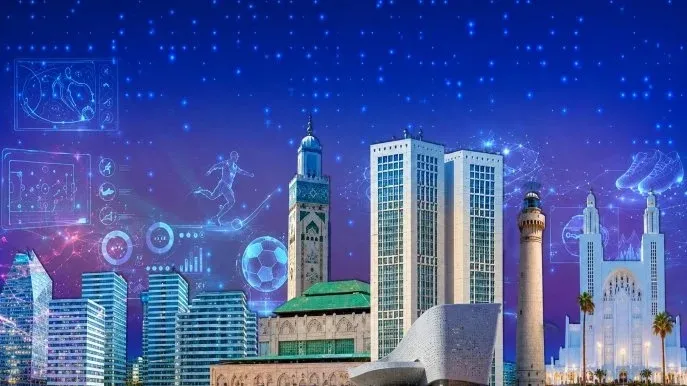
Looking ahead to 2026 and the unfolding era of Artificial Intelligence, the city is faced with an exciting new challenge: to build a data-enhanced city while maintaining its identity and human dimension. The goal is not to accumulate isolated smart projects but to deploy cutting-edge technological solutions, particularly augmented reality, to expedite the city's development in time for the 2030 World Cup, as articulated by Aawatif Hayar, the president of the scientific committee of Smart City Casablanca. This vision was prominently featured in the tenth edition of the Casa Smart City forum, held in the heart of the metropolis, under the theme: "Augmented Smart City: 10 Years of Animation in Service of Urban Innovation in Culture, Sports, and Economy."
Augmented Reality: A Game Changer for Casablanca
Specifically, Smart City Casablanca aims to develop a "digital twin" or metropolitan digital twin capable of modeling the city's operations in real-time. In simpler terms, this involves creating a virtual replica of Casablanca that incorporates its territorial, human, and infrastructural dimensions. Beyond optimizing mobility flows and monitoring the environment, this technology will allow simulations, facilitated by augmented reality and Artificial Intelligence, of various projects before their real-world implementation.
In the context of urban development projects, multiple optimization scenarios can be tested on this digital twin, taking into account the actual characteristics of the territory, existing infrastructures, and the needs of the residents. This tool will provide the opportunity to evaluate the impact of different options, refine decision-making, and even engage citizens in the consultation process before the effective implementation of projects. This approach aims to make the city more agile, participatory, and aligned with the expectations of its inhabitants, as explained by former minister Aawatif Hayar.
However, this ambition is not without its challenges. The Mohammed VI Polytechnic University (UM6P) has urged caution in implementing this model, fearing that an algorithmic vision could cost the city its memory and even its identity. They advocate for a transversal approach that combines innovation with identity, performance with meaning, and technology with community. Similarly, Hassan II University of Casablanca emphasizes the need for continuous mobilization of knowledge, action, and collective intelligence to tackle urban challenges and meet the needs of a growing local population as the city expands.
This perspective was further supported by Singapore's Minister of Social and Family Development, Masagos Zulkifli, who highlighted his country’s investment, recognized globally as a model, to improve the daily lives of its citizens. He asserts that a smart city is measured more by its capacity for inclusion than by its ability to harness the most sophisticated technological means. Djilali Lahiani, deputy mayor of Toulouse, echoed this sentiment, stressing the importance for metropolises like Casablanca to reconcile economic power, technological innovation, and human development to address contemporary challenges while relying on the city's vibrant youth.
As Casablanca sets a new course, it faces the significant challenge of effectively mobilizing technology to sustainably improve the daily lives of its citizens, the true benchmark of a smart city. The stakes are high for a metropolis where stark disparities between neighborhoods, traffic congestion, and constant pressure on public transport and services remain daily headaches for both residents and visitors.
As reported by lopinion.ma.