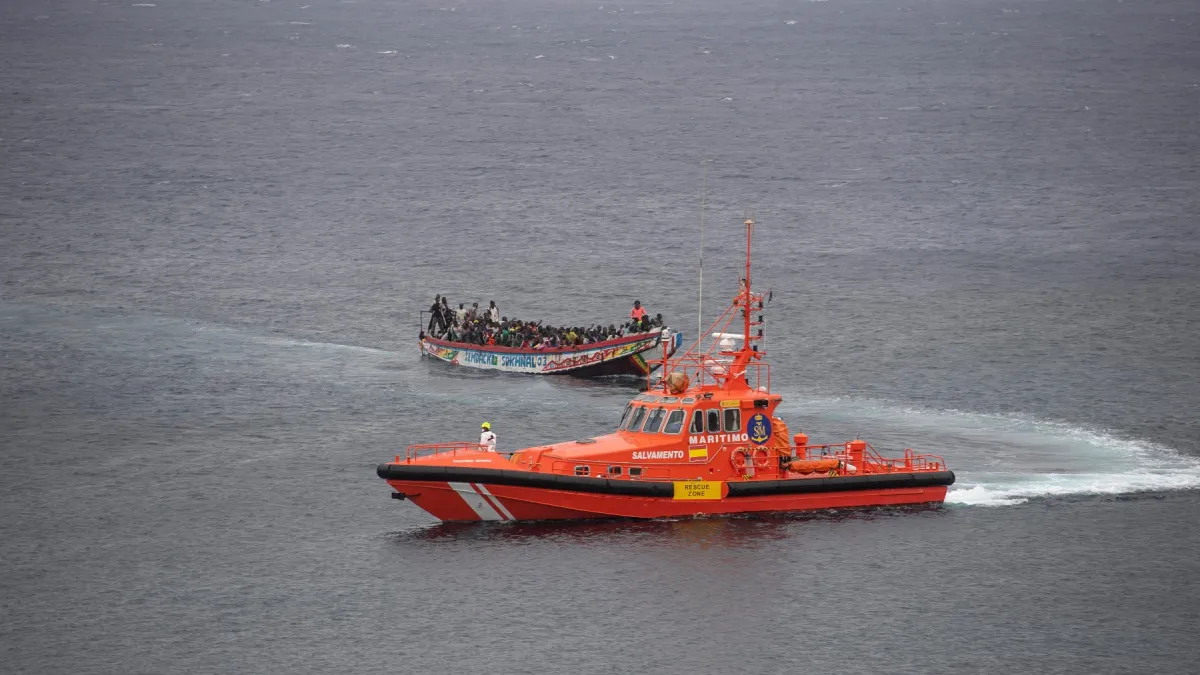
On May 7th, a group of 63 individuals set sail from Cabo Bojador, located in the occupied territory of Western Sahara, heading towards the Canary Islands. However, when they reached the shores of Las Palmas de Gran Canaria the next day, one individual was missing—**Daha Mohamed El Houcini**, a 35-year-old Sahrawi activist from El Aaiún, the capital of the Western Sahara occupied by Morocco. His brother, **El Oilai El Houcini**, awaited his arrival in Las Palmas. Two days after the boat's landing, El Oilai received an audio message from someone onboard Daha Mohamed’s vessel, revealing that a fight had erupted during the journey, resulting in his brother being thrown overboard.
On Tuesday, May 12th, El Oilai went to the **Superior Police Headquarters of the Canary Islands** in Las Palmas de Gran Canaria to report the incident. On May 14th, he filed an official complaint with the Instruction Section of the Court of First Instance of Las Palmas de Gran Canaria. Five days later, on May 19th, Judge **Florencio Luis Barrera Espinel** issued a ruling accepting the case but simultaneously decided to archive it. The family of Daha Mohamed could not comprehend this decision, as reported by publico.es.
According to El Oilai, all passengers from the boat had been taken to migrant detention centers on the island, making it relatively easy for authorities to gather their testimonies. However, Judge Barrera Espinel did not order any measures to investigate the potential homicide. In response to this decision, the family has appealed, seeking an explanation for the closure of the case, but they have yet to receive any updates.
While this appeal is pending, the National Police have continued their investigation. On June 8th, the **Unit Against Illegal Immigration Networks and Document Fraud** informed El Oilai that 13 members of the boat had identified two individuals as responsible for his brother's death. By June 17th, the police announced the arrest of two suspects believed to be involved in the death of a migrant. One was arrested on charges of facilitating illegal immigration and homicide, while the other was detained as a suspected perpetrator of homicide. Both have been placed at the disposal of the appropriate judicial authority.
El Oilai believes that the aggression against his brother is directly linked to his political activism. Daha Mohamed was a prominent Sahrawi activist who stood firmly against Morocco's illegal occupation of Western Sahara, which has persisted since 1976. His tragic fate, according to El Oilai, was not unexpected but rather a culmination of the long-standing persecution faced by those opposing the Moroccan colonial regime. Prior to his disappearance, Daha Mohamed had endured harassment, arrests, and even abandonment in the desert, all in pursuit of the self-determination rights long promised to the Sahrawi people by the United Nations.
A Legacy of Struggle
Daha Mohamed El Houcini hailed from a lineage of revered Sahrawi activists who have faced severe repression from the Moroccan regime. His grandfather, **Deida Ould El Yazid**, was affectionately referred to as "the grandfather of peaceful resistance" in El Aaiún. During the Spanish administration of the Sahara, Deida Ould served as a soldier in the Spanish Army, and he received a pension from the Spanish state, as confirmed by El Oilai. Following the Moroccan occupation, he became an active participant in the Sahrawi cause, supporting protests in El Aaiún in 1999 and 2004, and being part of the Gdeim Izik Sahrawi camp in 2011. Each of these civil protests faced severe repression from the Moroccan police, resulting in numerous arrests, disappearances, injuries, and fatalities.
Both Deida Ould and his grandson Daha Mohamed were frequent targets of police brutality. El Oilai recounts how Daha Mohamed's life took a decisive turn after being detained in 2011 as a minor, during which he suffered torture and was isolated for three days in a cell, emerging with visible injuries. After eight months, Daha Mohamed was released, but his cousin **Naama Asfari** was not as fortunate; he received a 30-year prison sentence on dubious charges, as confirmed by the UN Working Group on Arbitrary Detention.
Following his release, Daha Mohamed faced incessant harassment from the Moroccan regime, which sought to limit his ability to study or work. A desperate attempt to flee the oppressive conditions led him to initiate a hunger strike at the Mauritanian border in April 2014, an act that resulted in his arrest and subsequent abandonment in the desert by Moroccan authorities. He was rescued by nomadic Sahrawis and returned to El Aaiún, where he continued to grapple with bureaucratic obstacles, detentions, and threats, ultimately leading him to consider the perilous journey across the sea. Traveling by plane was not an option for him, as visa applications are routinely denied to Sahrawis.
Despite these challenges, Daha Mohamed managed to build a life; he got married, had a son, and occasionally worked as a transporter. However, in late April of this year, the police confiscated his van, which was vital for his family's financial stability. After a series of broken promises regarding the van's return, Daha Mohamed, in desperation, traveled to Cabo Bojador and spoke with his brother for the last time, where El Oilai tried to dissuade him from boarding the boat. Unfortunately, his pleas went unheard.