
Political opposition plays a crucial role in any modern democratic system, serving as a mirror that reflects flaws and as a voice that proposes alternatives for evaluating governmental paths and correcting policies. However, the exercise of this opposition is subject to unwritten norms and rules, the highest among them being that internal disagreements, regardless of their intensity, should dissipate once national borders are crossed. Nations are built through constructive internal criticism, yet they crumble when such criticism becomes a tool for foreign entities to extort and undermine the state's diplomatic stance.
In this context, a stark paradox emerges when comparing the behavior of opposition in countries that respect their sovereignty to that of certain individuals claiming to be opposition members in Morocco. These individuals have chosen to play the role of the 'fifth column' through Spanish and French media platforms, exploiting transient political crises to deliver 'treacherous blows' to their homeland.
The Canadian Example
In September, Canadian opposition leader Pierre Poilievre, who heads the Conservative Party, provided a profound lesson in political and national ethics during an interview on CNBC's 'Squawk Box.' Amid sensitive trade disputes with the United States, the American host attempted to lure Poilievre into attacking then-Prime Minister Mark Carney, who was out of the country at the time, questioning whether Carney was negotiating in 'good faith.' Poilievre could have easily used this prominent American platform to settle internal political scores and deliver a fatal blow to his political rival. However, his response was decisive and firm, establishing a non-negotiable principle: 'national sovereignty comes first.' He boldly stated, 'My job here is to defend my country, not to score political points at home. Politics ends at the border.' This stance not only reflects political maturity but also embodies a deep-seated belief that undermining a negotiator abroad weakens the entire state. Using foreign media to attack state institutions is a betrayal of voter trust and the nation's higher interests. The opposition understands that the genuine arena for accountability lies in parliament and the electoral polls, not in foreign media studios.
The Moroccan Context
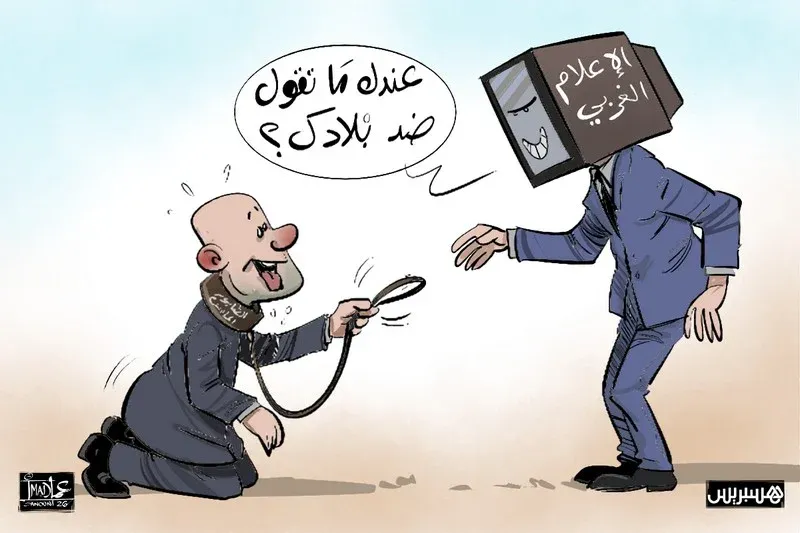
In stark contrast to this political elevation, the Moroccan context presents a troubling phenomenon represented by voices that claim to advocate for change while using the guise of 'opposition' to serve foreign agendas. This 'fifth column' carefully selects the timing of its attacks, often coinciding with periods of diplomatic tension between Morocco and certain European capitals, particularly within the French-Spanish axis. Instead of aligning with their country's interests during crises, these individuals rush to hostile media outlets to provide material that is exploited in systematic extortion campaigns against Rabat. They do not propose alternative programs or contribute to internal public discussions; rather, they offer a bleak and repulsive image of their homeland, alarmingly aligning with narratives imposed by old colonial circles on a rising state that has chosen to diversify its partnerships and assert its sovereignty.
A glaring example of this deviation is Moroccan activist Reda Benchemsi, in his interview with the Spanish newspaper 'El Independiente,' known for its open hostility towards Morocco and its constant defense of its adversaries. Benchemsi did not hesitate to tarnish his country's image with a discourse filled with inaccuracies and contradictions. Living off the glories of previous journalistic experiences, he attempts to portray Morocco as a 'large prison' where freedoms are suppressed and freedom of expression is absent. The danger in Benchemsi's statements lies not only in his exaggerated claims regarding the curtailment of freedoms initiated by the new reign of King Mohammed VI but also in his explicit and implicit calls for continued 'international pressure' and foreign intervention in Moroccan judicial matters, citing specific names such as journalists Tofiq Bouachrine, Slimane Raissouni, Omar Radi, and Ali Lamrabet.
This blatant resorting to foreign influence is an affront to the rule of law and national judicial institutions, clearly embracing a logic of Western guardianship. Benchemsi does not stop there; he attempts to exploit the hardships of youth and 'Generation Z' to justify irregular migration towards occupied Ceuta, falsely linking it to a lack of prospects and 'repressive policies.' He even goes so far as to downplay significant national achievements, trivializing Morocco's preparations to host the 2030 World Cup and pitting sports infrastructure against the health and education sectors in a desperate attempt to incite public opinion and fuel social discontent.
In a similar vein, journalist Omar Radi appears on 'Radio 5' in Spain in an interview with journalist Francisco Carrión, known for his support of the Polisario's narratives, to present a hostile argument lacking the most basic standards of objectivity against his country's institutions. Radi speaks of a 'political and institutional paralysis' and a government in a 'state of stagnation,' thereby belittling the will of millions of Moroccans who participated in the elections and labeling constitutional institutions as merely 'cosmetic.' However, Radi’s major blunder lies in his treatment of the sensitive migration issue; instead of condemning European policies or approaching the topic from a comprehensive developmental perspective, he literally adopts the narrative of the European far-right and the anti-Moroccan circles, accusing Rabat of 'deliberately using its geographical position and migrant flows as leverage and bargaining chips against Spain and Europe.' This statement is akin to a bullet in the back of Moroccan diplomacy, providing a free pass to Europe for its historical responsibilities in southern crises.
Even the 2030 World Cup project is not spared from Radi’s barbs, as he accuses the state of carrying out extensive demolition operations for what he calls 'quasi-mafia economic interests,' ignoring the unprecedented urban development seen in Moroccan cities. He concludes his discourse with an open call for 'collective retaliation,' after claiming that the regime has dismantled parties and unions and eliminated opposition.
When placing the Canadian stance in one scale and the statements of Benchemsi and Radi in the other, the inherent differences between national allegiance and 'political opportunism' become glaringly apparent. Canadian opposition leader Poilievre views his Prime Minister as a political rival domestically but regards him as a legitimate representative of the nation and defender of its interests as soon as he steps beyond the borders to negotiate with a foreign state. He understands that undermining a negotiator equates to undermining national interests. Conversely, the 'fifth column' in Morocco sees diplomatic crises as ripe opportunities to pounce on their homeland. Benchemsi and Radi do not address the Moroccan public with a rational discourse to propose solutions; instead, they turn to the Spanish and French audiences with language of denunciation and incitement.
They provide justifications for foreign media to distort the image of Moroccan institutions, feeding the narrative attempting to portray Morocco as a rogue state using migrants as a weapon, lacking the most basic components of democracy and human rights. This is not merely a difference in opinions; it is a dangerous deviation towards dependency. When Benchemsi declares that 'international pressure' is the solution and when Radi adopts the opponents' thesis on migration, they willingly relinquish their nation's sovereignty in favor of agendas that harbor no goodwill towards Morocco and do not seek its stability.
There is no doubt that targeting Morocco during critical phases of its history is not a new phenomenon, and the utilization of certain individuals who label themselves as 'human rights defenders' or 'independent journalists' to act as the 'fifth column' in foreign media is an overt tactic. The lesson drawn from the rich practice of democracy, as articulated by Poilievre in Canada, is that politics and party disputes should yield to respect for the nation and its strategic interests when facing foreign entities. As for those who thrive on humiliating their homeland through Spanish and French media, history will note that they chose to align with those seeking to hinder Morocco's progress and thwart its ambitions. Despite their clamor, the Moroccan people possess sufficient awareness and intelligence to clearly distinguish between those who raise their voices to reform their internal affairs and those who open their doors to outsiders and detractors aiming to dismantle and undermine them.
As reported by hespress.com.