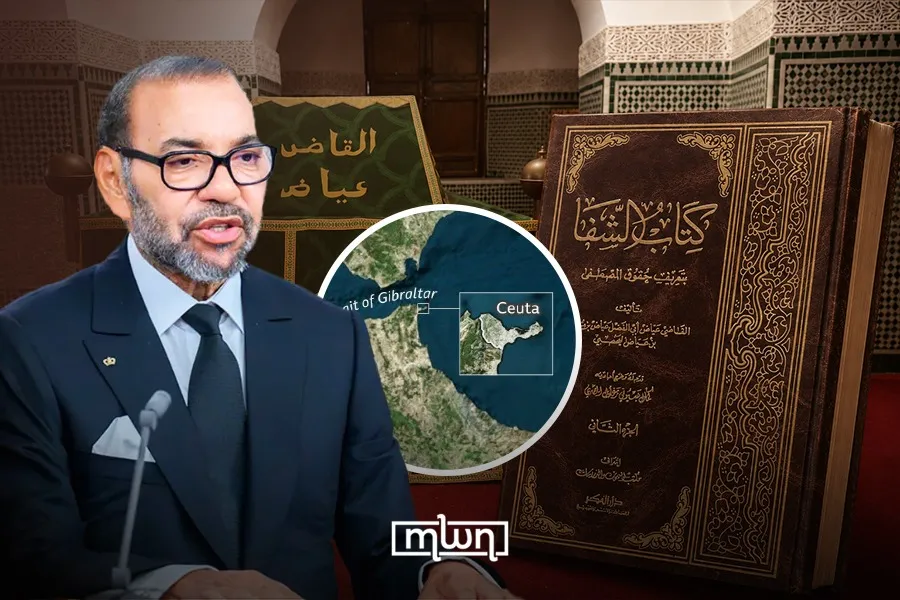

Fez, Morocco — A poignant mention of Ceuta during the Mawlid ceremony held on August 24 has brought to light the enduring legacy of one of the most influential scholars from the medieval Muslim West. King Mohammed VI, serving as the Commander of the Faithful, presided over the ceremony at the Royal Palace in Rabat. During this significant gathering, Minister of Endowments and Islamic Affairs, Ahmed Toufiq, presented an annual report detailing the activities of Morocco's scholarly councils. In his presentation, Toufiq highlighted the remarkable contributions of two scholars whose roots trace back to Ceuta: Qadi Iyad, renowned for his seminal work “Kitab al-Shifa” (The Book of Healing), and Abu al-Abbas al-Azafi, noted for “Al-Durr al-Munazzam” (The Ordered Pearls). This acknowledgment of their origins is a reminder of Ceuta's critical role in the intellectual heritage of the Muslim world.
This reference also resonates with a royal initiative announced in September 2025, where King Mohammed VI called for a critical edition of Iyad’s “Kitab al-Shifa” to commemorate 15 lunar centuries since the birth of Prophet Muhammad. Additionally, the king invoked al-Azafi’s work in relation to the Mawlid. Such royal endorsements not only honor these scholars but also prompt a broader inquiry into the life of Qadi Iyad and his ascendance as a prominent authority within Sunni Islam.
The Roots of Qadi Iyad
Cadi Ayyad, another variation of his name, is a figure familiar to many Moroccans, as the prestigious university in Marrakech bears his name. Yet, the nuances of his life and work remain less known. His full name is Abu al-Fadl Iyad ibn Musa al-Yahsubi al-Sabti, where the suffix “al-Sabti” connects him directly to Sabta, the Arabic name for Ceuta. Born in 476 AH, which corresponds to 1083 CE, Iyad grew up in a vibrant port city that served as a crucial link between Morocco and al-Andalus, facilitating the movement of merchants, pilgrims, jurists, and scholars across the Mediterranean.
Iyad began his studies in his hometown before venturing into al-Andalus around 1113 to enhance his knowledge of Maliki jurisprudence and hadith. His educational journey allowed him to engage with esteemed scholars from cities like Córdoba, Murcia, and Granada. Notably, he was in the scholarly orbit of Ibn Rushd al-Jadd, the esteemed Maliki jurist and grandfather of the philosopher known in the West as Averroes. Upon returning to Ceuta, Iyad eventually assumed the role of qadi, or judge, but his influence extended far beyond the judicial arena. His scholarly contributions, as analyzed in historian Janina Safran’s peer-reviewed work on Iyad’s “Al-Ghunya,” reveal a vast network of educators, texts, and scholarly connections that he helped to preserve, thereby maintaining the infrastructure essential for the transmission of knowledge.
The Enduring Impact of Qadi Iyad’s Scholarship
Qadi Iyad’s most significant legacy is encapsulated in his magnum opus, “Al-Shifa bi-Ta’rif Huquq al-Mustafa” (The Healing by the Recognition of the Rights of the Chosen One), commonly referred to as “Kitab Al-Shifa.” This work meticulously investigates the attributes and exalted status of Prophet Muhammad, outlining the obligations believers hold towards him, as well as exploring themes of reverence, theology, and law. The influence of “Al-Shifa” transcended the borders of Ceuta and has been the subject of extensive research, including a European Union-funded project aimed at tracing the manuscript tradition of this vital text from the 13th century to contemporary times.
Despite the political upheavals that marked Iyad’s life, including the rise and fall of dynasties and the shifting political landscapes of the Maghrib, his works continued to be revered, copied, and disseminated throughout generations. In addition to “Al-Shifa,” Iyad authored “Tartib al-Madarik” (The Arrangement of Perceptions), a comprehensive biographical account that documented the intellectual history of the Maliki school. His scholarly endeavors not only preserved the legal tradition but also connected successive generations of jurists to the foundational tenets of Moroccan religious life.
Qadi Iyad’s life was interwoven with the tumultuous political climate of medieval Morocco. His affiliation with the Almoravid order during the rise of the Almohad movement is well-documented, and his resistance during the political turmoil surrounding this transition has been the subject of scholarly inquiry. Although later narratives romanticize his final years as marked by persecution, historians approach these accounts with caution, recognizing the need to distinguish between legend and documented fact. This is particularly true regarding the claims that he ordered the burning of Abu Hamid al-Ghazali’s “Ihya Ulum al-Din,” a narrative that lacks substantial contemporary evidence.
Today, the connection to Ceuta enriches the narrative of Qadi Iyad’s legacy. More than 330 years after his death, when Portuguese forces captured the city in 1415, Ceuta transformed significantly, eventually falling under Spanish administration. Yet, the intellectual contributions of Iyad and his contemporaries remain integral to the historical discourse surrounding the region. The acknowledgment of Iyad’s significant role in shaping Islamic thought underscores that Ceuta was not merely a peripheral locale but a vibrant center of knowledge that produced influential ideas and texts.
In conclusion, Qadi Iyad, along with Abu al-Abbas al-Azafi, exemplifies the rich intellectual heritage of Ceuta, contributing to a broader understanding of Islamic scholarship. With his name immortalized in a major Moroccan university and his works still studied across the Muslim world, Qadi Iyad offers a profound insight into the medieval intellectual landscape. His legacy reminds us that knowledge and scholarship transcended geographical boundaries, enriching the fabric of Islamic thought and practice throughout history.
As reported by moroccoworldnews.com.