Understanding the Historical Significance of the Morocco War
The historian and writer Aquilino González Álvarez from Lugo asserts that the Morocco War has profoundly shaped the history of Spain. He has made this conflict the focal point of both of his novels, where he intricately weaves historical research with fiction, aiming to illuminate events that he believes remain crucial for understanding the evolution of Spain in the 20th century. González emphasizes, "This war is part of the misfortunes that befell Spain years later. The two factions that formed during this brutal, merciless conflict later reflected in the Spanish Civil War."
Aquilino González: A Journey from Tragedy to Historical Narratives
Aquilino González Álvarez, born in Lugo in 1966, experienced a life-altering event at the age of 23 when a severe traffic accident left him with tetraplegia. He pursued studies in Geography and History at UNED, complementing his education with several master's degrees related to communication and the management of European cultural heritage. Specializing in contemporary history, he has dedicated much of his research to the Morocco Wars (1909-1927). Besides being a historian, González is also a novelist and has published two works that aim to make complex historical events more accessible to the general public, often overlooked outside academic circles.
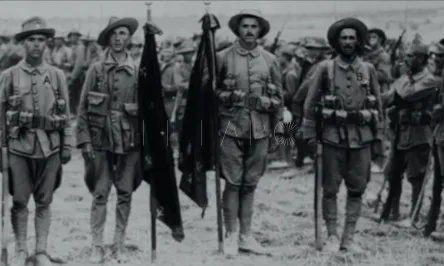
The first of his novels, 'Bajo la sombra de una gumía', memorializes a young soldier from Lugo who perished during the Annual Disaster, which resulted in the death of over eight thousand military personnel in just a few days, particularly from the renowned Alcántara Cavalry Regiment. This narrative begins within that context and delves into the subsequent events leading to Monte Arruit. On the other hand, his second novel, 'Con razón o sin ella', broadens the scope to encompass the narrative of the Spanish protectorate in Morocco, covering significant occurrences such as the rescue of Melilla and the Alhucemas landings. This work also addresses later battles and what is referred to as the 'campaign of retribution'.
In 'Con razón o sin ella', the protagonist is a fictional character—a disgruntled ex-guardia civil with a broken heart—who joins the Legion during the era when Millán Astray began establishing the “Tercio de Extranjeros.” González's narrative adeptly blends historical facts with both real and fictional characters, all the while maintaining a strong storytelling approach. He articulates, "I aim for it to be an engaging story, almost like an adventure novel, but well-researched. Real characters intermingle with fictional ones, yet everything is based on actual events."
The documentation process for his novels has been extensive, involving the study of Legion diaries, essays on the Morocco War, and historical materials from that time. This research has allowed him to construct a plot centered around a group of soldiers, reflecting the diverse backgrounds and personal circumstances found within the Legion—men from various conflicts such as World War I and the wars in Russia, alongside individuals with challenging personal histories. "People without homes, others with dark pasts. This amalgamation of characters truly represented what the Legion was about," he notes.
Beyond the historical narrative, González also introduces a deeper reflection within his work. He believes that his novels convey values such as camaraderie, honor, and sacrifice, while also portraying the extreme hardships and injustices of war. He reminds readers that the Morocco War was an 'unpopular conflict' in Spain, leaving a profound mark on society and the military. "It was a cruel, merciless war that affected an entire generation," he summarizes.
In his perspective, the events of those years not only elucidate the conflict in North Africa but also significant aspects of Spain's subsequent history, including the Civil War and the roles of certain military leaders who had connections to the protectorate. Regarding the reception of his books, González observes that they are beginning to resonate with readers, though he acknowledges that perceptions vary regionally. He remarks, "The mindset here in the north differs from that in the south regarding the Legion," which influences how historical novels are received. Nevertheless, he insists that once readers engage with his works, their reactions are generally positive, observing, "When people read them, they enjoy them and get hooked quickly."
As the interview nears its conclusion, González is asked whether the current international context could lead to situations similar to those depicted in his novels, especially concerning Ceuta and Melilla and the role of the United States in its relationship with Morocco. He responds cautiously, clarifying that "these are not the same times," although he admits uncertainty about whether certain geopolitical balances are entirely stable. "I want to believe that they are not," he states, referencing the potential for renewed tensions in these territories, while acknowledging the existence of international factors that might influence future developments.
Looking ahead, González intends to conclude this phase focused on Morocco and delve into the Spanish Civil War. In the meantime, he continues to navigate the realms of history, memory, and literature, striving to ensure that the events of the past are not confined to academic texts but reach any reader eager to comprehend them from a different perspective.
As reported by elfarodemelilla.es.