
The Disillusionment of Hopeful Migrants
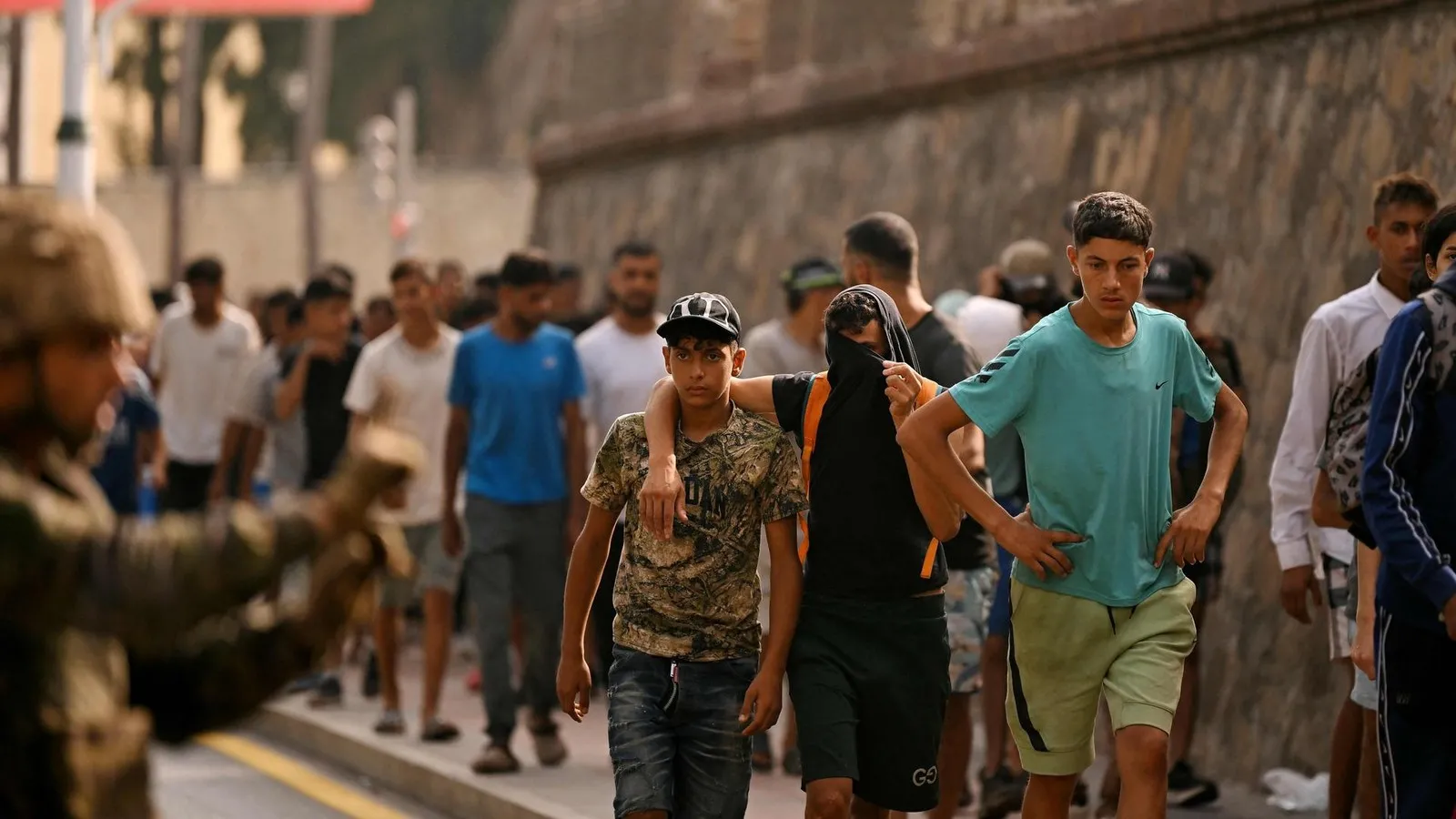
In a poignant display of despair, a stream of disappointed individuals trudges back towards the Moroccan border, many clad in torn pants and worn-out sneakers, while some are barefoot and others have bandaged limbs. Just two days prior, these men arrived in the Spanish exclave of Ceuta, filled with hope for a new beginning. Now, they find themselves retracing their steps back to Morocco, utterly exhausted, hungry, and stripped of their dreams. The once-hopeful vision of Europe has swiftly turned into a harsh reality. Countless young Moroccans recount a similar narrative: "We were told that we would be welcomed in Spain, but that was a lie." Many had anticipated registering in Ceuta, being placed in reception centers, and eventually being permitted to continue their journey to mainland Spain. This misinformation spread rapidly through social media channels in Morocco, fueling their hopes.
Upon arrival, the newcomers were confronted with an overwhelmed border town. The few reception facilities in Ceuta became hopelessly overcrowded in no time. Thousands were forced to sleep outdoors—in parks, on sidewalks, on beaches, or amidst the hills overlooking the city. Due to security concerns, numerous shops, bars, and supermarkets remained closed, leaving even those with money struggling to find food.
A Humanitarian Crisis Unfolding
A young couple from northern Morocco, accompanied by their small daughter, expressed their dismay: "We are going back because there is nothing to eat." A young man named Mohammed added, "No one has helped us. We were promised papers for Spain, and that was a deception." Thus, the largest migration wave Ceuta has ever witnessed came to an abrupt end, nearly as swiftly as it had begun. According to the Spanish Ministry of the Interior, more than 48,000 of the estimated 50,000 individuals who had entered the exclave irregularly since Thursday had already returned to Morocco by Saturday, with none allowed to proceed to the Spanish mainland. On that Saturday, a tense calm descended upon Ceuta as the border town struggled to return to normalcy, with no new crossings being recorded. The Moroccan security forces, who had largely vacated their checkpoints during the mass influx, have since resumed securing the border facilities.
On the Spanish side, workers began implementing a visible response to the crisis: a 500-meter buoy barrier is being installed at the El Tarajal beach border dam, intended to clearly delineate the border line even in the water. This development follows a ruling by Spain's Supreme Court, which stated that migrants arriving by swimming cannot be turned away immediately, as they have not crossed a physical border barrier. This ruling, which was recently made public, is believed to have contributed to the surge of irregular immigrants from Morocco, with most arriving by sea. In an effort to close this legal loophole, Madrid has initiated the installation of the buoys. Police divers continue to search for missing persons off the coast, repeatedly recovering bodies from the waters around the border dam. By Saturday afternoon, the death toll had risen to 67, as individuals tragically drowned while attempting to swim the short distance to the Spanish coast. This incident marks the deadliest migration catastrophe ever recorded at this border.
As the streets of Ceuta begin to empty, the remnants of the state of emergency are still evident everywhere. Trash piles up on sidewalks and in parks, while empty cans, yogurt cups, plastic bags, and remnants of clothing are scattered among the palm trees. Cleaning crews are working to restore order, but many shops and restaurants in the city remained closed even on Saturday. The mass movement of returnees also left a chaotic scene on the Moroccan side, with thousands stranded in the border town of Castillejos, searching for buses or taxis to take them back to their hometowns. Here, too, many businesses and restaurants remained shuttered out of fear of unrest.
The Spanish government interprets the return of immigrants as a sign that the measures negotiated with Morocco are proving effective. Madrid and Rabat had agreed to the rapid repatriation of irregular immigrants. Spain's Interior Ministry emphasized that not a single migrant had left Ceuta for the Spanish mainland. Simultaneously, Spanish Prime Minister Pedro Sánchez avoided public confrontation with Rabat, recognizing the importance of cooperation with the southern neighbor in securing the European external border. Instead of casting blame, he praised the reinvigorated collaboration with Moroccan authorities, blaming smuggling networks for the mass movement.
However, even after the crisis has subsided, the reasons behind the unprecedented mass influx remain unclear. According to the Spanish government, smugglers exploited the Supreme Court ruling to their advantage. In early July, the court had ruled out the immediate rejection of migrants arriving by sea to Ceuta. This prompted rumors on Moroccan social media that anyone who reached Spanish soil by swimming would automatically receive residency papers. The fact that approximately 50,000 individuals were able to make the journey from Morocco to Ceuta within just 24 hours cannot solely be attributed to this. Internal discussions within the Spanish government acknowledge that such a surge would likely not have occurred without at least some temporary passivity from Moroccan security forces. Some speculate that the escalation at the Moroccan-Spanish border in Ceuta may have been tacitly encouraged by Morocco. The North African country has long claimed Ceuta and its roughly 400-kilometer distant sister city Melilla, calling them "occupied territories". Spain has firmly rejected Morocco's claims, asserting that Melilla and Ceuta have been part of Spain for centuries.
Both cities, which Spain regards as "gates to Africa" and of significant strategic value for controlling the Mediterranean, are remnants of European colonial policy. Melilla was conquered by Spain over 500 years ago from the Arabs and has belonged to the Spanish crown ever since. Ceuta was initially seized by the Portuguese in the Middle Ages and fell under Spanish control in the 16th century, along with Portugal. Today, both garrison towns, which have been defended against Arab attacks throughout the centuries, have nearly 84,000 inhabitants each. However, the cultural influence of their Arab neighbors is palpable, with one-third of the residents in both Ceuta and Melilla being of the Islamic faith. Furthermore, the economies of these two Spanish outposts, which are part of the EU, are heavily reliant on their Moroccan neighbor.
As reported by abendblatt.de.