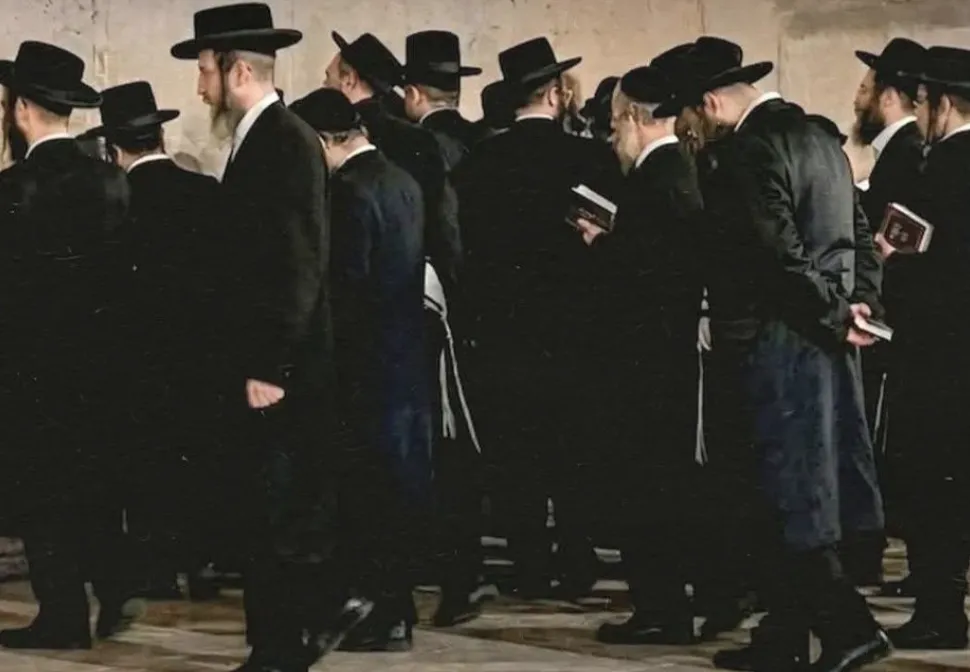
A recent and unusual scene in the heart of historic Marrakech has ignited a widespread debate that has transcended what many initially perceived as a mere incident. A group of ultra-Orthodox Jews (Haredim) gathered to perform collective religious rituals in front of the historic Bab Doukkala gates. This event quickly morphed into a catalyst for a broader discussion surrounding identity, normalization, and the fine line between coexistence and provocation.
As the sun rose on Wednesday, April 23, 2026, hundreds of citizens flocked to Bab Doukkala for a massive protest, brandishing banners denouncing what they termed the "Judaization of public space" and an attempt to replicate foreign rituals in a historically significant area. Social media platforms erupted with public anger, showcasing a sharp division in opinions and interpretations of the event and its implications.
Islamic Perspective: A Complete Crime
Among the prominent voices weighing in was Hassan Benajih, a leader in the Justice and Spirituality Movement, who contextualized the incident within a historically charged narrative. He referred to the destruction of the historic Moroccan Quarter in Jerusalem in 1967 and the subsequent demolition of the Bab al-Maghariba pathway in 2007 to facilitate settler incursions. Benajih asserted that what transpired at Bab Doukkala was not merely an innocent religious practice; in his view, it constituted a "complete crime" perpetrated by what he termed an "occupying gang of Palestine," aimed at provoking and mocking a population that stands firmly in support of the Palestinian cause. He framed the event as a continuation of the aggression that began in Jerusalem with the assault on Bab al-Maghariba.
Academic Perspective: Empty Show and Childish Reactions
On the contrary, academic Omar Sharqawi delivered a boisterous and sarcastic response, suggesting that the debate surrounding the incident "exceeds the bounds of reason." He expressed disbelief at those who would abandon their everyday concerns to defend a wall he described as "piss-soaked and drunk on alcohol." Sharqawi dismissed the protests as an "empty display," reminding critics that the walls of Bab Doukkala are far older and more entrenched than any individual's stance, citing its construction under the order of Lalla Massouda in 1557. He underscored that "the stone remains unchanged, and those who stand before it have no impact."
Beyond the incident itself, journalist Mustafa Benradi raised a more profound and alarming question: "Have we in Morocco become more divided since resuming relations with Israel?" He interpreted the scene as indicative of a dangerous and convoluted equation, whereby "your nationalism is now measured by how closely your position aligns with the official stance." He viewed this maneuvering as far from innocent, ultimately serving a purely Israeli objective of dismantling popular resistance and gradually normalizing relations from the elite down to the grassroots level.
What began as a scene in front of a historic wall has, in reality, unearthed delayed questions intersecting identity, memory, foreign policy, and public space. Between those who perceive the event as a blatant provocation that cannot go unchallenged and those who deem the reactions exaggerated and manipulated, lies a deeper crisis of trust that is plaguing Moroccan society. The lingering question remains: Where does the freedom of religious practice end, and the boundaries of shared space begin? What price is Morocco paying for its internal cohesion amid an extremely tense regional and international context?
As reported by febrayer.com.