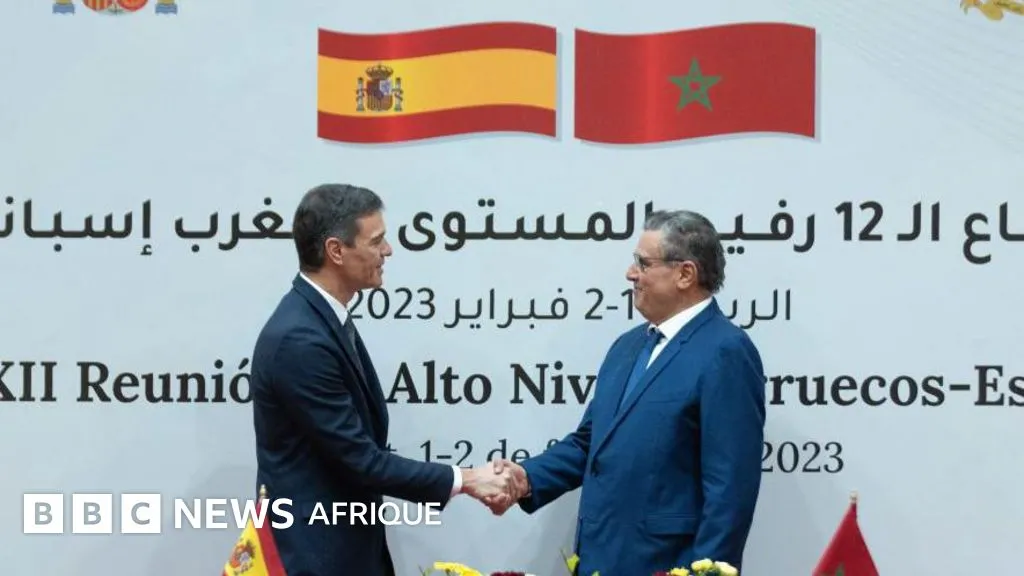

Understanding the Intricacies of Spain and Morocco's Diplomatic Relations
The relationship between neighboring countries is often fraught with complexities, and the ties between Spain and Morocco are no exception. Recently, thousands of migrants crossed from Morocco into the Spanish enclave of Ceuta, located in North Africa, highlighting the intricate diplomatic links between the governments of Madrid and Rabat. According to estimates from Spanish authorities, nearly 60,000 individuals managed to access Ceuta through land and maritime routes. However, reports indicate that over 48,000 of these migrants have already returned to Morocco. Tragically, it has been confirmed that at least 57 people drowned while attempting to reach Ceuta, a territory under Spanish control for centuries. The Spanish government has attributed these events to human trafficking networks that have exploited a recent ruling by the Spanish Supreme Court, which prohibits the deportation of individuals arriving by sea. In response, Pedro Sánchez’s government has commended Morocco's cooperation in curbing further crossings and facilitating returns. Nonetheless, questions have arisen regarding whether the Kingdom of Morocco, a constitutional monarchy led by King Mohammed VI, may have intentionally allowed this massive influx of migrants.
The Underlying Issues Influencing Spain-Morocco Relations
In light of a similar migration crisis that occurred in 2021, diplomatic tensions between the two nations had eased after Sánchez altered Spain's long-standing neutrality regarding the contested territory of Western Sahara and engaged in discussions with King Mohammed VI the following year. In December, after signing several agreements in Madrid, Sánchez and Moroccan Prime Minister Aziz Akhannouch asserted that bilateral relations were experiencing an 'excellent' phase. However, beneath this seemingly friendly surface lie deep-rooted points of friction, such as the status of Western Sahara, Morocco's claims over Ceuta and Melilla, and Spain's delicate balancing act between Morocco and Algeria, Rabat's regional rival. Additionally, the dynamics of immigration play a critical role; while Spain monitors its border, it heavily relies on Morocco's ability to actively prevent departures from its territory.
One of the primary issues at the heart of this relationship is the future of Western Sahara. Once a Spanish colony until 1975, Morocco claims this territory as its own, despite the fact that the United Nations has kept it on its list of non-self-governing territories since 1963. The Sahrawi independence movement, led by the Polisario Front and supported by Algeria, demands a referendum and the establishment of an independent state. In 2022, Sánchez's government shifted from Spain's historical stance of neutrality regarding Western Sahara, endorsing Morocco's plan to grant autonomy to the region while denying its independence. This pivot came after a significant migrant influx in May 2021, when Moroccan authorities relaxed border controls, leading approximately 8,000 individuals from Morocco and sub-Saharan African countries to enter Ceuta within just two days. This incident followed a controversy wherein Spain allowed a Sahrawi independence leader to receive medical treatment in a Spanish hospital, sparking a diplomatic row between Madrid and Rabat.
Another significant point of contention involves the Spanish enclaves of Ceuta and Melilla, which have been under Spanish rule since 1497 and 1668, respectively. Morocco has laid claim to these cities, but Madrid staunchly defends its sovereignty and refuses to negotiate. Unlike Western Sahara, Ceuta and Melilla are not listed by the UN as territories awaiting decolonization. The crisis in 2002 over the Perejil islet, which is situated just off the Moroccan coast but is under Spanish sovereignty, further illustrates the tensions that arise between these nations. In July of that year, the islet was occupied by Moroccan soldiers before being reclaimed by Spain in a military operation. Recent incidents, such as the mass migration into Ceuta in 2021 following Morocco's easing of border controls, have further exacerbated these tensions.
Lastly, the relationship between Spain and its historical rival, Algeria, adds another layer of complexity. Spain has historically sought to maintain a balance in its relations with these two major Maghreb powers. While Morocco is a crucial partner for Spain in terms of trade and migration control, Algeria serves as a significant supplier of gas and a primary international supporter of the Sahrawi independence movement. The shift in Spain's stance on Western Sahara in 2022, favoring Morocco's autonomy plan, sparked a severe diplomatic crisis with Algeria. Despite this, relations have begun to thaw, with Sánchez visiting Algiers and the two governments announcing a 'new phase' of cooperation. However, the recent surge of migrants into Ceuta, occurring just days after Sánchez's visit to Algeria, has led some analysts to speculate whether this could be a retaliatory measure by the Moroccan government.
As reported by bbc.com.