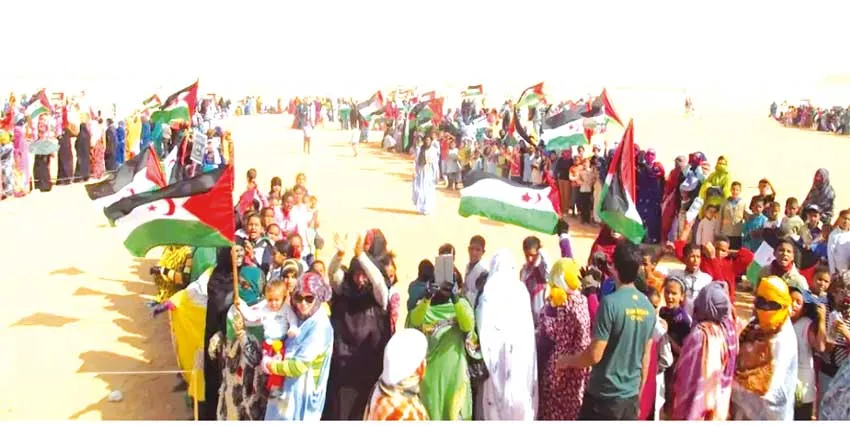

The 81st session of the United Nations General Assembly has once again served as a significant platform advocating for justice regarding the Sahrawi cause and the inalienable right of its people to self-determination and independence. This gathering has effectively dispelled the illusions surrounding Moroccan occupation and its maneuvers aimed at solidifying colonial realities in this disputed region. During the high-level general debate of the 81st UN General Assembly, the legal and moral responsibility of the international organization towards the Sahrawi territory and its inhabitants was firmly reiterated, practically nullifying Moroccan claims of sovereignty over the area.
In this context, the President of Namibia, Hage Geingob, reaffirmed her country’s support for the Sahrawi cause in her address to the assembly, emphasizing the urgent need for a fair and lasting solution that ensures the Sahrawi people's right to self-determination within the framework of the United Nations process. President Geingob highlighted that the UN bears the responsibility to facilitate a just and enduring resolution to the Western Sahara issue, in accordance with its charter and relevant resolutions concerning decolonization and the right to self-determination. Furthermore, she expressed Namibia's support for the mandate of MINURSO and the need for a UN-backed referendum in Western Sahara, allowing the Sahrawi people to exercise their right to self-determination.
The Sahrawi delegation in New York engaged in numerous meetings with heads of state and officials, renewing support for the Sahrawi people's right to self-determination and independence. In a meeting with the Sahrawi Minister of Foreign Affairs and African Affairs, Mohamed Yassine Bey, the President of Angola, João Lourenço, reiterated his country’s support for the Sahrawi people's right to self-determination and independence, aligning with the principles of the UN Charter and the foundational law of the African Union. Additionally, Bey held bilateral meetings with the Lesotho Minister of Foreign Affairs and International Relations, Limpho Tau, and the Cuban Minister of Foreign Affairs, Bruno Rodríguez Parrilla, both of whom reaffirmed their countries' principled and unwavering positions regarding the Sahrawi cause and unconditional support for the Sahrawi people's right to freedom and self-determination.
Unmasking Misinformation and Diplomatic Maneuvers
Despite the blatant diplomatic maneuvers undertaken by the Moroccan regime to rally international support for its colonial claims, including the purchase of favors from nations for a fictitious recognition of its alleged sovereignty over Western Sahara, the UN Secretary-General's report on Western Sahara, dated July 31, 2026, presented to the 81st General Assembly, reiterates that the Special Political and Decolonization Committee (Fourth Committee) of the General Assembly, and the Special Committee on the Situation with regard to the Implementation of the Declaration on the Granting of Independence to Colonial Countries and Peoples, address Western Sahara as a matter of decolonization. This report further underscores that Morocco's efforts to extract recognitions of its supposed sovereignty do not alter the legal status of the territory as one awaiting decolonization and do not undermine the decisions of the UN Security Council, which stress the necessity of adhering to the UN Charter and ensuring the right to self-determination for the territory's inhabitants.
Throughout this session, Morocco's representative attempted to impose unilateral proposals as a fait accompli, issuing misleading claims and attempting to distort the facts regarding the international status of the Western Sahara issue. The Sahrawi government viewed this as a continuation of the Moroccan regime's habitual tactics to divert domestic opinion from its profound structural crisis. In a statement released on Thursday, the Sahrawi government asserted that the Minister of Foreign Affairs of the occupying state tried to mislead member states by presenting his erroneous interpretation and selective reading of Security Council Resolution 2797. It is undeniable that the Security Council has not recognized any sovereignty of the Moroccan occupying state over the occupied Western Sahara and has not stipulated that the expansionist proposal of the occupying state is the only basis for a solution. Moreover, it has been confirmed that it was the Moroccan occupying state that violated the ceasefire on November 13, 2020, as indicated in the Secretary-General's reports.
Misleading Narratives of Occupation
In light of its expansionist policies, the Sahrawi government also highlighted the Moroccan regime's actions threatening regional and international security and stability by flooding the area with drugs and supporting and financing cross-border terrorist groups and organized crime. Furthermore, it pointed out that the occupying state’s minister neglected to discuss its alliances with the forces of evil in the world to threaten the security of its neighbors and the manipulation of its own citizens to destabilize the region and engage in political extortion. Consequently, the Sahrawi government warned that a state that continues to violate the principles and objectives of the UN Charter, pursues expansionist and occupation policies, and threatens regional stability lacks the political and legal legitimacy to hold a seat in a UN body primarily established to maintain international peace and security.
As reported by ech-chaab.com.