Unprecedented Bird Sightings in Morocco
In the spring of 2026, recent data released by the global monitoring platform eBird, affiliated with Cornell University, revealed extraordinary field recordings of numerous rare and endangered bird species across various regions in Morocco. Observers and ornithologists have documented the return of species previously thought to be locally extinct or critically endangered, highlighting a significant scientific event.
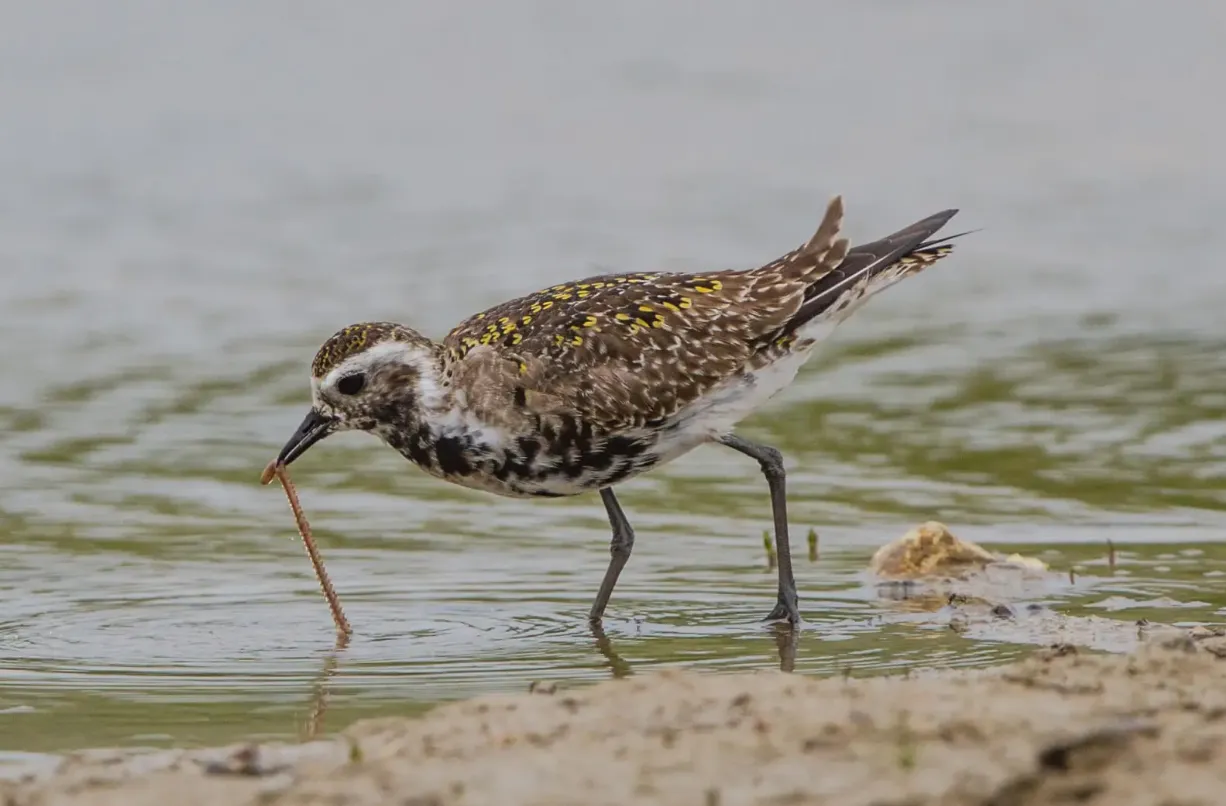
The sighting of a single American golden plover in the Meknes-Tafilalet region stands out as a noteworthy occurrence that raises questions about transcontinental migration pathways. This sighting may reflect changes in wind patterns or climatic conditions that have prompted this North American bird to appear in the heart of Morocco, an area outside its usual range. Similarly, the re-emergence of the globally threatened marbled teal, with sightings of two individuals in Meknes-Tafilalet and one in Souss-Massa, underscores the fragility of its presence, as this species relies on shallow wetlands that are experiencing continuous decline. This observation indicates that certain ecological pockets can still support this species despite increasing human pressure, thus emphasizing the importance of protecting these delicate habitats.
Significant Avian Diversity and Indicators of Environmental Health
In Meknes-Tafilalet, three individuals of the rusty duck were recorded, a species associated with open inland waters. Their early spring presence reflects a relative stability in some water bodies that have survived the severe droughts of recent years. In contrast, the common duck was also spotted in the same area with three individuals, indicating notable diversity within the same ecosystem despite climatic changes. Moving north to the Tangier-Tetouan region, a single sighting of the ferruginous duck, though minimal, carries significant scientific implications, as this species continues to face habitat loss, making any new sighting a vital indicator of the ongoing environmental threads. Alongside this, the green duck, a more common species, was also observed in the same area, playing a critical role in understanding the ecological balance among various bird species.
In Souss-Massa, where coastal and desert ecosystems intersect, a single sighting of the broad-billed sandpiper was recorded. This migratory bird relies on nutrient-rich wetlands, and its presence indicates favorable environmental conditions, even if temporarily available. Additionally, two individuals of the quail were noted in Souss-Massa, with one also found in Fez-Boulemane, signaling interactions with seasonal agricultural activities. In the Marrakech-Tensift region, the Barbary partridge made a reappearance with two individuals spotted, a local bird that faces pressures from hunting and habitat degradation, highlighting its current fragmented distribution. Four individuals of the spotted sandgrouse were recorded in Meknes-Tafilalet, a desert species requiring specific environmental conditions, suggesting relative stability in certain arid systems.
The crowned sandgrouse was noted with two individuals in Guelmim-Es Semara and another two in Meknes-Tafilalet, indicating a noteworthy geographical extension for this relatively rare species during this season. Concurrently, three cuckoo individuals were recorded in Marrakech, a migratory bird that relies on brood parasitism for reproduction, suggesting a precise environmental synchrony with other species. Nighttime observations included three individuals of the red-necked phalarope in Souss-Massa, a rare nocturnal bird, along with one Eurasian phalarope and four Egyptian plovers in Meknes-Tafilalet, reflecting unusual environmental activity for this species at this time, potentially linked to subtle climatic changes affecting migratory behavior.
Along the coast, four Eurasian oystercatchers were recorded in Souss-Massa, alongside three grey plovers, three ringed plovers, and two little ringed plovers, all species dependent on sandy shores, indicating relative balance in coastal ecosystems despite pollution and tourism pressures. A single stone curlew was also sighted in the same area, a shy species that is often difficult to observe. In wetland areas, the water hen was spotted in multiple locations, including Marrakech, Souss, and Tangier, while the Eurasian wigeon was recorded in the same regions, alongside the rare western sultan in Tangier, suggesting localized improvements in water quality.
The presence of wild pigeons was noted across various regions, with four European turtle doves sighted in Fez, Marrakech, and Souss, a species threatened by intense hunting. The presence of the collared dove in several areas reflects a variance in the status of closely related species. In the skies above, the common swift soared in Marrakech and Souss, alongside pallid and little swifts, all of which depend on flying insects, indicating rich ecological activity during this season.
This series of field observations at the onset of spring 2026 cannot be interpreted as definitive evidence of comprehensive ecological recovery; rather, they should be viewed as preliminary indicators within a broader scientific context that necessitates long-term temporal tracking and comparative analysis of data. The emergence of rare or nearly extinct species at specific points may reflect localized improvements in environmental quality, but it could also result from disturbances in migratory patterns or environmental pressures in other areas that have compelled these birds to alter their traditional routes.
As reported by lakome2.com.