
As Morocco prepares to elect its next government on September 23, 2024, the political landscape is charged with discussions surrounding the territories of Ceuta and Melilla. However, analysts indicate that a radical shift in the kingdom's foreign policy, especially regarding its relationship with Spain, is unlikely. While recent events in the autonomous city of Ceuta had fostered a somewhat positive atmosphere, experts caution that new challenges may arise in the coming months that could complicate bilateral relations.
In Morocco, foreign policy is predominantly shaped by King Mohamed VI and his inner circle, who are responsible for establishing priorities and strategies for international relations. Riccardo Fabiani, the North Africa director at the Crisis Group think tank, emphasizes the role of the king in maintaining coherence between the monarchy and government, as he appoints the Minister of Foreign Affairs. Currently, this position is held by Naser Burita, who has been in office since April 2017 and has a long-standing diplomatic career within the ministry. His continued tenure seems assured, given Morocco's significant international advancements, particularly regarding its primary cause: Western Sahara.
The Monarchy's Influence on Foreign Policy
The fact that the king appoints the foreign minister explains the scant mention of foreign policy in the electoral programs of governing coalition parties, as noted by Irene Fernández-Molina, a professor of International Relations at the University of Exeter and an academic council member at the Center for Contemporary Arab Studies (CEARC). Only the opposition Justice and Development Party (PJD), which opposes rapprochement with Israel, includes a minor section on foreign policy, but it is unlikely to achieve a surprising electoral outcome that would allow it to join the government coalition.
Current indications suggest a continuation of the existing coalition led by the National Independent Rally (RNI), under Prime Minister Aziz Ajanuch, along with the Authenticity and Modernity Party (PAM) and the nationalist Istiqlal Party. The uncertainty lies in whether the RNI will emerge at the forefront or if it will be the PAM, but experts like Fernández-Molina assert that there will be no substantial changes in foreign policy. The international agenda has been clear and consistent for years, with unmovable axes centered on the Western Sahara issue and the claims over Ceuta and Melilla, according to David Hernández, a senior non-resident researcher at the Royal Elcano Institute for the Middle East and North Africa.
Potential Challenges Ahead
Despite the expectation of continuity in foreign policy, there are several potential challenges that could strain Morocco-Spain relations in the upcoming months. Miguel Hernando de Larramendi, a professor of Arabic and Islamic Studies at the University of Castilla La Mancha (UCLM), warns that new obstacles may arise, such as the planned visit of the Moroccan royal family to Ceuta and Melilla, the approval of a law granting nationality to Sahrawis, and the potential visit of Algerian President Abdelmadjid Tebboune to Spain. The latter could coincide with a High-Level Meeting (RAN) between the two countries in Madrid.
Hernando de Larramendi recalls that during the only previous royal visit in 2007, there was a limited Moroccan response involving the recall of its ambassador. The nationality law for Sahrawis, while a sensitive topic linked to Western Sahara, may face delays in the Senate due to the majority held by the Popular Party (PP). Both Hernando de Larramendi and Hernández agree that a change of government in Spain could significantly impact bilateral relations. They point to the Moroccan Foreign Ministry's statement on September 10, which cautioned against being used as a scapegoat for political disputes and reiterated the immutable nature of geographic proximity.
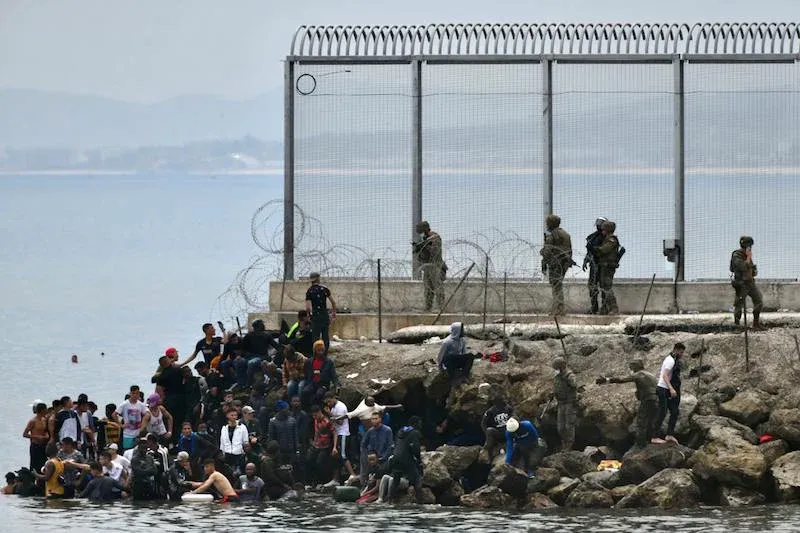
In light of these dynamics, the upcoming elections will be critical, particularly concerning voter participation, which has been declining and reflects societal disillusionment, especially among the youth. For Morocco, it is essential to restore its image as a reliable partner, not only for Spain but also for the European Union, following a decline in credibility due to recent events in Ceuta. As Hernández notes, the mass influx of migrants in late July served as a significant challenge to King Mohamed VI’s narrative, highlighting the increasing receptiveness among young Moroccans to the idea of leaving the country.
As reported by europapress.es.