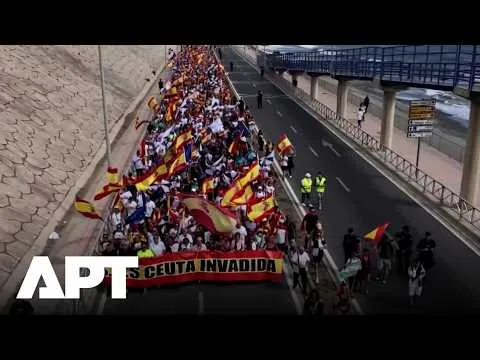
On September 23, Morocco will hold legislative elections that are set to be one of the most significant political events in recent history. With 27 parties vying for power and nearly 16 million citizens eligible to vote, these elections extend beyond the Maghreb region, as analysts suggest the outcomes could be pivotal for the current situation regarding Ceuta and Melilla.
These elections are characterized by a strong dissenting tone against the Alaouite monarchy's government, particularly among the youth who have been protesting for years over economic conditions, social control, and demanding an increase in personal freedoms. Although the government still relies on the monarch's approval, the results may influence whether Morocco continues to pursue its expansionist agenda in the region.
Complex Elections Ahead
This election cycle is marked by a high level of polarization, with a widespread rejection of the electoral process by Generation Z, who likely harbor doubts about the legitimacy of the results. According to a recent Afrobarometer survey, only 37% of young people aged 18 to 35 express confidence in Parliament, with similar levels of trust seen for the head of government, political parties, and municipal councils, all hovering around one-third. Many young Moroccans perceive higher levels of corruption among elected officials compared to older generations and are increasingly disengaging from traditional political channels, preferring social media and protests instead. Notably, over one-third of Moroccans indicate they do not intend to vote, with a study by the Moroccan Center for Citizenship revealing that 94.8% of 1,197 surveyed individuals lacked confidence in political parties.
The youth unemployment rate in Morocco stands at approximately 37%, according to data from the High Commission for Planning. Issues such as the cost of living, the quality of public healthcare and education, and perceptions of inequality have become central themes in the campaign, which have sparked significant protests organized by the GenZ212 movement. This movement emerged in response to the tragic deaths of eight pregnant women last September at the Hassan II Hospital in Agadir due to alleged faulty materials. Rallying under the slogan "we want hospitals, not stadiums," thousands of young people have mobilized to demand more rights and substantial improvements to their living conditions.
Similar to the "Cockroach Party" movement in India, these young activists utilized platforms like Discord and other social media to organize. Their distinguishing feature has been decentralized coordination: the movement's server grew from under 1,000 members on September 18 to over 130,000 by October 2, and then reached 260,000 during King Mohammed VI's speech to Parliament on October 10, all without a visible leadership that authorities could target. In response, the state enforced brutal repression and institutional censorship, leading to over 5,780 arrests, with 2,480 individuals facing judicial proceedings, of which 1,473 remain in preventive detention. The Moroccan Association for Human Rights has condemned these police actions as "security repression," highlighting systemic targeting of minors imprisoned in Tamesna. The government of Aziz Akhannouch has countered with announcements of social spending, yet these efforts have failed to quell mobilization, which also saw labor marches in June and July 2026 protesting rising prices.
Political Parties and Their Stance on Ceuta
Morocco's political landscape is distinctly divided into three blocs. The first consists of parties that have governed together since 2021, representing a continuity of the current system. The second is the formal opposition, prominently featuring the PJD (Party of Justice and Development). The third includes smaller parties and those who directly discredit the electoral process, viewing it as corrupt.
The Rassemblement National des Indépendants (RNI), now led by Mohamed Chaouki following Aziz Akhannouch's withdrawal, emerges as the leading force from the outgoing parliament with 102 seats. This party is pragmatic and closely aligned with economic interests, maintaining a low profile concerning Ceuta and Melilla during the campaign, as its priority lies in preserving stable relations with Spain, Morocco's primary trading partner. A strong RNI is generally associated with a more subdued approach and management style, likely resulting in fewer instances of migratory pressure as experienced in July.
The Parti Authenticité et Modernité (PAM), effectively led by Fatima Ezzahra El Mansouri (minister and mayor of Marrakech), holds the second position with 87 seats. This party is closely connected to the palace environment—founded by a personal friend of the king—and has been particularly vocal in its claims over Ceuta and Melilla, with several ministers asserting a "historical and geographical right" to these territories. Should PAM gain influence or lead the next coalition, an increase in combative rhetoric is anticipated. For instance, during an interview on public television channel 2M this August, Minister Abdellatif Ouahbi stated that "the issue of Ceuta and Melilla will remain a topic of dialogue between us and Spain, and we will maintain our historical right," calling for the establishment of a "dialogue commission" to facilitate the return of both cities to the nation.
The Istiqlal party, led by Nizar Baraka, represents the third pillar of the coalition with 81 seats. As a historic nationalist and conservative party rooted in reformist Islamic thought, Istiqlal has been the most explicit in its discourse regarding the "occupied cities." Baraka and other leaders have used strong language, asserting that Ceuta and Melilla must be reclaimed "under any circumstances" and that there can be "no steps backward."
In opposition, the PJD, led by Abdelilah Benkirane, seeks to recover from the significant losses it suffered in 2021, where it plummeted from 125 to just 13 seats after conflicts with the Alaouite monarchy. While the PJD maintains a strong nationalist stance regarding Ceuta and Melilla, its previous governance prioritized stability with Spain. The current narrative focuses on denouncing the "state control" or the "deep state," making it unlikely for their central agenda to revolve around claims for Ceuta or Melilla.
Other parties, such as the USFP, PPS, Popular Movement, and more radical left factions, hold less influence. Some leftist leaders have also referred to Ceuta and Melilla as "occupied cities," though their capacity to effect real political change is limited. The Justice and Spirituality movement calls for a boycott of the elections, asserting that they do not bring about any substantial change due to the palace's control over the process and subsequent governance.
In conclusion, while the September 23 elections are unlikely to disrupt the overarching strategy, they will provide a revealing snapshot of Morocco's political landscape. The anticipated high abstention rate among younger voters will indicate the extent to which the government operates with or without the support of a generation that has lost faith in the electoral process. Moreover, the distribution of seats among the RNI, PAM, and Istiqlal will determine whether Ceuta and Melilla remain issues of discreet management or escalate as political banners within the next government. Ultimately, both the election results and the tone adopted by Rabat will hinge not just on who wins, but on the margin of victory and the social legitimacy with which it is achieved. Therefore, rather than resolving issues immediately, the elections in September will serve as an indicator of Morocco's future priorities regarding the autonomous cities over the coming years.
As reported by eleconomista.es.