Highlights from the 58th Conference on Habitat and Francophonie
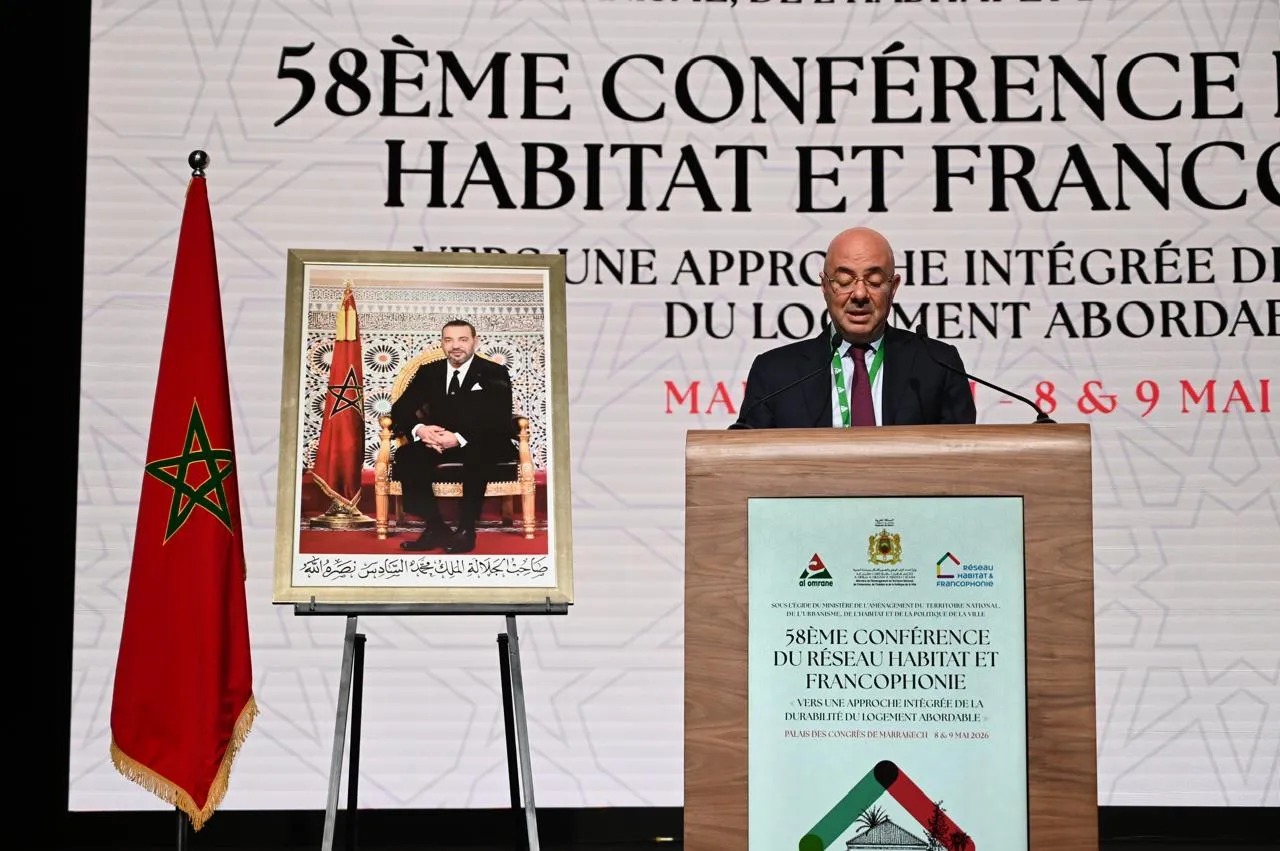
The 58th Conference of the Habitat and Francophonie Network (RHF) was inaugurated this Friday in Marrakech, under the auspices of the Ministry of National Land Planning, Urbanism, Housing, and City Policy. This two-day event brought together international experts, institutional leaders, and sector stakeholders to discuss the theme: "Towards an Integrated Approach to Sustainable Affordable Housing." This gathering, organized by the Al Omrane Group, underscores Morocco's growing role as a key player in international discussions concerning housing, urban planning, and sustainable territorial development.
The inaugural ceremony featured a speech delivered on behalf of the Minister of National Land Planning, Urbanism, Housing, and City Policy by Mr. Adib Benbrahim, the Secretary of State for Housing. This strategic address outlined Morocco's key housing directions and provided a comprehensive overview of the urban challenges faced by Francophone countries. The minister contextualized housing issues within a global framework characterized by rapid urbanization, land tensions, climate change effects, and persistent social inequalities. Affordable and sustainable housing is framed not merely as a technical or urban issue but as a significant concern for social cohesion, human dignity, and societal stability.
Integrated Approach to Territorial Development
One of the central messages of the minister's speech emphasized the need for an integrated approach to territorial development. The minister called for moving beyond traditional sectoral policies to adopt a comprehensive vision that connects housing, mobility, public amenities, quality of life, services, and territorial enhancement. This perspective is directly inspired by Royal High Directives aimed at reducing social and spatial disparities, placing the citizen at the heart of public policies. According to the minister, this integrated vision forms the foundation of Morocco's public action in housing and territorial planning, striving to create a housing policy that harmonizes economic development, social justice, and environmental sustainability.
The minister also provided statistical insights into public policies implemented in recent years. Since 2004, nearly two million citizens have been relocated as part of programs combating substandard housing, while 62 cities have been declared free of slums, with a clear goal of complete eradication by 2028. Furthermore, the direct housing assistance program launched in 2024 was highlighted as a significant public action reform, benefiting over 95,000 low-income households and middle-class families through a fully digitized process founded on transparency and direct support for citizens.
Additionally, the environmental aspect of the Moroccan strategy was underscored, with the construction sector now recognized as a central lever for energy transition. The nation is focusing on constructing energy-efficient buildings, supported by a national label awarded to structures meeting specific energy performance criteria. Urban planning received particular attention, with nearly 90% of the national territory currently covered by urban planning documents, reflecting Morocco's commitment to anticipating territorial changes and managing urban expansion effectively.
The rehabilitation of historical medinas was also identified as a strategic pillar of Moroccan public policy. Programs in cities such as Marrakech, Fès, Rabat, and Essaouira illustrate a commitment to preserving heritage while enhancing living conditions and stimulating economic activity in these areas. Finally, the minister addressed the Al Haouz earthquake, viewing it as a real-world test of the Kingdom's territorial resilience. The reconstruction program benefiting over 60,000 families represents a new model of territorial governance based on coordination among public institutions, local authorities, and grassroots operators.
Through this exchange of experiences, Morocco aimed to project an image of a developmental model rooted in territorial integration, social cohesion, and sustainability. This vision is now positioned at the core of Moroccan authorities' aspirations for cooperation within the Francophone community, in a global context where housing emerges as one of the principal strategic challenges for the coming decades.
As reported by lareleve.ma.