Moroccan Watermelon Gains Traction in European Markets
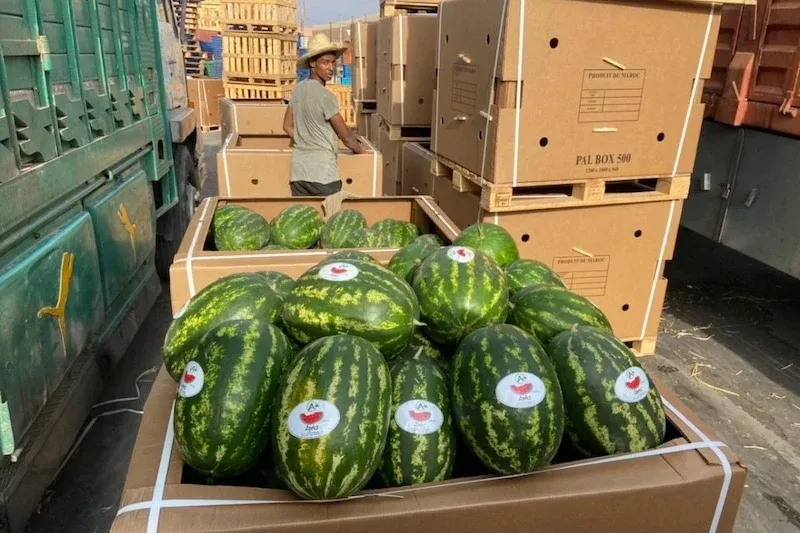
Moroccan watermelon has established a significant presence in European markets, having commenced its marketing phase for the 2025-2026 season just a few weeks ago. This trend is expected to continue until the upcoming summer, ensuring a steady flow of exports. Despite facing challenges in production, industry players assert that Moroccan watermelon remains a strong competitor against Italian and Mauritanian products, which tend to enter the European markets earlier. The quality of Moroccan watermelon is cited as the key factor that upholds its competitive edge.
Recently, watermelons from the regions of Dakhla and Zagora have made their way to European shores, and it is anticipated that the export dynamic will be further bolstered in the coming weeks by products from Souss, Rahamna, Chichaoua, and other areas, thanks to staggered harvesting schedules. Habib Najmi, a commercial representative at the international Rungis market for fruits and vegetables in France, noted that the marketing of Moroccan watermelon has been underway for over three weeks, starting with the Dakhla and Zagora growers. He mentioned that although the volume of exports is satisfactory, it has not yet reached the expected figures.
Najmi elaborated that climatic fluctuations affecting various regions of Morocco, such as flooding, heavy rainfall, and hail, have had some impact on watermelon growth, which thrives in warmer conditions. As a result, larger sizes, which are in high demand in Europe, are not as readily available this season. He anticipates that Moroccan watermelon will continue to enter European markets until August, particularly varieties produced around Taroudant, Chichaoua, Rahamna, and parts of Safi and the western regions.
Additionally, Najmi highlighted that the entry of Moroccan produce into European markets follows the conclusion of the marketing period for its Mauritanian counterpart, which benefits from earlier growing conditions in Mauritania. Moroccan watermelon is renowned for its exceptional quality, although it occasionally faces challenges related to pests—a global issue rather than one confined to Morocco. He affirmed that in European markets, prices are intrinsically linked to quality, as customers typically seek high-quality goods.
Despite moderate demand levels, which reflect a broader trend across European markets—not solely in France—Najmi stated that the Italian product will soon enter the market. Nevertheless, Moroccan produce retains its customer base and occupies a prominent position, especially in the French market, allowing it to outperform its Italian counterparts that will continue to be marketed until early June. This competitive advantage underlines the resilience and reputation of Moroccan watermelon in the European agricultural landscape.
As reported by hespress.com.