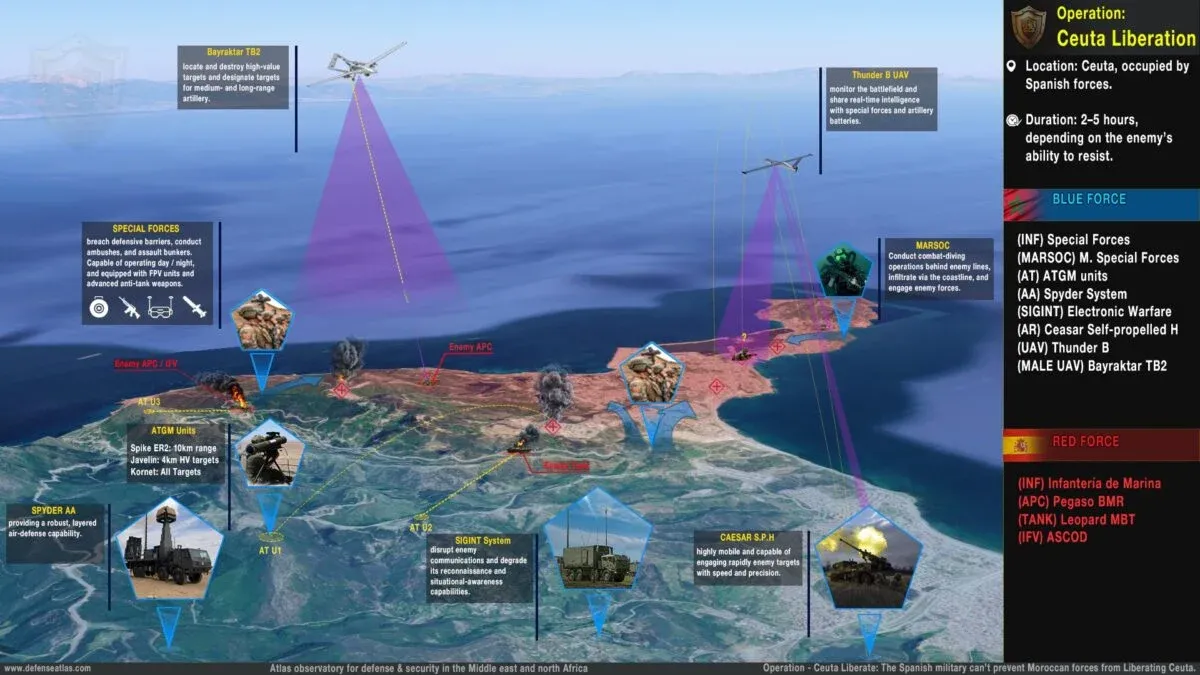

A provocative narrative has emerged from a Moroccan propaganda platform, which has outlined a bold strategy to conquer the Spanish city of Ceuta in less than five hours. This plan, named Ceuta Liberation, was released by Defense Atlas, a media outlet that brands itself as an 'Atlantic Observatory for Defence and Armament'. The publication includes a comprehensive mix of a website, forum, magazine, and radio station, all dedicated to military affairs.
The document asserts that Moroccan forces could take control of Ceuta within a time frame of 'two to five hours' by employing Bayraktar TB2 drones to eliminate key targets. Following this aerial bombardment, special forces would reportedly breach border defenses and launch a ground assault on the city, supported by anti-tank missiles, self-propelled artillery units, and air defense systems. Illustratively, the plan uses color-coded maps to depict Spanish military forces in red and Moroccan forces in blue, showcasing mobile anti-tank guided missile (ATGM) units with American-made Javelin launchers positioned in the hills, while Caesar self-propelled howitzers provide artillery support against Spanish defenses.
The envisioned invasion is characterized not by overwhelming infantry, but rather by targeted strikes from Morocco's elite special forces, tasked with breaching defensive barriers, executing ambushes, and assaulting fortified positions. According to Defense Atlas, military assessments and preliminary security analyses suggest that the Spanish army would be incapable of thwarting any Moroccan military initiative directed toward these so-called 'occupied cities'. They claim that the Moroccan armed forces possess the capability for rapid deployment within Ceuta in a manner that is sudden, swift, and overwhelming, utilizing advanced electronic warfare technologies and effective engagement strategies against opposing forces, all while ensuring the safety of civilians caught in the conflict.
While no concrete ties to Morocco's Royal Armed Forces have been established regarding Defense Atlas, and the authenticity of the plan remains unverified as a reflection of official military strategy, its publication aligns with an unsettling escalation of rhetoric from Moroccan officials. This week, two ministers in King Mohamed VI's government rekindled Morocco's historical claims to Ceuta, with Justice Minister Abdellatif Ouahbi asserting on state television that the cities of Ceuta and Melilla should 'return to the bosom of the homeland'. He characterized Morocco's stance as a 'historic and geographic right' and advocated for the establishment of a joint commission to negotiate the future of these territories.
In a subsequent event, Religious Affairs Minister Ahmed Toufiq, during a ceremony celebrating the birth of the Prophet Mohammed, referenced two Islamic scholars from Ceuta and further alluded to the historical figure Al-Jazuli as a symbol of 'liberation of the occupied cities'. Analysts have interpreted these remarks as intentional, suggesting they were crafted to resonate with the king and the public during a significant religious occasion.
In response to these claims, the Spanish government has firmly rejected them, with sources from the Foreign Ministry expressing that the 'Spanishness of Ceuta and Melilla is beyond any doubt'. Defence Minister Margarita Robles emphasized during a visit to Ceuta that both cities 'are not to be touched' and are 'thoroughly Spanish', even as the Interior Minister, Fernando Grande-Marlaska, has continued to acknowledge Rabat's cooperation concerning the return of migrants.
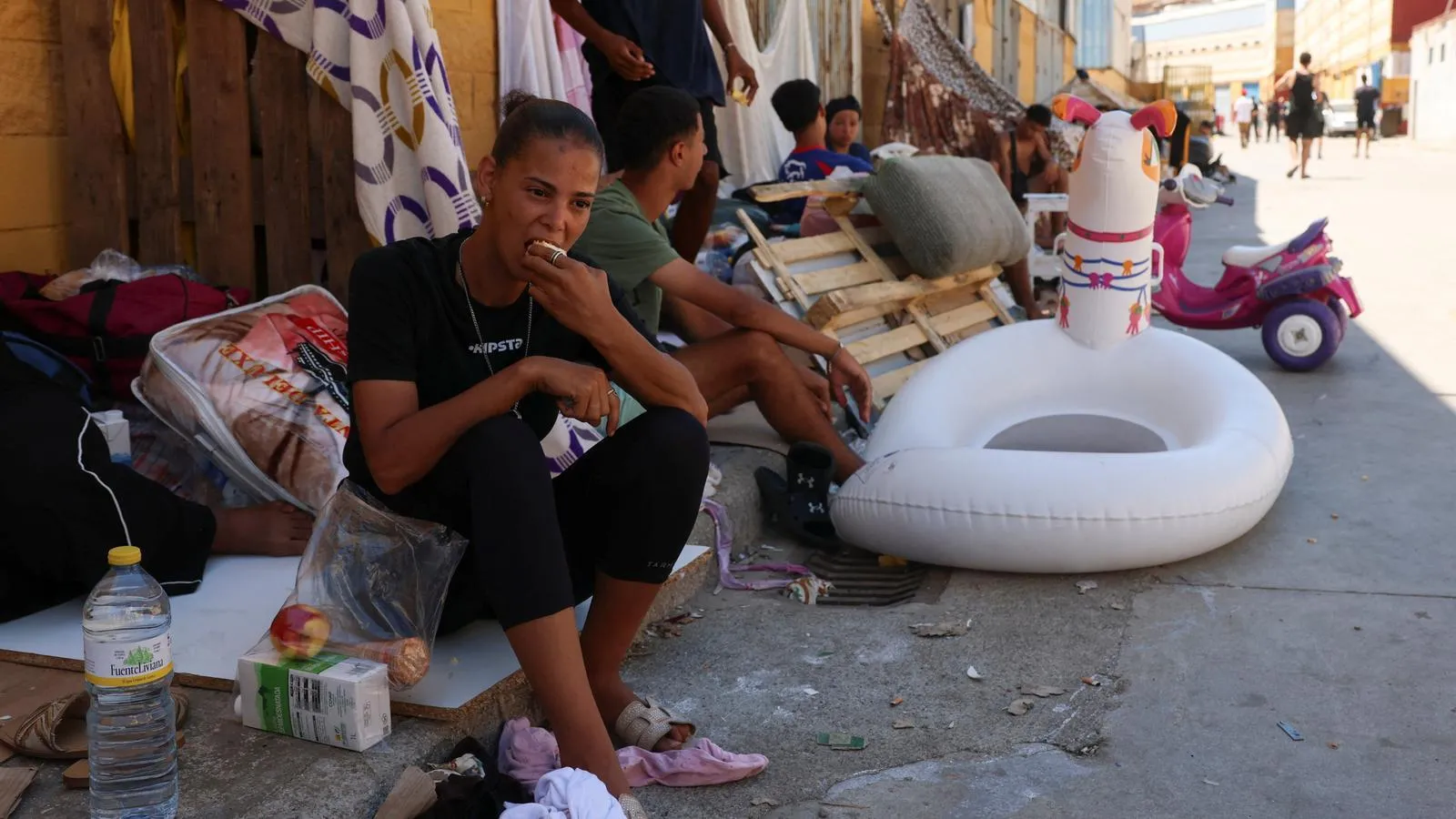
The emergence of this propaganda narrative and ministerial rhetoric follows the mass influx of migrants into Ceuta on July 30, an event that has spurred Moroccan commentary questioning Spain's capacity to maintain control over the city. This surge in rhetoric and military posturing coincides with Morocco's upcoming parliamentary elections on September 23, a vote that the governing coalition has framed, in part, around the promise of reclaiming these territories. As Morocco prepares for the polls, the rhetoric continues to escalate.
As reported by theolivepress.es.