The ongoing discussion in Morocco revolves around a recent incident where a group of Jewish tourists performed religious rituals in an open space near the historic wall of "Bab Doukkala" in Marrakech. This situation has sparked a divide among the public, with some viewing it as a normal expression of religious freedom, while others perceive it as a provocative act that offends Moroccan sentiments, particularly in the context of heightened international tensions related to the Palestinian issue and ongoing violence.
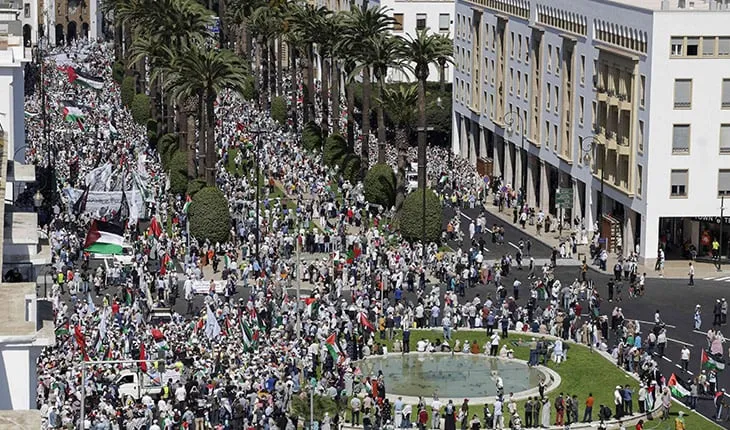
The incident unfolded when a bus carrying foreign Jewish individuals stopped, and they began to engage in collective prayers adjacent to the historical wall. This scene quickly circulated on social media, prompting significant public reaction and leading hundreds of citizens to participate in a protest organized by the "Moroccan Front for Support of Palestine and Opposition to Normalization." The demonstrators raised slogans condemning what they described as "provocative and normalizing practices," chanting phrases like "the people want to end normalization" and "stop the execution of prisoners."
In response, Jackie Kadouch, the head of the Jewish community in Marrakech, sought to clarify the circumstances surrounding the event. He explained that the individuals who prayed were "Haredim" Jews visiting from abroad and that their actions fell within their routine religious practices, particularly the obligation to perform three daily prayers. Kadouch noted that the timing of their prayers coincided with their location outside of synagogues, emphasizing that there was no intention to provoke or conduct any extraordinary rituals.
However, this explanation did little to quell the rising criticism. The "National Working Group for Palestine" expressed its strong condemnation of what they termed "deliberate audacity," asserting that such practices extend beyond religious freedom to provoke Moroccan feelings. They labeled the incident as indicative of what they called a "Zionist infiltration" into public spaces and called for an end to all forms of normalization, demanding accountability from those who allowed the incident to occur.
The civil entity voiced its disapproval of the authorities' silence regarding this behavior, which they believe falls under the neglect of national sovereignty. They asserted that normalization and relations with what they described as a criminal entity pose a genuine threat to Moroccan security, urging officials to swiftly put an end to this trajectory and sever all relations with the Israeli state.
The discourse surrounding the incident highlights a complex interplay between religious freedom and social sensitivities. Mohamed Hamdaoui, a member of the political circle of the "Justice and Spirituality" group, remarked that the event represents a "serious provocation and violation of Morocco's sovereignty." He noted that mimicking rituals from the "Buraq Wall" in a historic Moroccan space is not an innocuous religious practice; rather, it carries symbolic and political implications, particularly in light of the escalating aggression against Palestinian territories, which exacerbates societal tensions and fuels public anger.
In a legal and cultural analysis, poet Nofal Said emphasized that Morocco's public space is not entirely neutral, unlike in some Western countries. He argued that it is governed by religious and identity symbolism under the institution of "Imarat al-Mu’minin," which frames religious matters. This makes the practice of rituals outside this framework susceptible to various interpretations, potentially crossing from personal observance to disturbing the symbolic public order.
Moreover, researcher and civil activist Mohamed El Massoui sparked a parallel discussion on the historical backgrounds associated with Judaism in Morocco, affirming that the presence of the Jewish faith in the country is ancient but pertains to Moroccans who converted to Judaism, rather than an ethnic Jewish presence. He criticized what he described as "Zionist narratives" being propagated without historical scrutiny, particularly in the context of identity being employed for political ends.
In a similar vein, Moroccan writer Salah Bousrif argued that the incident constitutes a clear provocation to Moroccan sentiments. In an article published in the Moroccan newspaper "Al-Masaa," he questioned the motivations behind conducting such rituals in public at this specific time, pointing out that Moroccan Jews have historically been part of the social fabric without engaging in such practices. Bousrif highlighted that the current context, especially related to events in Gaza, renders these actions particularly sensitive and impactful.
Similarly, Aziz Henawi, the secretary-general of the "Moroccan Observatory Against Normalization," criticized the incident as part of a series of events raising questions about what he termed "attempts at Judaization" in certain locations, calling for vigilance and resistance against anything that threatens national identity. Meanwhile, journalist Younes Zouhir advocated for an investigation into the incident to uncover its circumstances and assign responsibilities. He affirmed that while freedom of belief is guaranteed, it should not infringe upon public sentiment or exploit the sensitive geopolitical context, reminding that the historic wall of Marrakech symbolizes a cultural heritage and national identity that must be preserved.
As reported by alquds.co.uk.