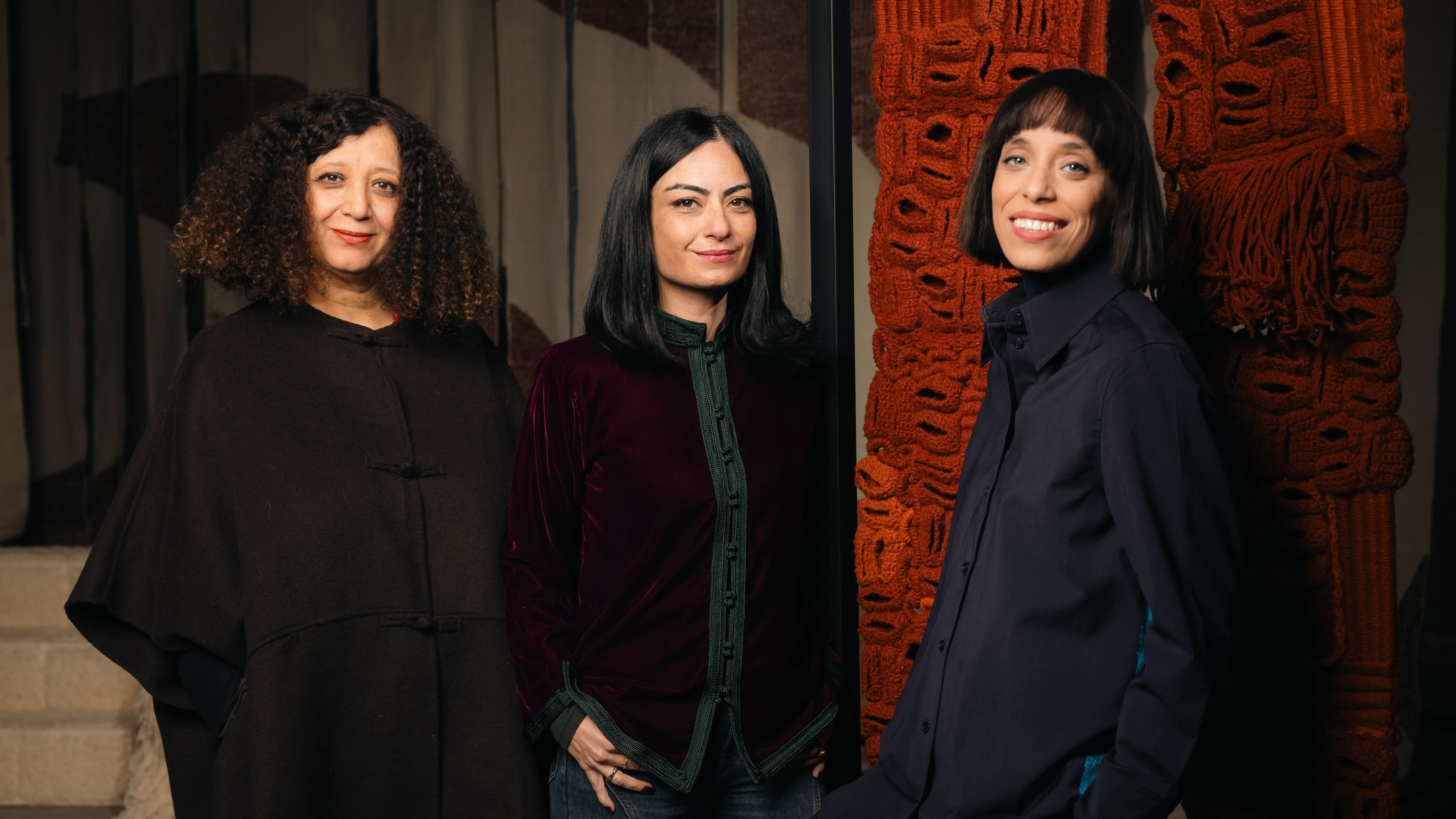
After a week of refreshing spring showers in Marrakech, the sun graced the morning of my visit to the talented artist Amina Agueznay, whose creative studio and archives are nestled to the north of the city's vibrant center. As I approached her atelier, adorned with lush fuchsia bougainvillea and framed by swaying palm trees, Agueznay greeted our small group from the upper terrace, inviting us to explore her captivating world.
Upon ascending the beautifully tiled outdoor steps, we were welcomed by an impressive array of large, intricately woven artworks displayed in a natural setting. The collection featured fibrous raffia artfully arranged to emphasize subtle block patterns, elongated panels dyed in rich hues, and complex openwork designs echoed in zigzags and circles. Among these creations lay a shaggy off-white cubic ottoman reminiscent of a playful puli dog, showcasing Agueznay's exceptional ability to blend textures that tell stories.
With a warm smile, Agueznay welcomed us, offering Moroccan tea and almond cookies, as she expressed her enthusiasm for making her debut at the Venice Biennale a resounding success. This year marks a significant milestone for Agueznay and Morocco, as the country will be hosting its first official national pavilion at the Arsenale during the 61st International Arte Exhibition, opening on May 9. Though Morocco previously participated in the Architecture Biennale and smaller exhibitions in 2005 and 2009, this occasion marks its inaugural national representation. Agueznay has been appointed to showcase her country's artistry alongside curator Meriem Berrada; this collaboration, while rooted in years of partnership on various projects, is their most ambitious undertaking yet, bolstered by a talented team of women artisans and professionals.
Highlighting the importance of collaboration, Agueznay shared her gratitude for the 166 artisans from various Moroccan regions who have contributed to the project. "Without them, there wouldn’t be a Biennale," she remarked, her voice tinged with emotion. "I wish they could all come to Venice, but we will celebrate in Marrakech instead." Over the two days spent with Agueznay, it became evident that she is passionately invested in this endeavor, recognizing the honor it represents while also feeling the weight of responsibility it entails. Her journey as an artist is deeply personal, shaped by her upbringing as the daughter of a Moroccan artist mother and a father who practiced medicine, her architectural training in the United States, her pivot to jewelry making, and her commitment to collaborating with traditional artisans.
Agueznay embodies the essence of Marrakech's rich cultural landscape, which is reflected in attractions like the Jardin Majorelle and the Yves Saint Laurent Museum, as well as in the city's dynamic independent art scene. She serves as an inspiring figure, bridging traditional craftsmanship with contemporary artistic expression. "To be an artist is a calling, but also a full-time job," she explained during our conversations, emphasizing her role as an "artisan-creator" working with public institutions and regional development agencies to elevate artisan crafts.
The theme for this year’s Biennale, "In Minor Keys," conceived by the late curator Koyo Kouoh, invites artists to delve into nuanced narratives. This aligns with the intricate symbols and stories woven into Agueznay's artistic vision. Her pavilion, titled "Asetta," which translates to ritual weaving in the Amazigh language, employs weaving and other crafts as an immersive metaphor for cultural transmission. This concept encompasses spatial elements, intangible knowledge, and skill-based practices, such as basket weaving and silversmithing, illustrating the deep ties between craft and cultural identity.
Despite facing logistical challenges that delayed the shipment of approximately 90% of her artwork to Venice, Agueznay compensated with an engaging display of pavilion prototypes, previous works, and a treasure trove of materials, including beads and textiles. While her architectural practice may be behind her, Agueznay remains deeply connected to the principles of materiality and scale, envisioning her 300-square-meter pavilion filled with over 200 intricately woven bands suspended from the ceiling, crafted from naturally dyed wool sourced from Tiflet. Some bands will feature tactile elements akin to low-relief sculptures, while other parts of the pavilion will showcase small beaded creatures that reflect Venice’s cultural heritage.
Visitors will find a designated area for reflection, but Agueznay anticipates that many will meander through the space, perhaps unaware of the gold embedded within the walls. Since returning to Morocco in 1997, she has infused her artistic journey with talismanic qualities drawn from her jewelry-making roots, stating, "At a certain point, the piece leaves the bodies and enters the space." This perspective adds profound depth to her work, evoking a sense of protection and reverence.
Throughout her practice, Agueznay emphasizes sacred femininity, evident in her use of henna to create womb-like shapes and in collaborative pieces with women artisans that evoke memories of the natural world. She carefully respects each artisan's unique technique, believing in the importance of honoring their craft. "I won’t ask them to change their technique. Who am I to do that?" she mused, highlighting her commitment to preserving traditional methods.
According to the pavilion’s commissioner, Mohammed Benyaacoub, Morocco's participation in the Biennale signifies a cultural awakening, with public officials recognizing the value of their rich and diverse heritage. Berrada, a confident and stylish art director at the Museum of African Contemporary Art Al Maaden in Marrakech, further emphasized Agueznay's vision, noting that her work is a testament to the immense creative potential that exists within the country.
As Agueznay continues to nurture her artistic practice from her base in Casablanca, where she lives with her husband and looks after numerous cats, she remains deeply engaged with her community. Her dedication to fostering the next generation of artisans is evident, as she passionately advocates for the continuity of traditional crafts. "At some point, you sit down and say, ‘Maybe this is my calling.’”
As reported by vogue.com.