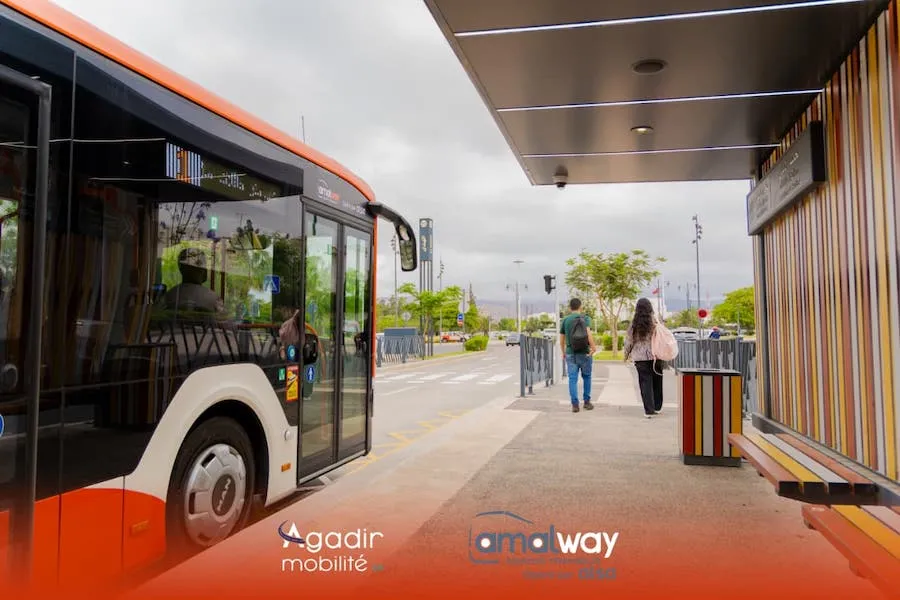
The city of Agadir has officially launched its first High-Level Bus Service (BHNS), a significant initiative that is part of the Urban Development Program (PDU). This project, spearheaded by the Local Development Company Agadir Mobilité, has emerged from a robust institutional partnership involving the Ministry of the Interior, the Souss-Massa Region, the Grand Agadir Territorial Collectives Group (GCT), the Agadir Municipality, and several public and institutional contributors committed to transforming the capital of Souss.
The 'Amalway TRAMBUS' project is distinguished by its adherence to international quality standards, providing an efficient alternative to private vehicles. Thanks to dedicated lanes, the BHNS ensures remarkable regularity and high frequency, even during peak hours. Passengers benefit from enhanced security through a permanent video surveillance system at stations and onboard, alongside optimal comfort offered by modern, air-conditioned vehicles that are accessible to individuals with reduced mobility.
On a technical level, the inaugural line spans a strategic route connecting the Port of Agadir to the Tikiouine neighborhood. Key components of the project include the establishment of 35 modern stations, the construction of a state-of-the-art maintenance and storage center, and the complete refurbishment of urban facades and green spaces along the route. Additionally, the project features a real-time passenger information system and electronic ticketing to ensure a seamless user experience.
Beyond enhancing mobility, this initiative serves as a catalyst for urban redevelopment. The deployment of the Amalway TRAMBUS has led to unprecedented improvements in the cityscape, including the renovation of major thoroughfares, widening of sidewalks, and creation of new green spaces. This transformation not only elevates Agadir's tourist appeal but also reclaims public space for pedestrians, fostering a more aesthetic and harmonious urban environment.
To maximize transportation efficiency across the greater Agadir area, special attention has been given to intermodality. The BHNS line is designed to act as the backbone of the network, seamlessly connecting with existing bus lines and future exchange hubs. This integration allows users to make smooth and rapid transfers, facilitating access to employment centers, university zones, and recreational areas.
The financing of the project is structured through a partnership involving multiple stakeholders, including the Transport Reform Support Fund (FRAT), the Souss-Massa Region, the Agadir Municipality, and the French Development Agency (AFD). Indeed, the realization of this world-class infrastructure has benefited from the financial and technical support of the AFD. As a strategic foreign funder, the AFD is backing Agadir's transition to sustainable and low-carbon mobility. This partnership exemplifies international confidence in Morocco's urban modernization strategy and underscores a shared commitment to reducing carbon footprints and enhancing citizens' quality of life.
According to Madame Catherine BONNAUD, Director of the AFD in Morocco, "The BHNS of Agadir illustrates what we aim to promote through our funding at AFD: mobility projects that concretely improve the lives of residents while supporting the low-carbon transition of cities. This project is part of a long-term partnership that AFD has been building with Moroccan public actors for over three decades. Amalway is one of the most concrete and structuring achievements of this collaboration." As reported by snrtnews.com.