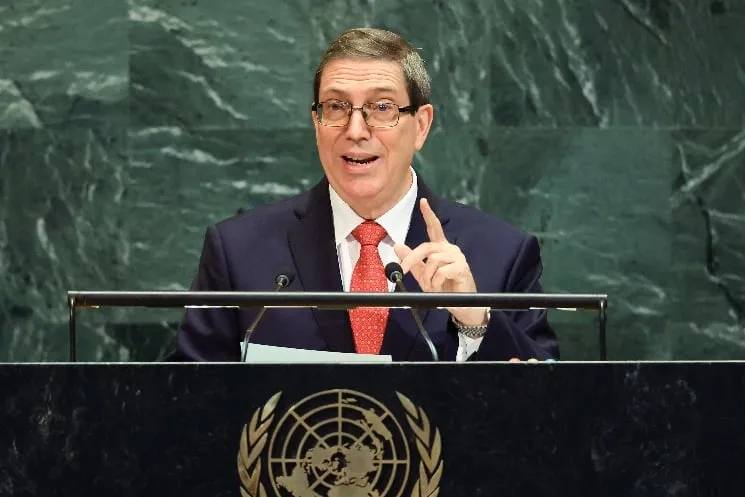
The United Nations recently witnessed a significant moment as the United States failed in its attempt to block a discussion regarding the long-standing economic embargo it has imposed on Cuba. The majority of UN member states voted overwhelmingly in favor of opening the debate on these extensive sanctions that have burdened the Cuban economy for decades. During a session held on July 7th, 136 countries supported the motion to discuss the embargo, while only 9 countries, including the United States and Morocco, voted against it. Additionally, 30 countries chose to abstain from the vote.
Following the vote, a lengthy session ensued, featuring numerous speeches that predominantly criticized the ongoing American embargo, which has been in place for over sixty years. Cuba had requested the inclusion of a specific agenda item to discuss the economic, trade, and financial sanctions imposed on it within the annual agenda of the General Assembly. The tensions between Washington and Havana have escalated recently, as the United States has implemented restrictions on fuel shipments, accompanied by a series of additional sanctions, exacerbating the living crises on the island, including power outages and severe shortages of essential goods.
The eight countries that supported the American stance included Israel, Argentina, Paraguay, Costa Rica, Morocco, the Czech Republic, North Macedonia, and Ukraine. Notably, Morocco's position in this vote marks an unprecedented shift in its diplomatic behavior; historically, Rabat has consistently voted in favor of UN resolutions advocating for the lifting of the embargo on Cuba or, at the very least, abstained from voting, as affirmed by a journalist who has been closely following Cuban affairs for many years.
This marks the second time in 2021 that the General Assembly has discussed the embargo against Cuba, although no resolution condemning the American restrictions has been passed. In a 25-minute speech, Cuban Foreign Minister Bruno Rodríguez highlighted the increasing humanitarian damage inflicted on the Cuban people in recent months, stating that it has led to a decline in the quality of life. He added, "The hostility and threats faced by Cuba today are part of a disturbing sequence of violations of international law and a precursor to what could happen to any other country tomorrow."
U.S. representative Jeff Bartos characterized the meeting as a "waste of time fraught with political motivations," noting that the three-hour session cost approximately $84,000—funds that could have been better allocated towards purchasing emergency health supplies, solar-powered lamps, or food for thousands of Cuban families. In response to Bartos's remarks, Rodríguez asserted that the impact of US sanctions has worsened over the past seven months, likening the fuel embargo to a "maritime blockade." He quoted former President Donald Trump, who expressed disbelief that "more pressure could be applied other than through invasion and destruction." Rodríguez further revealed that the child mortality rate has increased to 9.9 deaths per 1,000 live births because of intensified sanctions, with the survival rate for children diagnosed with cancer dropping from 85% to 65%. He estimated the economic damages at $8,083 billion in just the past year and stated that the cumulative impact of the embargo, since its initial implementation, amounts to $178.7 billion at current prices, refuting Washington's claims that Cuba's economic problems are self-inflicted.
According to a leaked cable from the State Department revealed by The Nation, a coordinated campaign from Washington aimed to suppress the Assembly's discussion by pressuring allies to publicly reprimand Cuba, urging the Non-Aligned Movement to remain silent, and warning governments that typically support Cuba to "listen closely to their words." Over several hours, representatives from the Group of 77 and China, which includes 134 developing countries, the Association of Southeast Asian Nations, the Non-Aligned Movement with 121 members, the Friends of the UN Charter group, the Organization of Islamic Cooperation, the Caribbean Community, the African group, and the European Union voiced their concerns.
These regional groups condemned the embargo and called for Cuba's removal from the U.S. list of state sponsors of terrorism. The Group of 77 and China criticized the new measures that hinder oil supplies and impose sanctions on third countries, labeling them as violations of the UN Charter and international law, as well as a breach of a rules-based and non-discriminatory multilateral trading system. The African group, represented by the Malian ambassador to the UN, advocated for an end to the embargo and the removal of additional measures imposed since 2017, reaffirming their support for international medical cooperation with Cuba and asserting that the nation does not pose a threat to international peace and security.
While the European Union acknowledged the "negative humanitarian impact" of the embargo and reiterated its support for a diplomatic resolution, it also criticized Havana's human rights record and its backing of Russia in the war against Ukraine by voting in the General Assembly and sending soldiers to assist Putin in fighting against Ukraine.
As reported by alquds.co.uk.