Rediscovering Tamedoult: An Ancient Industrial Hub
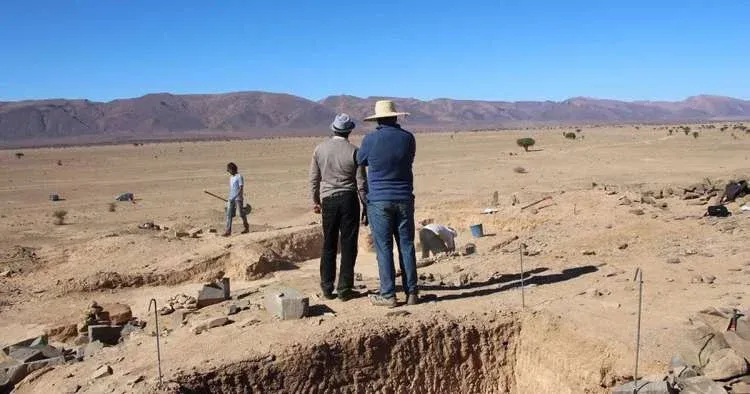
The historical site of Tamedoult, located on the banks of the Drâa Valley approximately 13 kilometers southeast of Akka in the Tata province, has long been recognized as a significant agricultural and trans-Saharan commercial center. However, recent archaeological research published in the journal Historical Metallurgy unveils a new perspective on this ancient city, revealing it as one of the most sophisticated and vital centers for metal production and processing in northwest Africa during the medieval Islamic period. Conducted by an international team from the Cyprus Institute, the British Museum, and the University of East Anglia, in collaboration with Morocco's National Institute of Archaeology and Heritage (INSAP) in Rabat, this study is based on findings from excavations that began in 2018 as part of the Jbel Bani Archaeological Project. Notably, laboratory analyses of industrial remains have confirmed that Tamedoult, founded in the 9th century by the Idrisids, possessed fully integrated production chains for silver, lead, copper, and brass, redefining the site as an industrial capital.
Advanced Metallurgical Techniques and Spatial Organization
Despite historical records not detailing the decline of Tamedoult, recent radiocarbon dating of charred date pits uncovered at the site and in the nearby area of Telrisht indicates continuous occupation and activities in the region between 1233 and 1430, extending into the 15th century. Coins from the Almoravid and Almohad periods have also been discovered, adding to the site's historical relevance. The scientific importance of these findings lies in their ability to fill historical gaps; previously, documentation had not mentioned copper, iron, or brass production activities at Tamedoult. Chemical and microscopic analyses have now revealed that artisans at Tamedoult skillfully leveraged the local geology, rich in complex veins of lead, zinc, and copper sulfides. They implemented two advanced industrial processes for their time. The first involved the production of lead and silver, evidenced by the remnants of smelting furnaces, lead-rich powdered ores, and blocks of slag containing high levels of lead oxide. Rare fragments of cupellation hearths were also discovered, indicating the use of a thermochemical technique to separate silver from lead at temperatures ranging between 950 and 1,000 degrees Celsius. Researchers estimated that this process was conducted on a significant industrial scale, producing silver ingots of about 500 grams per cycle before being cast into clay molds to create discs or spheres.
The second process involved brass manufacturing, established through the unexpected discovery of a complete production cycle utilizing the cementation technique. On the hilltop, researchers found blowing tubes, remnants of copper smelting furnaces, particles of zinc carbonate ores, and a large number of crucibles made from refractory clay mixed with charcoal dust. This combination created a reducing environment that prevented the evaporation and oxidation of zinc vapor, allowing it to be absorbed by molten copper to form a brass alloy. Additionally, long casting molds with V-shaped or trapezoidal sections designed for producing elongated ingots intended for export were also uncovered. The study sheds light on the meticulous spatial organization of the city, demonstrating that industrial activities were strategically distributed based on their security, environmental, and strategic value. Heavy and polluting operations for the primary smelting of copper and lead occurred outside the city walls, in the valley, both to the west and east. In contrast, higher-value activities, such as silver refining and casting, brass manufacturing, and ingot production, were carried out in protected workshops within the citadel and fortified residential areas atop the hill. This organization allowed for official oversight and reduced the risks of theft and smuggling. However, researchers have yet to find any traces of waste associated with iron reduction or forging within Tamedoult, suggesting that either the excavated areas are limited in scope or that local authorities intentionally reserved scarce firewood in the semi-desert environment for higher-value industries, like those of silver and copper, leaving iron work to neighboring regions.
As reported by yabiladi.com.