
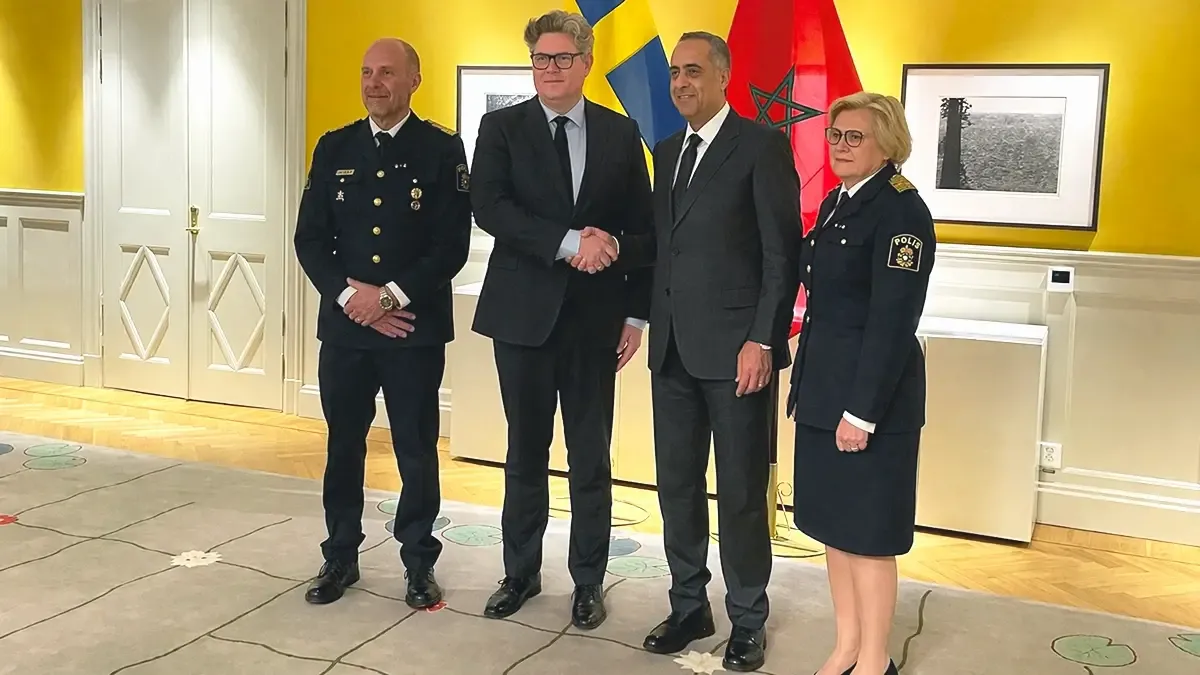
The Emerging Security Alliance Between Morocco and Sweden
The security agreement signed between Morocco and Sweden is part of a long-standing dynamic that has now been formalized with increased visibility. This development is not an isolated initiative or merely a reactive measure. For years, Morocco has been building a robust cooperation network with various European nations, focusing on intelligence sharing and operational strategies that have directly contributed to the prevention of threats on European soil.
As highlighted by our collaborator at Atalayar, Mohamed Larbi, the visit of Abdellatif Hammouchi to Sweden on April 20-21, 2026, served as a pivotal moment in this evolving relationship. This was not simply a ceremonial signing; it involved substantive working meetings with high-ranking Swedish officials. In Stockholm, Hammouchi engaged with Justice Minister Gunnar Strömmer and National Police Chief Petra Lundh, discussing shared risks and the pressing need to establish a more stable partnership that transcends ad hoc agreements in favor of sustained collaboration.
Expanding Cooperation Beyond Borders
The expressed goal of these discussions was to transform the relationship into a "durable strategic partnership" capable of responding to threats that are no longer confined to local contexts but have become transnational in nature. The core of the visit involved signing a protocol between Morocco's DGSN-DGST and the Swedish police, which formalizes and organizes a framework for what has already been partially operational: information exchange, police coordination, and technical support.
The scope of the agreement extends to various critical areas, including terrorism, violent extremism, organized crime, illicit trafficking networks, and cybercrime. These are the very threats that currently permeate Europe without clear boundaries. According to Larbi, the Swedish side not only acknowledged the effectiveness of Morocco's model but also regarded it as a regional operational benchmark. Moreover, discussions have included the potential integration of Morocco into European mechanisms for tracking wanted persons, representing a significant qualitative leap in cooperation.
This Swedish interest cannot be understood without considering the internal context. Sweden has been grappling with a growing problem of organized crime linked to international networks for several years. This issue transcends urban violence, as it involves intricate structures that operate across countries, with logistics spanning from Southern Europe to Northern regions. Various European investigations have identified routes connecting Western Mediterranean ports with destinations in Scandinavia, highlighting nodes in Spain, Belgium, or the Netherlands, along with indirect connections to North Africa.
In this framework, Morocco is not merely a peripheral player; it emerges as a crucial control point in specific transit routes and in acquiring operational intelligence. Abdellatif Hammouchi frequently appears in these types of agreements, not as a ceremonial figure but as a central component of a strategy that analysts describe as an intelligence diplomacy. Under his leadership, Moroccan services have expanded their presence in cooperation networks with Europe, Africa, and international organizations. The focus is not only on sharing information but also on integrating it into more stable operational structures.
This form of cooperation is not new. In 2019, Moroccan intelligence was instrumental in dismantling jihadist cells in Spain linked to Sahel networks. This was not a one-off operation; rather, it was part of a recurring dynamic of intelligence exchange that has continued over the years. Furthermore, a joint operation between Morocco and Spain in 2021 led to the arrest of radicalized individuals in Spanish territory who maintained active foreign connections. In both instances, the approach was preventive rather than reactive, aimed at intervening before networks could solidify.
In this context, Spain occupies a challenging intermediary position that is difficult to replace. Proximity is a key factor, as many of the criminal routes that concern northern countries traverse or indirectly pass through Spanish territory. This raises an emerging question in the European debate: if bilateral cooperation between Northern European countries and Morocco intensifies, Spain's role as an intermediary could shift, potentially losing some centrality in certain operational flows while not entirely disappearing.
For years, Morocco's security relationships were primarily focused on France and Spain. Although this axis remains significant, it has broadened to include countries that previously had less direct exposure to threats from the Mediterranean region. Sweden is not an isolated case; it exemplifies a broader trend of Northern European countries beginning to forge direct security ties with Southern actors.
Such agreements also prompt uncomfortable discussions about governance. The growing dependence on external intelligence raises questions about institutional control, transparency, and the legal boundaries of cooperation. These frameworks are rarely explained in detail, yet they significantly impact how investigations, surveillance, and judicial coordination are managed within Europe.
All indications suggest that this is not an isolated episode. The trend points toward an expansion of such agreements, with Morocco reinforcing its role in areas like cybersecurity, migration, and transnational crime. In this sense, the agreement with Sweden is not a starting point but rather a confirmation of a broader process: a gradual reorganization of how Europe structures its external and internal security, integrating non-European actors into increasingly structural roles.
As reported by atalayar.com.


