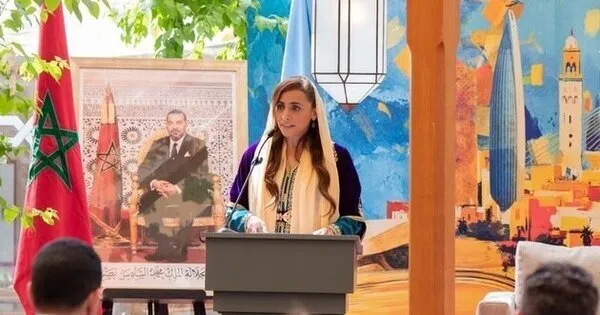
On April 26, 2026, Sheikha Bodour bint Sultan Al Qasimi, a UNESCO Goodwill Ambassador for Education and Book Culture, officially launched the 'Reading for the Future' campaign in collaboration with UNESCO, coinciding with the celebrations marking Rabat as the World Book Capital for 2026. This significant initiative is designed to enhance youth literacy rates and underline the importance of reading as a cornerstone for inclusive knowledge societies.
In addition to the campaign, Sheikha Bodour introduced the 'Young Voices of World Book Capitals' initiative, which aims to support budding writers by empowering them to articulate their viewpoints and contribute to future narratives through their writings. The announcement took place during a well-attended ceremony in Rabat, which featured prominent attendees, including Mohamed Mehdi Bensaid, Morocco's Minister of Youth, Culture, and Communication, and Charaf Ahmimed, the Director of UNESCO's Regional Office for the Maghreb, along with various officials and representatives from the cultural and educational sectors.
During her address, Sheikha Bodour emphasized the critical link between reading and the quality of education, as well as societal stability. She asserted that investing in reading is tantamount to investing in individuals’ awareness and their capacity to actively participate in shaping their futures. The 'Reading for the Future' campaign is particularly focused on mobilizing global efforts to tackle the literacy challenges that affect children and youth. Current global statistics reveal that approximately 244 million children worldwide are out of school, with nearly 70% of children in low-income nations unable to read a basic text by the age of ten.
Sheikha Bodour further elaborated that the 'Young Voices of World Book Capitals' initiative will serve as an international platform dedicated to supporting emerging writers and amplifying their literary and intellectual contributions. She reiterated that the future of societies is not solely defined by the accumulation of knowledge but also by the ability to read, comprehend, and transform that knowledge into actionable awareness. This assertion is backed by historical evidence, as reading has always been central to human renaissance, and civilizations have flourished not only through wealth but through the establishment of libraries.
Moreover, Sheikha Bodour stressed that reading should not be perceived as the ultimate goal; rather, it is crucial to empower youth to become active participants in molding their futures instead of passive observers. She noted that reading fosters awareness, while writing bestows the power of expression, creativity, and influence.
Charaf Ahmimed remarked on the occasion, stating that books and literature are not mere remnants of the past; they are vital instruments for constructing the future. He highlighted that this event, which unites established literary figures with emerging writers in the modern yet historic context of Rabat, exemplifies how storytelling is a potent response to contemporary challenges. Through initiatives such as 'Young Voices of the World Book Capital,' UNESCO is dedicated to ensuring that future generations do not merely read the narrative of their times, but actively participate in writing it.
The program also featured a panel discussion titled 'Imagining Better Futures: How Literature Helps Us Navigate Uncertainty and Find Hope,' moderated by Oussama Benjelloun. This panel brought together education policy expert Farid Chafiki and authors Racha Belokda and Kawtar El Qorchi to explore how literature and creativity can influence perspectives on the future amid cultural transformations.
This campaign aims to reaffirm reading as a fundamental element of education, creativity, and engagement in the knowledge economy, fostering partnerships that unite educational and cultural institutions, publishers, and policymakers. Additionally, it aligns with the UN's Sustainable Development Goal 4, which seeks to promote equitable access to knowledge.
The 'Young Voices of World Book Capitals' initiative invites young individuals aged 18 to 30 from across the globe to submit their short stories, essays, poetry, and reflections on reading and societal issues. Each year, five emerging voices will be selected, with their works featured in a UNESCO-supported anthology and showcased at future World Book Capital events.
This initiative aspires to amplify the presence of a new generation within the global cultural landscape and establish a sustainable network of collaboration among World Book Capitals, commencing in Rabat. Since its launch in 2001, the 'World Book Capital' initiative by UNESCO has aimed to promote literacy, lifelong learning, copyright protection, and freedom of expression, with Medellin, Colombia, designated as the World Book Capital for 2027.
As reported by bignewsnetwork.com.