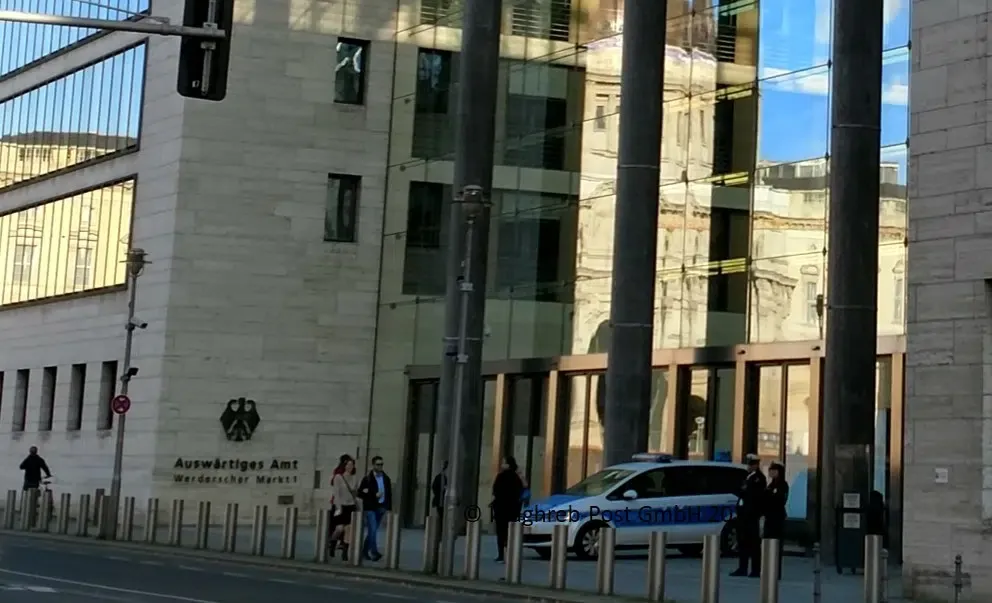
The recent Africa Day celebrated on May 5, 2026, at the Foreign Office in Berlin marked a significant evolution in the dynamics of African diplomacy, particularly in its engagement with Germany. This occasion was not merely a symbolic commemoration of the founding of the Organization of African Unity in 1963; it epitomized a shift towards a more action-oriented diplomatic approach. At the forefront of this event was Morocco, represented by Her Excellency Ambassador Zohour Alaoui, who emphasized that the time for political declarations has ended, and the focus now shifts to tangible implementation of cooperative initiatives.
During her address, which took place in the presence of Foreign Minister Johann Wadephul, Ambassador Alaoui, who also chairs the Africa Day Committee of African ambassadors in Berlin, articulated that the era of reflection and expectation had concluded. She underscored the necessity for collaboration to be underpinned by effective measures and reliable strategies. Highlighting the current geopolitical climate as "extremely unstable," she also pointed to the opportunities it presents for deepening partnerships between Germany and Africa.
This call for action reflects a broader trend where African nations are increasingly asserting themselves with clearly defined expectations, demanding partnerships that are aligned with mutual interests. Morocco's proactive diplomatic stance plays a crucial role in this context, as it seeks to shape discussions on the quality and commitment of international collaborations.
The momentum from Berlin coincides with a well-established bilateral dynamic. The recent visit of Foreign Minister Wadephul to Rabat and the strategic discussions held there have elevated German-Moroccan cooperation to a more operational level, focusing on economic collaboration, energy partnerships, and regional stability issues. This progression indicates that relations are advancing beyond mere political signals, as Morocco endeavors to transform its strategic closeness with Germany into concrete projects. For Berlin, this partnership offers a collaborator that possesses both political stability and growing economic capacities, particularly in the realm of renewable energy and as a logistical conduit between Europe and Sub-Saharan Africa.
The intensification of ties between Germany and Morocco is closely intertwined with global transformative processes. Uncertain supply chains, an escalating demand for alternative energy sources, and demographic shifts on both continents are reshaping strategic priorities. While Europe grapples with structural challenges in its labor market, Africa is witnessing a burgeoning pool of young talent. Morocco is strategically positioning itself as a pivotal interface—geographically, economically, and politically. The "shared responsibility" emphasized by Ambassador Alaoui suggests that cooperation is no longer perceived as a one-sided transfer but rather as a mutual assurance of economic and societal stability.
In this context, issues such as skilled labor migration, industrial value creation, and energy exports, notably in green hydrogen, are gaining prominence. They illustrate that the partnership is increasingly defined by specific interests rather than mere political symbolism. Signals emanating from both Berlin and Rabat indicate that German-Moroccan relations are undergoing a phase of recalibration. While symbolic gestures such as Africa Day retain their significance, they are no longer sufficient to sustain long-term partnerships. The critical factor will be the translation of political commitments into solid projects.
Morocco is making it clear that trust is contingent upon the capability for implementation. In a shifting geopolitical landscape, the measurement of reliable partnership will hinge on which actors are perceived as trustworthy. For Germany and Europe, this translates to a reality where their role in Africa increasingly relies on concrete outcomes rather than the quality of diplomatic declarations.
As reported by maghreb-post.de.