Opening the Dialogue on National Narrative
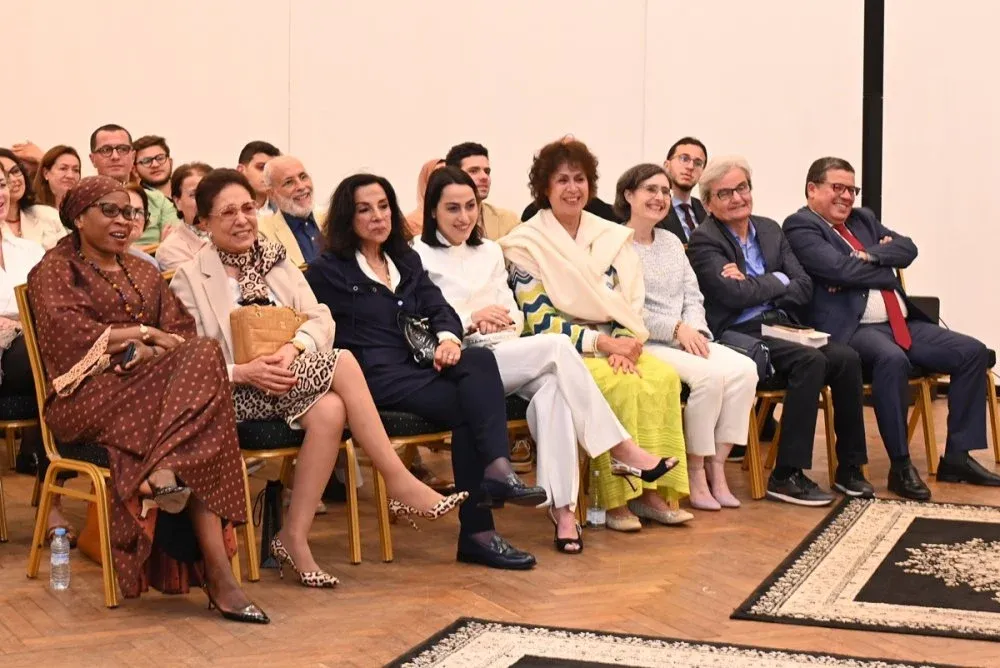
The **Book Club** program launched by the **Groupe Le Matin** coincided with the International Salon of Publishing and Book (**SIEL**), marking a significant intellectual and symbolic gathering. Central to this event was **Abdelmalek Alaoui**, who presented his work, "**Morocco, the Challenge of Power**". The audience included prominent figures such as **Nadia Fettah Alaoui**, the Minister of Economy and Finance, **Leïla Benali**, the Minister of Energy Transition and Sustainable Development, **Chakib Benmoussa**, High Commissioner for Planning, and **Noureddine Boutayeb**, President of the Moroccan Foundation for the Promotion of Preschool Education (FMPS), among others, including Dr. Assia Ben Salah Alaoui, the author's mother. The moderation led by **Mohammed Haitami**, CEO of Groupe Le Matin, set a tone of depth and structure for the discussion, transforming it from a mere book presentation into an engaging dialogue that intertwined Morocco’s historical narrative, economic model, political centrality, sovereignty transformations, and the conditions for sustainable power. This choice of moderator was far from neutral; it connected the event to a strong editorial and institutional continuity linked to the legacy of **Moulay Ahmed Alaoui**, the founder of Groupe Le Matin and father of the speaker.
Abdelmalek Alaoui did not shy away from the emotional weight of the occasion, expressing his deep affection for the venue, which he referred to as an "old house" where significant discussions had taken place. The conversation ventured beyond the confines of a single book to encompass reflections on Morocco itself, particularly regarding how the country is narrated, understood, and, at times, misinterpreted. He emphasized the critical need for Moroccans to regain control over their own narrative.
Frustration as the Starting Point: "The Confiscation of Our Narrative"
When questioned about the motivations behind his book, Alaoui articulated a deep-seated frustration—not personal, but rather an intellectual irritation with what he termed "the confiscation of our narrative." This confiscation, he argued, began in the 1960s and 70s, when foreign geopolitical analysts, economists, and observers began to dominate the discourse surrounding contemporary Morocco. While these perspectives occasionally held value, they have ingrained a series of preconceived notions within the public's imagination. Alaoui pointed out that the narratives established during that era have significantly influenced how Moroccans perceive themselves today.
One striking example he provided was the term "**Makhzen**," which now carries heavy political connotations but originally referred to a system of resource management and social solidarity, historically overseen by the Sultan. Alaoui aimed to contest this distortion, arguing that the issue transcends semantics; it touches on Morocco’s intellectual sovereignty. He posed critical questions about who tells the story of Morocco, with what terminology, based on what archives, and with what biases. The central inquiry of his book emerged: "How can we, as Moroccans, reclaim our national narrative?"
Alaoui asserted that this reclamation should not devolve into an apologetic or defensive discourse, nor should it replace foreign biases with national propaganda. Instead, it should foster a Moroccan thought process about Morocco grounded in facts, contradictions, and nuances. He emphasized the importance of contributing to an intellectual exercise rather than just a set of beliefs. Rigid convictions can be dangerous, while thoughtful analysis allows for a clearer perspective on the nation without falling into the traps of blind praise or uncritical ideology.
The discourse was underscored by Alaoui’s view that genuine power extends beyond mere infrastructure or economic indicators; it starts with a nation’s ability to introspect, to create its own analytical frameworks, and to narrate its history authentically and without excess. The national narrative is not static; it is a dynamic, debated, and re-evaluated construct shaped by historical context and contemporary transformations.
During the discussion, Alaoui highlighted a significant methodological choice in his writing: he purposefully utilized numerous Anglo-Saxon archives. By engaging with British and American sources, particularly from Oxford, he discovered perspectives that often portrayed Morocco with greater balance and fairness. This exploration of alternative archives allowed him to position Morocco within a broader geopolitical narrative and to challenge entrenched historical interpretations. His intention was not to write a dry academic history but a narrative accessible to younger generations, filled with lesser-known facets of Morocco’s national journey.
This approach led him back to the foundational moment of independence between 1955 and 1957, a time when Morocco was deeply marked by colonial rule, characterized by centralization and territorial imbalances, and facing the daunting task of building a viable nation-state with limited human resources. Alaoui summarized this period as one marked by the imperatives of experimentation, the acceptance of error, and the need to maintain social consensus. His analysis of Morocco's contemporary economic sequences—industrial choices, tourism development, and public enterprise policies—revealed a nation continually striving to balance transformation with stability.
In concluding his reflections, Alaoui reiterated the importance of ongoing dialogue regarding the Sahara, a subject that he dedicated a specific chapter to in his book. He argued that Morocco's approach to this issue exemplifies its capacity for strategic patience, with the monarchy balancing spiritual and temporal leadership to navigate complex geopolitical landscapes. He underscored the need for the Moroccan narrative to evolve with the times while remaining steadfast in its core principles, addressing the challenges of territorial disparities as the nation progresses.
As reported by lematin.ma.