As spring sun graces the boulevards of Rabat in 2026, it illuminates the city's remarkable transformation over the past eleven years. The Moroccan capital has embraced an urban aesthetic revolution, culminating in a pivotal edition of the Jidar – Rabat Street Art Festival. This event has once again transformed concrete into a canvas for storytelling, art, and expression, capturing the imagination of both locals and visitors alike.
A Geometry of Vertigo
In the heart of the Agdal district, the work of the artist RDS commands attention and silence simultaneously. Towering at 40 meters, a colossal mural—440 square meters of raw concrete—has found its voice across from a maternity hospital. Instead of merely painting a façade, the artist breathes life into the structure with mineral poetry. The muted grays of the mural intertwine with vibrant orange flashes reminiscent of rust, creating an organic form that seems to emerge from the very building itself. This monumental fresco represents just a glimpse of an extraordinary artistic endeavor, with 15 new pieces added this year, bringing the total to an impressive 146 murals. The open-air museum of Rabat now boasts over 20,000 square meters of painted surfaces, firmly establishing the city as a key player in the global street art scene.
A Constellation of Perspectives on the City
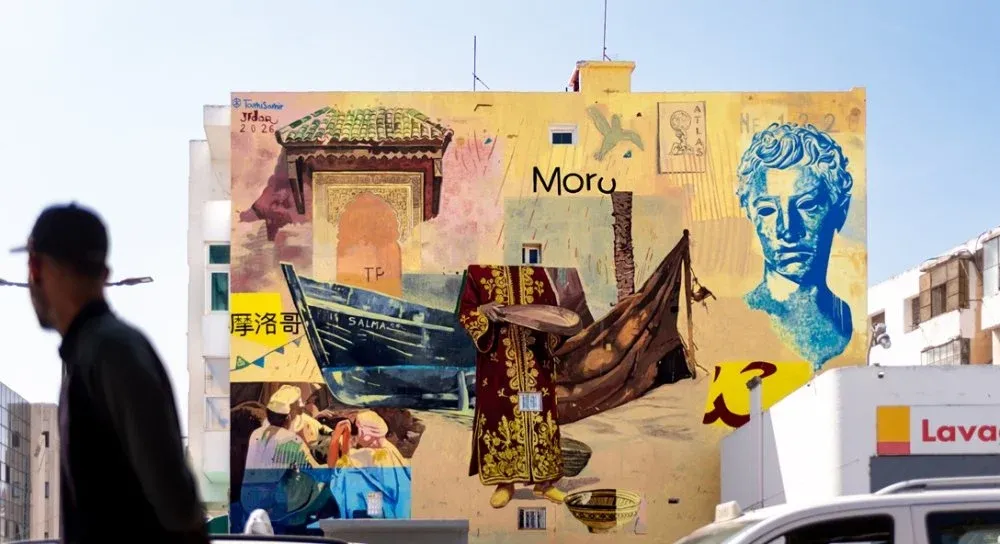
The essence of Jidar lies in its ability to transform Rabat into a crossroads of international artistic trajectories. Artists from various backgrounds converge here, sharing and dialoguing through their distinctive signatures. Italian artist Vesod reinterprets Moroccan lanterns in the L’Océan neighborhood, crafting a mirage where the city appears to rise from the Atlantic. In Yacoub El Mansour, Ecuadorian artist Azpeger presents a humanistic piece centered on equality, while Chilean Jumu conjures a protective lion amidst palm trees and floral motifs inspired by Moroccan visual culture, bridging the gap between personal narrative and collective memory.
This deep connection to the locale continues in Agdal, where Catalan artist Guillem Font draws inspiration from orange blossoms and the discreet presence of lizards, evoking a sensitive relationship with nature and daily life. Moroccan artist Nassim Azarzar, in turn, explores a plastic language influenced by the ornamentation of transport trucks, creating a subtle dialogue between popular culture and contemporary abstraction. South African artist Keya Tama resonates with the theme of communal wisdom in her mural, stating, "Knowing people is wealth" (Ma’rifat en-nas kenz). Through dynamic movements and ceramic motifs, her work celebrates coexistence and community. A resident from the Hassan neighborhood reflects, "The festival does more than add color; it transforms our relationship with public space."
Jidar serves as a breeding ground for emerging talent, functioning as a true incubator for artists. The "Collective Wall" has become a hallmark of the festival, acting as a laboratory for experimentation. Artistic director Salah Malouli describes it as a "nursery" where many Moroccan artists, including Nassim Azarzar and Rosh, have made their debut. This setting facilitates the transition from intimate scales to monumental heights, all under the watchful eyes of passersby.
The public's enthusiasm has been palpable, with guided tours fully booked throughout the event. From L’Océan to Yacoub El Mansour, residents have embraced this evolving cultural heritage. Over eleven editions, Jidar has successfully transcended its initial ephemeral status, embedding itself into the very identity of Rabat. The city has evolved beyond simply housing walls; it has empowered them to tell stories.
Jidar by the Numbers:
- Murals created in 2026: 15 monumental and 1 Collective Wall.
- Total number of murals since 2015: 146.
- Painted surface in 2026: approximately 2,500 square meters.
- Total painted surface since inception: over 20,000 square meters.
- Invited artists since 2015: more than 250.
As reported by lematin.ma.