Polisario's Response to American Diplomatic Engagement
The separatist front known as Polisario has issued a statement responding to the recent official visit by Duke Buchan III, the U.S. Ambassador to Morocco, to the city of Dakhla. In this statement, the group attempted to frame this diplomatic development within the context of ongoing political negotiations supervised by the United Nations, which involve relevant international stakeholders. The front claimed that this visit, alongside recent developments in the city of Smara, reflects a trend that could disrupt the balance of the political process. They characterized these events as counterproductive to fostering a climate of trust among the parties involved, and reiterated their skepticism about the positions of certain international actors regarding the Western Sahara issue.
Polisario's Stance on Ceasefire and International Dynamics
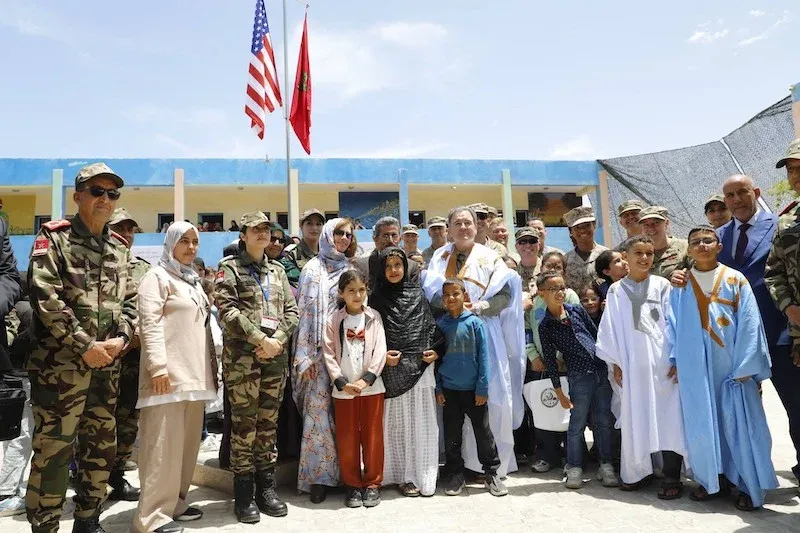
Furthermore, Polisario reaffirmed its rejection of the ceasefire process, asserting that it is "practically nonexistent," implicitly justifying their recent escalation amid increasing international criticism following attacks targeting the city of Smara. Duke Buchan III condemned the terrorist activities of the Polisario front, providing a stark comparison between the Moroccan state and the separatist group, emphasizing the former’s commitment to supporting local populations as opposed to the latter's targeting of civilian infrastructure. In a tweet, he noted, "I was in Dakhla, where American and Moroccan doctors stood side by side to provide medical care to the people of Moroccan Sahara. Meanwhile, peace opponents launched missiles aimed at civil infrastructure."
Researcher Said Bouchaqouk indicated that the dynamics surrounding the Western Sahara conflict have undergone significant changes recently, particularly since the issuance of UN Resolution 2797, which, according to him, reinforces the international community's support for the autonomy option under Moroccan sovereignty as the sole reference framework for any political resolution. He emphasized that these shifts reveal a clear international ceiling for the solution, yet the leadership of Polisario appears either unaware or dismissive of this context, despite the severe humanitarian toll that the ongoing stalemate imposes on the residents of the Tindouf camps and broader economic implications hindering Maghreb integration.
Moreover, Bouchaqouk highlighted that the U.S. Ambassador's visit to Dakhla represents a practical embodiment of the American position supporting Morocco's sovereignty over its southern regions, a stance that has remained consistent across successive U.S. administrations. This factor contributes to further isolating the separatist narrative and diminishing its influence on the negotiation process, especially in light of the recent international condemnations of the attacks on Smara, which are deemed violations of the ceasefire agreement and threats to international peace and security. He argued that the current phase necessitates a redefinition of balances within the file based on a realistic solution grounded in autonomy, which is gaining international consensus.
In summary, the visit by Duke Buchan III signals a qualitative shift in international engagement with the Western Sahara issue, marking a departure from traditional political support for Morocco towards a clearer endorsement of investment and economic partnerships in the southern provinces. The reactions from Polisario, labeling the visit as "provocative," are seen as attempts to influence the international momentum supporting the autonomy initiative, especially following the critical UN Resolution 2797 that reinforced the realistic political framework for resolution.
As reported by hespress.com.