The Impact of Phosphate Duties on U.S. Farmers
The global fertilizer market, particularly for phosphate, operates under unique constraints that significantly influence agricultural production. Unlike energy commodities, which benefit from diverse production sources across numerous countries, phosphate fertilizer supply is highly concentrated in specific regions. A prime example is Morocco, which has historically been a dominant supplier to the United States. The ongoing debate in the U.S. regarding the repeal of countervailing duties (CVDs) on Moroccan phosphate is not merely a legislative detail; it represents a critical confrontation with the unintended repercussions of utilizing trade remedy tools in markets where viable alternative sources are limited. The repercussions of trade policy disruptions in such a concentrated market can be felt throughout the entire food production chain, affecting farmers' input costs and ultimately, food prices.
Countervailing duties are designed to counteract the competitive advantages that foreign subsidies provide to exporters. These duties differ from standard tariffs in their specific targeting and legal framework, as outlined in the U.S. Trade Act of 1974. The Department of Commerce investigates the existence and magnitude of subsidies, while the International Trade Commission (ITC) evaluates the material injury suffered by domestic industries as a result. The CVD orders established in 2021 stemmed from petitions by U.S. producers, particularly Mosaic Company, who argued that subsidized phosphate exports from Morocco and Russia were harming domestic operations. The resulting duty rates imposed on Moroccan producers ranged from approximately 16.6% to over 47%, with OCP S.A., Morocco's state-affiliated enterprise, facing a rate of 19.97%. This effectively rendered Moroccan phosphate uncompetitive in the U.S. market, compounding existing tariff burdens.
Legislative Action and Future Implications
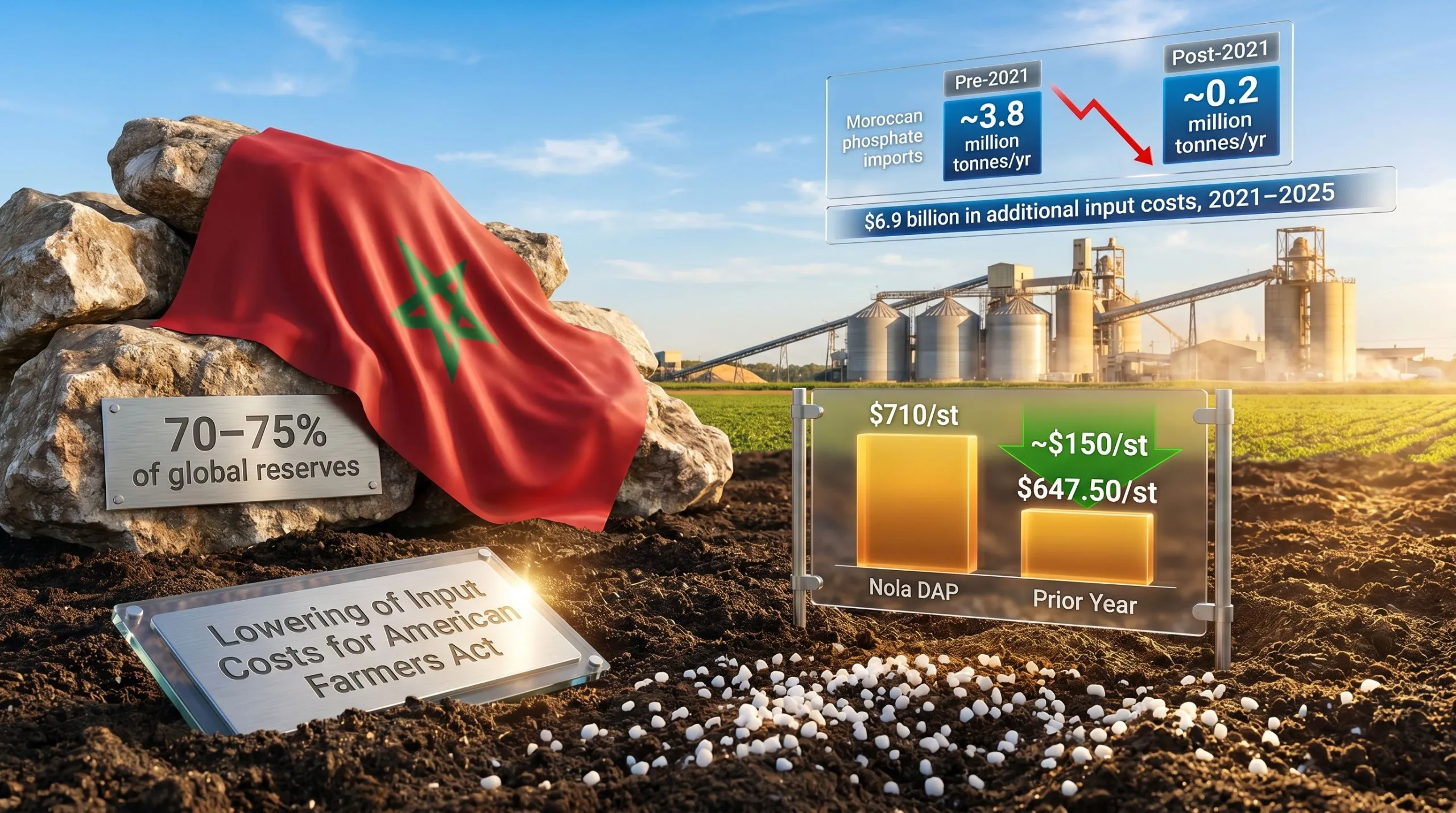
The imposition of these duties has created a distinct structural imbalance in the U.S. phosphate market. Phosphate is an essential nutrient for crops, and there are no suitable substitutes that can match the scale or effectiveness of diammonium phosphate (DAP) and monoammonium phosphate (MAP) in U.S. agricultural practices. The consequences of the CVD orders are evident in trade statistics, which reveal a staggering decline in imports: prior to the duties, U.S. imports of DAP and MAP peaked at 1.85 million tonnes in 2018. However, following the implementation of the duties, annual imports plummeted to an average of just 182,300 tonnes — a reduction exceeding 90%. By 2025, imports from Morocco had effectively ceased, leaving U.S. farmers reliant on more expensive alternatives from countries such as Jordan, Israel, and Tunisia.
The geopolitical landscape further complicates the issue. Conflicts in the Middle East, particularly the Gulf conflict, have disrupted the flow of phosphate from Saudi Arabia, further tightening the domestic market. As a result of these combined pressures, U.S. farmers are facing elevated domestic prices for phosphate fertilizers, with limited short-term solutions available through conventional market mechanisms.
In response to these mounting concerns, U.S. Senator Roger Marshall of Kansas announced intentions to introduce a bill aimed at repealing the countervailing duties on Moroccan phosphate fertilizers. This legislative effort is part of a larger initiative to alleviate the financial pressures on farmers, as highlighted by recent reports. The proposed repeal could significantly lower phosphate fertilizer costs, potentially reducing prices by over 20%, equating to approximately $150 per short ton. This action, alongside other proposed legislation focused on price transparency and research into domestic production efficiency, illustrates a multifaceted approach to addressing the affordability crisis faced by U.S. agriculture.
Interestingly, a five-year sunset review of the CVD orders was already in progress at the time of this announcement. This required review assesses whether the existing duties remain justified and whether their removal could lead to renewed material injury to domestic producers. The existence of simultaneous pathways for potential duty removal reflects the considerable political pressure surrounding agricultural input costs, and creates uncertainty among market participants regarding future pricing and supply stability.
Ultimately, the debate surrounding the repeal of these duties encapsulates a broader tension between protecting domestic producers and ensuring the affordability of agricultural inputs for farmers. While U.S. phosphate producers argue for the legitimacy of the CVDs based on the competitive edge that subsidized Moroccan exports provide, the reality remains that Morocco holds a dominant position in global phosphate reserves, accounting for an estimated 70 to 75% of the world's known phosphate rock. This geological advantage means that any decision to exclude Moroccan phosphate from the U.S. market is not merely a matter of choosing a different supplier, but rather accepting a structurally higher cost for a non-substitutable agricultural input.
The ongoing legislative discussions and the implications of the sunset review place U.S. phosphate policy in a critical position. Each pathway toward potential duty removal carries its unique outcomes and timelines, but all converge on the overarching reality of rising costs faced by American farmers. The $6.9 billion burden that has accumulated from these duties underscores the significant economic pressures impacting agricultural productivity, raising essential questions about the balance between trade policy and food security.
As reported by discoveryalert.com.au.