Transforming Military Dynamics in Africa
The 2026 edition of the African Lion exercise signifies Morocco's strategic evolution as a pivotal operational hub for testing and validating military capabilities tailored to the complexities of modern conflict. This event transcends traditional military drills, emerging as a foundational framework where technological innovation, information superiority, and doctrinal shifts coalesce. Central to this development is Morocco's relatively unencumbered electromagnetic spectrum, which creates an optimal environment for integrating advanced military systems. These include tactical communications, intelligence, surveillance, reconnaissance (ISR) sensors, data links, and command and control (C2) architectures, all while facilitating experimentation in electronic warfare.
Within this context, the African Lion exercise has evolved beyond mere equipment testing; it functions as a comprehensive validation space for a complete technological ecosystem, uniting armed forces, defense industries, and data frameworks. Consequently, Morocco is progressively becoming a key player in the transition toward data-centric warfare, emphasizing the control of information flows, intelligence fusion, and accelerated decision-making. This transformation is particularly relevant as it aligns with the shifting security dynamics across Africa and the Euro-Atlantic region.
A New Era of Security Cooperation
As global tensions escalate, Morocco's role in co-hosting the African Lion with the United States—a significant platform for security cooperation on the continent—takes on greater importance. This collaboration extends well beyond the exercise itself. Through integrated frameworks like Flintlock, Handshake, and Atlas Handshake, Morocco and the U.S. are cementing their partnership from 2026 to 2036, focusing on strategic alignment rather than superficial cooperation. The emphasis has shifted towards co-developing operational responses to shared interests, intertwining interoperability, projection capabilities, and the safeguarding of critical strategic flows.
Originally designed as a joint training exercise, African Lion has matured into a vital mechanism for co-producing security across Africa. It now incorporates specialized training cycles focused on emerging technologies, reflecting a paradigm shift from collective training to the formulation of a unified security strategy aimed at securing vital maritime, energy, and logistical routes. The resilience of these corridors is becoming increasingly crucial in the evolving power balance on the continent.
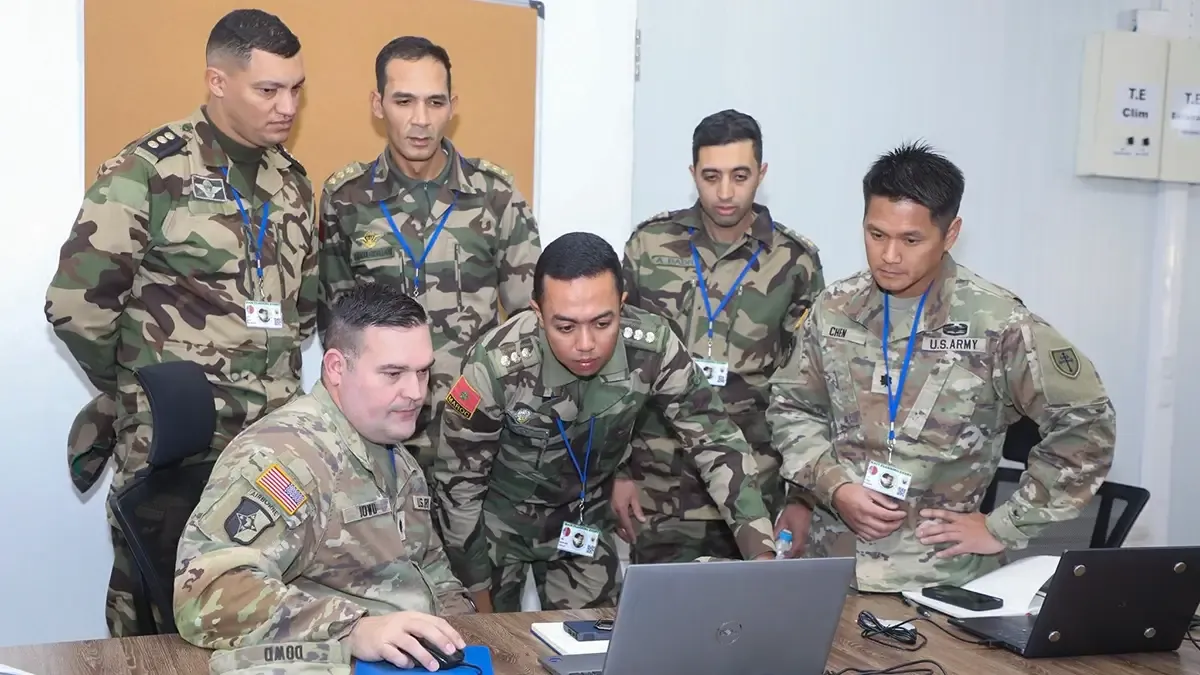
The 2026 edition marks a significant inflection point as Morocco emerges as a comprehensive testing ground for next-generation combat technologies. Over forty U.S. technology firms are actively involved in the exercise, collaborating with deployed forces to accelerate the timeframe between innovation and operational deployment. The initiative is overseen by the U.S. Army Southern European Task Force, Africa, through its Advanced Capabilities Directorate, establishing a critical link among military, industry, and the broader innovation ecosystem. Notable participants include leading U.S. defense firms, from startups specializing in artificial intelligence and autonomous systems to major defense contractors like Lockheed Martin and Northrop Grumman.
This evolving landscape underscores the need for integrated, interoperable, and intelligence-driven capabilities, particularly in addressing the multifaceted threats present in Africa. The operational environment is fraught with challenges, including transnational criminal activities and the rise of violent extremist organizations exploiting poorly governed regions. In response, the focus shifts toward developing capabilities that compress decision-making cycles and ensure rapid responses to emerging threats, while fostering durable partnerships and enhancing command-and-control structures.
As Morocco solidifies its strategic position at the juncture of the Atlantic, Mediterranean, and Sahel regions, it becomes a natural anchor for securing the continent's critical flows and strategic corridors. The country's extensive training ranges and relatively uncongested airspace create ideal conditions for large-scale military maneuvers, further supported by an electromagnetic spectrum conducive to advanced military integration. This environment not only facilitates the testing of electronic warfare operations but also fosters real-time data integration and synchronization, essential for modern military effectiveness.
Ultimately, the outcomes of these operational validations extend far beyond technical advancements. They contribute to the progressive enhancement of Morocco's Royal Armed Forces, promoting the adoption of critical technologies and advanced operational standards. This transformation enhances the ability of Moroccan forces to navigate multifaceted environments while supporting the development of a robust defense innovation ecosystem. As the African Lion exercise continues to evolve, it plays a crucial role in shaping the future of military dynamics across the continent, reinforcing Morocco's status as a key player in the co-production of security.
As reported by atalayar.com.